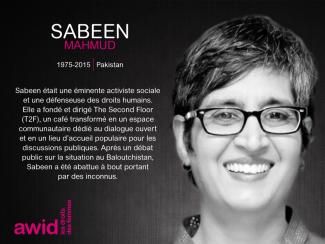
Sabeen Mahmud
Au cours des dernières années, nous avons observé une nouvelle tendance inquiétante dans les espaces internationaux consacrés aux droits humains. Les discours axés sur « la protection de la famille » sont en effet utilisés pour défendre des violations des droits de membres de la famille, pour renforcer et justifier l’impunité des auteurs de ces violations et pour restreindre l’égalité des droits au niveau de la vie familiale.
La campagne en faveur de la « Protection de la famille » est motivée par une volonté conservatrice d’imposer des conceptions « traditionnelles » et patriarcales de la famille et de priver les membres de la famille de leurs droits pour les transférer à « l’institution familiale ».
Depuis 2014, un groupe d’Etats travaille de front dans les espaces dédiés aux droits humains sous le nom de « Group of Friends of the Family » (Groupe des ami-e-s de la famille) ; des résolutions sur la « Protection de la famille » ont été adoptées chaque année depuis 2014.
Ce programme s’est propagé au-delà du Conseil des droits humains. Nous avons observé l’introduction d’un discours régressif autour de la « famille » à la Commission sur la condition de la femme, ainsi que des tentatives d’introduction dans les négociations sur les Objectifs de développement durable.
L’AWID travaille avec des partenaires et des allié-e-s pour s’opposer ensemble à la « Protection de la famille » et à d’autres programmes régressifs et défendre l’universalité des droits humains.
En réponse à l’influence croissante d’acteurs régressifs au sein des espaces dédiés aux droits humains, l’AWID a rejoint des allié-e-s afin de créer l’Observatoire sur l'Universalité des droits (OURs) (site en anglais). L’OURs est un projet de collaboration qui surveille, analyse et diffuse les informations concernant les initiatives anti-droits telles que la « Protection de la famille ».
Le premier rapport de l’OURs, Nos droits en danger, trace une cartographie des acteurs et actrices qui constituent le lobby mondial anti-droits et identifie leur réthorique et stratégies clés ainsi que leur impact sur les droits humains.
Le rapport précise que le programme de « Protection de la famille » a développé une collaboration entre un large éventail d’acteurs régressifs aux Nations Unies, qu’il décrit comme « un cadre stratégique abritant des positions anti-droits et patriarcales multiples, où le cadre vise entre autres à légitimer et institutionnaliser ces positions. »
The co-creation of our feminist realities starts with ourselves and how we treat each other. We are dedicated to creating and protecting safe and supportive spaces for our communities both online and in person. We also consider that safe and welcoming spaces are co-owned and co-created.
We expect our members to act in a manner that is ethical, responsible and consistent with the values of AWID and assume collective responsibility to ensure an atmosphere of mutual respect and solidarity.
Connect with others, help break isolation and further solidarity. It’s easy to feel lost and alone, and a little friendliness and responsiveness goes a long way.
Interact and engage peacefully. Differences in opinion will naturally arise, so please think of these differences as useful for expanding your thinking and ways of seeing the world.
Help build a space that recognizes and validates multiple lived experiences and diversities of bodies and gender expressions. Recognize that we all carry intersectional identities.
Use inclusive language. Be respectful of how people want to be referred to in terms of gender identity or expression (like pronouns), and practice inclusive language.
Listen and make adjustments in your behavior and ways of engaging if someone says they feel uncomfortable. Don’t ask others questions that you wouldn't want to be asked yourself.
Help challenge oppressive behavior, which includes harassment, verbal or physical violence, violation of consent, and any action that perpetuates classism, ageism, ableism, racism, misogyny, heterosexism, transphobia and other oppressions. If needed, please reach out to AWID staff.
Practice speaking and listening with an open mind and heart and without judgement.
Be honest, open and heartfelt. Speak and share authentically about your experiences, your challenges, your hopes and dreams, and your vision for your own life and your community.
Practice active listening and self-awareness. Be aware of how much time and space you are taking up- leave room for others, practice active listening and learning.
Be mindful and credit others for their work and activism. Remember that we are all working collectively to contribute to change-- Ensure that you recognize the contribution of others and credit them when appropriate e.g. in discussions, or in articles, pictures etc.
Stay safe! We encourage you to take measures to protect yourself online and in person, especially if you have reason to believe that speaking out will put you in danger. Members may use aliases or profile images that conceal their identity. For more information please refer to the “Digital Security First Aid Kit for Human Rights Defenders” produced by APC - Association for Progressive Communications.
Respect the privacy needs of others! Do not share or forward any information without explicit permission.
We take a position in solidarity with each other and diverse struggles for justice and freedoms. We strive to mobilize and strengthen collective action and practice meaningful ways of working with each other.
We believe in a full application of the principle of rights including those enshrined in international laws and affirm the belief that all human rights are interrelated, interdependent and indivisible. We are committed to working towards the eradication of all discriminations based on gender, sexuality, religion, age, ability, ethnicity, race, nationality, class or other factors.
We strive for transparency, responsible use of our resources, fairness in our collaborations and accountability and integrity with our members, partners, funders and the movements with(in) which we work. We are committed to reflecting on our experiences, sharing our learnings openly, and striving to change our practices accordingly.
We believe that for feminist movements to be transformative and strong we must continue to work across our similarities and differences. We also must interrogate power and privilege both within and outside our movements.
We celebrate everyone's right to choose their identities, relationships, goals, work, dreams and pleasures, and what they do with their mind, body and spirit. We believe in working towards access to resources, information and safe and enabling environments that allow this to happen.
We work towards a world based on social, environmental, and economic justice; and interdependence, solidarity, and respect. We work towards dismantling systems of oppressive power and against all its manifestations, including patriarchy, fundamentalisms, militarisms, fascisms and corporate power that threaten our lives and our world. We want a just world where resources and power are shared in ways that enable everyone to thrive.
Please note:
AWID reserves the right to delete comments, suspend or revoke membership when our community guidelines have been violated. AWID members are not authorised to represent AWID in any official capacity unless stipulated in writing. Members cannot use AWID spaces to proselytize or recruit members to join a religious faith or organisation. Members cannot use AWID spaces to request funds for personal use although links to external fundraising efforts or activism campaigns are permissible.
Cynthia Cockburn était une sociologue, écrivaine, universitaire, photographe et militante pour la paix féministe.
Elle a étudié les aspects genrés de la violence et du conflit et fait d’importantes contributions au mouvement pacifiste en explorant les thèmes de la masculinité et de la violence, ainsi que par son activisme local et international.
Ayant introduit une analyse féministe aux questions de militarisation et de guerre, Cynthia figurait parmi les universitaires dont les écrits et analyses illustraient la manière dont la violence basée sur le genre joue un rôle essentiel dans la perpétuation de la guerre. Travaillant en étroite collaboration avec des activistes pacifistes dans des pays en conflit, ses conclusions portaient sur des contextes aussi divers que l’Irlande du Nord, la Bosnie-Herzégovine, Israël et la Palestine, la Corée du Sud, le Japon, l’Espagne et le Royaume-Uni. Sa recherche et ses écrits universitaires ont permis d’éclairer le fait que la violence soit vécue selon un continuum de temps et d’échelle, et perçue très différemment lorsque l’on y applique le prisme du genre.
Elle disait que « [l]e genre nous aide à voir la continuité, la connexion entre les évènements de violence ».
Cynthia a pu mettre ses recherches en pratique grâce à son activisme local et international auprès de mouvements pour la démilitarisation, le désarmement et la paix. Elle a aidé à lancer le camp de femmes pour la paix de Greenham Common, qui prônait le désarmement nucléaire universel en Grande-Bretagne, ainsi que participé à la mise en place de la branche londonienne des Women in Black. Au fil des ans, Cynthia a organisé et participé à des veillées hebdomadaires locales et à la chorale politique Raised Voices, interprétant et écrivant certaines des paroles des chansons. Elle fut également active au sein du groupe Women’s International League for Peace and Freedom (WILPF), du Forum des socialistes féministes européennes et de Women Against Fundamentalism.
« Cynthia émettait une lumière féministe, tissait les communautés féministes entre elles, entonnait des chants de paix, écoutait, écoutait, écoutait, observait les oiseaux – et suspendait le flot de circulation. Je lui serai toujours reconnaissante et redevable, l’« autre » Cynthia. » – Cynthia Enloe
Cynthia est née en juillet 1934 et s’est éteinte en septembre 2019, à l’âge de 85 ans.
✉️ Requiere inscripción previa. Regístrate aquí
📅 Martes 11 de marzo de 2025
🕒 De 06:00 a 08:00 p. m.,
🏢 Chef's Kitchen Loft with Terrace, 216 East 45th St 13th Floor New York
Organiza: AWID
Lutter contre vents et marées : le récit de la victoire sans précédent du Réseau Solidarité.
En janvier 2022, le Réseau Solidarité a organisé une grève avec 400 travailleur·euses. Sa principale demande ? L’augmentation des salaires. La grève a été déclenchée après des mois de discussions sans résultats avec le ministère géorgien des Affaires Sociales.
Après avoir manifesté, négocié, parlé à la presse, résisté aux représailles et enduré le froid de l’hiver géorgien pendant des semaines, les travailleur·euses ont obtenu des concessions sans précédent de la part du gouvernement: augmentation des salaires, congés payés de maternité, couverture des frais de transport, arrêt des licenciement, indemnisation des jours de grève, et plus.
La grève a non seulement abouti à des gains matériels, mais a également permis aux travailleur·euses de se sentir uni·e·s et habilité·e·s à se défendre et à lutter pour des conditions de travail décentes, dans le présent et à l'avenir. Iels sont devenu·es une source d'inspiration pour tous·tes les travailleur·euses du pays.
Pour en savoir plus sur leur victoire, cliquez ici.
Etendez vos frontières. Les membres de l'AWID représentent de plus en plus une section transversale dynamique et variée de féministes travaillant, entre autres, sur les questions foncières, les droits des travailleures, les droits sexuels et l'autonomie corporelle. En devenant membre, vous pouvez relier vos luttes entre mouvements.

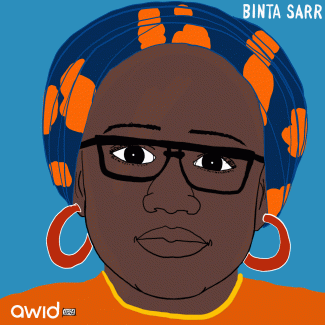
Binta Sarr was an activist for social, economic, cultural and political justice, and a hydraulic engineer in Senegal. After 13 years in civil service, she left this path to work with rural and marginalized women.
Out of this engagement grew the Association for the Advancement of Senegalese Women (APROFES), a grassroots movement and organization Binta founded in 1987. One of her main approaches was leadership training, relating not only to economic activities but also to women's rights and access to positions of decision-making.
“Grassroots populations must organize, mobilize, assume citizen control and demand democratic governance in all sectors of public space. The priority of social movements must go beyond the fight against poverty and must be focused on articulated and coherent development programs in line with human rights principles, while taking into account their needs and concerns both at the national and sub-regional levels and from a perspective of African and global integration.” - Binta Sarr
Rooted in Binta’s conviction that fundamental change in women’s status requires transformation in male attitudes, APROFES took an interdisciplinary approach, using radio, seminars and popular theatre, as well as providing innovative public education and cultural support for awareness-raising actions. Its popular theatre troupe performed original pieces on the caste system in Senegal, alcoholism, and conjugal violence. Binta and her team also looked at the crucial connection between the community and the broader world.
“For APROFES, it is a question of studying and taking into account the interactions between the micro and the macro, the local and the global and also, the different facets of development. From slavery to colonization, neocolonialism and the commodification of human development, most of the resources of Africa and the Third World (oil, gold, minerals and other natural resources) are still under the control of financial cartels and other multinationals that dominate this globalized world.” - Binta Sarr
Binta was one of the founding members of the female section of the Cultural and Sports Association Magg Daan. She received commendations from the Regional Governor and the Minister of Hydrology for her "devotion to rural people."
Born in 1954 in Guiguineo, a small rural town, Binta passed away in September 2019.
“The loss is immeasurable, the pain is heavy and deep but we will resist so as not to mourn Binta; we will not mourn Binta, we will keep the image of her broad smile in all circumstances, to resist and be inspired by her, maintain, consolidate and develop her work…” - Aprofes Facebook page, September 24, 2019
"Farewell Binta! We believe your immense heritage will be preserved." - Elimane FALL, president of ACS Magg-Daan
We strive for transparency, responsible use of our resources, fairness in our collaborations and accountability and integrity with our members, partners, funders and the movements with(in) which we work. We are committed to reflecting on our experiences, sharing our learnings openly, and striving to change our practices accordingly.
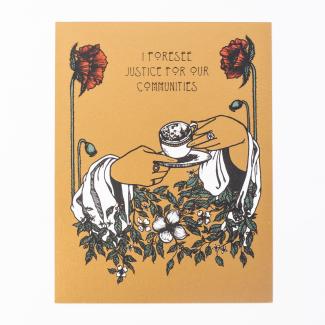
La tasséomancie est une méthode de divination qui interprète les motifs dans les feuilles de thé et/ou le marc de café. Il s’agit d’une pratique qui se transmet par les femmes de mon côté arménien et qui m’a été enseignée par ma mère, qui elle-même l’a apprise de sa mère, et ainsi de suite. Lorsque je regardais ma grand-mère lire le marc de café du café arménien préparé pour la famille et les amis, je remarquais que, souvent, elle voyait ce qu'elle avait envie de dire. Ces gravures disent certaines des choses que j’ai envie de voir dans le monde ; j'espère que vous aussi.
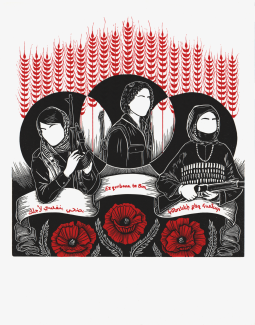
Cette gravure célèbre la résilience, le sacrifice et la force des combattant·e·s de la liberté de l’Asie du Sud-Ouest et de l’Afrique du Nord à travers l'histoire et la solidarité qui existe. Elle a été inspirée à l'origine par un article que j'ai lu sur une exposition organisée à Tatvan, un district de Bitlis, qui mettait en lumière la présence arménienne dans la région. Mes ancêtres sont originaires de Bitlis, se situant aujourd'hui sur le territoire de la Turquie actuelle.
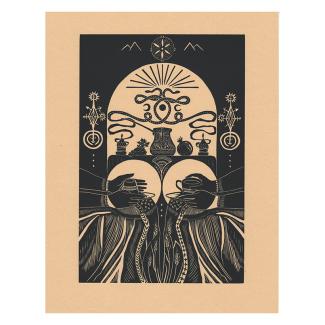
La tasséomancie (la lecture du marc de café) est une pratique culturelle utilisée par les femmes arméniennes depuis des siècles pour se parler entre elles et les unes aux autres, un langage codé permettant d'entamer des conversations, d'établir des relations et de tisser des liens.
![]Ali Chavez Leeds portrait](/sites/default/files/styles/max_325x325/public/2021-10/portrait.jpeg?itok=0yU3PqLe)
Laurie Carlos fue una actriz, directora, bailarina, dramaturga y poeta estadounidense, una artista y visionaria extraordinaria que tenía un poderoso don para hacer surgir el arte en otras personas.
«Laurie entraba en una habitación (cualquier habitación/todas las habitaciones ) con clarividencia arremolinada, con genio artístico, rigor corporizado, con un realismo feroz— y con la determinación de ser libre... y de liberar a otrxs. Una hacedora de magia. Una vidente. Alguien que cambiaba de formas. Laurie me dijo una vez que entraba en los cuerpos de las personas para descubrir qué necesitaban.» - Sharon Bridgforth
Combinaba estilos de actuación tales como gestos rítmicos y texto. Laurie era mentora de nuevxs actorxs, performers y escritorxs, y ayudaba a difundir su trabajo a través de «Naked Stages», una beca para artistas emergentes. Integraba el Penumbra Theater, con el que colaboraba mediante guiones que produjeran identificaciones, a fin de «traer más voces femeninas al teatro». Laurie integraba también Urban Bush Women, una compañía de danza contemporánea prestigiosa que relata historias sobre mujeres de la diáspora africana.
En 1976, como Lady in Blue, hizo su debut en Broadway, en la producción original galardonada del drama poético de Ntozake Shange For colored girls who have considered suicide / when the rainbow is enuf. La obra de Laurie incluye White Chocolate, The Cooking Show y Organdy Falsetto.
«Cuento las historias en el movimiento (las danzas internas que surgen espontáneamente, como en la vida), la música y el texto. Si escribo una línea, no necesariamente tiene que ser una línea que es hablada; puede ser una línea que es movida. Una línea a partir de la cual se crea música. El gesto se convierte en la oración. Gran parte de quienes somos como mujeres, como personas, tiene que ver con los gestos que hacemos entre nosotrxs todo el tiempo, y en particular, durante momentos emotivos. El gesto se convierte en una oración o una declaración de hechos. Si pongo en un guión “cuatro gestos”, eso no quiere decir que no estoy diciendo nada; significa que lo he abierto para que algo sea dicho físicamente.» - Laurie Carlos
Laurie nació y creció en la ciudad de Nueva York, trabajó y vivió en Twin Cities. Falleció el 29 de diciembre de 2016 a la edad de 67 años, luego de una batalla contra el cáncer de colon.
Tributos:
«Creo que esa era exactamente la intención de Laurie. Salvarnos. De la mediocridad. Del ego. De la pereza. De la producción de arte a medias. De estar paralizadxs por el miedo. Laurie quería ayudarnos a Brillar plenamente. En nuestra producción artística. En nuestras Vidas.» - Sharon Bridgforth para Pillsbury House Theatre
«Nadie que conociera a Laurie dejaría de definirla como una persona original. Era su propia persona. Era su propia persona, su propia artista; ponía en escena el mundo tal como lo conocía, con verdadero estilo y comprensión, y vivía su arte.» - Lou Bellamy, fundador de Penumbra Theater Company, para Star Tribune
Leer un tributo completo de Sharon Bridgforth (solo en ingles)
If you’re looking to have an impact through your work in feminist, social justice and other non-profit organizations, we hope this page provides a start.
Here you will find open vacancies and call for applications from AWID and the Alliance for Feminist Movements, when available. Follow us on social media to be in the loop.

Dada la situación global, nuestra Junta Directiva tomó la difícil decisión de cancelar el Foro que estaba programado en 2021, enTaipei.