Left
Half
Left

Analyses Spéciales

L´AWID est une organisation féministe mondiale qui consacre ses efforts à la justice de genre, au développement durable et aux droits humains des femmes

La mémoire comme forme de résistance : un hommage

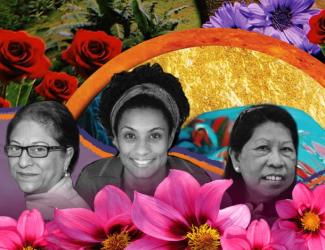
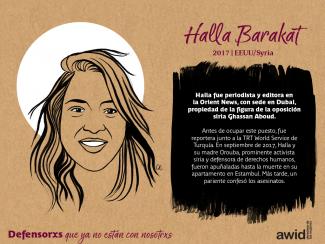
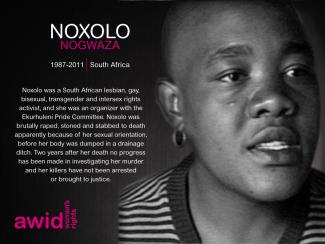
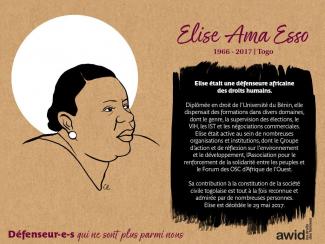
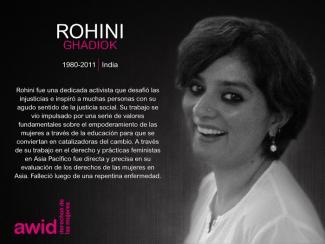
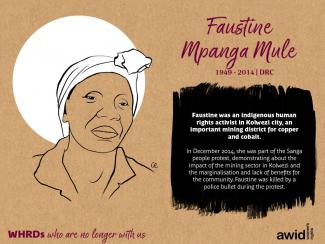
L’hommage se présente sous forme d’une exposition de portraits d’activistes du monde entier qui ne sont plus parmi nous qui ont lutté pour les droits des femmes et la justice sociale. 


En 2020, nous adoptons une démarche légèrement différente 

Cette année, tout en continuant à convoquer la mémoire de celleux qui ne sont plus parmi nous, nous souhaitons célébrer leur héritage et souligner les manières par lesquelles leur travail continue à avoir un impact sur nos réalités vécues aujourd’hui.

49 nouveaux portraits de féministes et de défenseur·e·s viennent compléter la gallerie. Bien que de nombreuses des personnes que nous honorons dans cet hommage sont décédé·e·s du fait de leur âge ou de la maladie, beaucoup trop d’entre iels ont été tué·e·s à cause de leur travail et de qui iels étaient.

Les histoires des activistes à l'honneur dans cet Hommage font vivre leur héritage et continuent d'inspirer le travail et l’action de nos mouvements.

Visiter notre exposition virtuelle

Les portraits de l'édition 2020 ont été illustrés par Louisa Bertman, artiste et animatrice qui a reçu plusieurs prix.

L’AWID tient à remercier nos membres, les familles, les organisations et les partenaires qui ont contribué à cette commémoration. Nous nous engageons auprès d’elleux à poursuivre le travail remarquable de ces féministes et défenseur·e·s et nous ne ménagerons aucun effort pour que justice soit faite dans les cas qui demeurent impunis.

« Ils ont essayé de nous enterrer. Ils ne savaient pas que nous étions des graines » - Proverbe mexicain

L'Hommage a été inauguré en 2012

Le premier hommage aux défenseur-e-s des droits humains a pris la forme d’une exposition de portraits et de biographies de féministes et d’activistes disparu·e·s lors du 12e Forum international de l’AWID en Turquie. Il se présente maintenant comme une gallerie en ligne, mise à jour chaque année.

Depuis, 467 féministes et défenseur-e-s des droits humains ont été mis·es à l'honneur.

Visiter notre exposition virtuelle

Contenu lié

Notre vision : La justice économique dans un monde féministe

En tant que féministes luttant pour la justice de genre, la paix, la justice économique, sociale et environnementale, nous savons qu'il n'existe pas de recette miracle, mais plutôt un éventail de possibilités qui peuvent faire changer les choses, et qui les font changer.


Cet éventail d’options est aussi diversifié que nos mouvements et les communautés dans lesquelles nous vivons et nous luttons.

Avant de vous présenter quelques-unes de ces propositions féministes pour un autre monde, voici les principes qui encadrent nos propositions :

1. Un développement autodéterminé, du local au global

Nous croyons qu'il ne doit pas y avoir un seul modèle pour tous, et que chacun-e doit avoir le droit de revendiquer et de contribuer à la construction d'un autre monde possible, comme le formule le slogan du Forum social mondial.

Cela inclut le droit de participer à la gouvernance démocratique et d'influer sur son avenir, politiquement, économiquement, socialement et culturellement.

L'autodétermination économique permet aux peuples de prendre le contrôle de leurs ressources naturelles et d'utiliser ces ressources pour atteindre leurs propres objectifs ou pour un usage collectif. En outre, le pouvoir d’agir des femmes dans la sphère économique est fondamental pour atténuer le caractère souvent cyclique de la pauvreté, le déni de l'éducation, de la sécurité et de la sûreté.

2. Les droits, l'égalité réelle et la justice au cœur de l'économie

Le principe de l'égalité réelle est énoncé dans la Convention sur l'élimination de toutes les formes de discrimination à l'égard des femmes (CEDAW) et d'autres instruments internationaux relatifs aux droits humains. Ce principe est fondamental pour le développement et la transformation vers une économie juste, car il affirme que tous les êtres humains naissent libres et égaux.

La non-discrimination fait partie intégrante du principe d'égalité, qui veille à ce que personne ne soit privé de ses droits en raison de facteurs tels que la race, le sexe, la langue, la religion, l'orientation sexuelle, l'identité sexuelle, une opinion politique ou autre, l’origine nationale ou sociale, la fortune ou la naissance.

La dignité inhérente à toute personne sans distinction doit être maintenue et respectée. Alors que les États doivent veiller à l'utilisation d’un maximum de ressources disponibles pour la réalisation des droits humains, le fait d’exiger ces droits et la dignité est un enjeu clé pour la lutte de la société civile et la mobilisation populaire.

3. Une redistribution juste pour tous et toutes, sans monopolisation ou accaparement (le principe d’anti-avidité)

Ce principe, mis en œuvre par les efforts coordonnés visant à transformer les institutions injustes, soutient le rétablissement de l’équilibre entre la « participation » (entrées) et la « distribution » (sorties), lorsque celui-ci est rompu.

Il permet de poser des limites à l'accumulation monopolistique de capital et d'autres abus liés à la propriété. Ce concept est fondé sur un modèle économique qui repose sur l'équité et la justice.

4. La solidarité féministe et inter-mouvements est fondamentale

Pour changer les choses, nous avons besoin de réseaux féministes solides et diversifiés. Nous avons besoin de mouvements qui renforcent la solidarité du niveau personnel au niveau politique, du niveau local au niveau global, et inversement.
 
Construire le pouvoir collectif grâce aux mouvements permet de convertir la lutte pour les droits humains, l'égalité et la justice en une force politique pour le changement qui ne peut être ignorée.

 « Seuls les mouvements sont en mesure de créer des changements durables à des niveaux que la politique et les lois seules ne permettraient pas d’atteindre. »


Pour en savoir plus sur ce sujet, consulter S. Batliwala, 2012 Changer leur monde. Mouvements féministes, concepts et pratiques.


Voir également

Le projet

5 menaces principales

Snippet - Intro WITM - RU

Основываясь на 20-летней истории привлечения более объемного и качественного финансирования для достижения социальных изменений под руководством феминисток(-ов), AWID приглашает вас принять участие в новом опросе: 

«Где же деньги для феминистских объединений?»

(далее – «Где деньги?»)

Пройти опрос!Руководство

Пожалуйста выберите язык, на котором вы хотите отвечать на вопросы в правом верхнем углу страницы

Annaliza Dinopol Gallardo Capinpin

Known as “Ate Liza,” Annaliza was the president of the Agrarian Reform Council for Mindanao Pioneers, an umbrella group in Tacurong City, Philippines.

A loved mother of four, teacher and community leader, Annaliza is remembered by her community as “she who leads when no one wants to lead, she who talks when no one wants to talk, she who stood with courage to help the agrarian reform beneficiaries to own lands.”

Annaliza was shot dead by unknown assailants in front of the Sultan Kudarat State University (SKSU) while on her way to Salabaca National High School in Esperanza.

Her family have said “Naghihintay pa rin kami ng hustisya para sa kanya” (we are still waiting justice for her).


AWID en 2014: Fortaleciendo la organización de las mujeres por sus derechos en todo el mundo

Snippet FEA Financial Precarities (EN)

This image represents a faceless person with dark hair, yellow glasses, and V-neck navy blue colored shirt that is writing on a burgundy piece of paper with a yellow pencil
FINANCIAL PRECARITIES
is constant

Alternative framework for economic governance

Context

The current global economic crisis provides stark evidence that the economic policies of the last 3 decades have not been working.

The devastation that the crisis has wrought on the most vulnerable households in the Global North and Global South is a reminder that the formulation of economic policy and the realization of human rights (economic, social, political, civil and cultural) have for too long been divorced from one another. Economic policy and human rights do not have to be opposing forces, but can exist symbiotically.

Macroeconomic policies affect the operation of the economy as a whole, shaping the availability and distribution of resources. Within this context, fiscal and monetary policies are key.

Definition

  • Fiscal policy refers to both public revenue and public expenditure, and the relationships between them as expressed in the government budget.
  • Monetary policy includes policies on interest and exchange rates and the money supply, as well as the regulation of the financial sector.
  • Macroeconomic policies are implemented using instruments such as taxation, government spending, and control over the supply of money and credit.

These policies affect key prices such as interest and exchange rates that directly influence, among other things, the level of employment, access to affordable credit, and the housing market.

Applying a human rights framework to macroeconomic policy allows States to better comply with their obligation to respect, protect, and fulfill economic and social rights. Human rights are internationally agreed-upon universal standards. These legal norms are articulated in United Nations treaties including, the Universal Declaration of Human Rights (UDHR), the International Covenant on Civil and Political Rights (ICCPR), and the International Covenant on Economic, Social and Cultural Rights (ICESCR).

Article 1 of the UDHR states that, “All human beings are born free and equal in dignity and rights.”

Although the UDHR was written about six decades ago its relevance is enduring. Many of the ideas address concerns and critical issues that people continue to face globally. Issues regarding inhuman punishment (Art. 5), discrimination (Art. 7), property ownership (Art. 17), equal pay for equal work (Art. 23/2), and access to education (Art. 26/1) are pertinent matters in countries South and North of the equator.

More specifically, States have an obligation under international law to respect, protect and fulfill human rights, including the economic and social rights of people within their jurisdiction. This is particularly relevant now given the financial crisis. In the U.S., regulation is skewed in favor of certain interests. The failure to extend government’s supervisory role in the context of social and economic change is a failure with regard to the obligation to protect human rights.

Feminist perspective

States should abide by key human rights principles to achieve economic and social rights. Some of the principles have potentially important implications for governance of financial institutions and markets, yet these possibilities have been underexplored.

Economic and social rights have a concrete institutional and legal grounding. Global declarations, international treaties, covenants, and, in a number of cases, national constitutions have incorporated aspects of the economic and social rights framework—providing an institutional infrastructure in national and international law.

Some have suggested that a consideration of global justice may not be a useful pursuit because of the institutional complexities involved. However, this does not get around that fact that global institutions already have an impact on social justice, both positive and negative.

It is useful to tease out the implications that elements of alternative frameworks have for economic governance, specifically those supported by existing institutions. Economic and social rights represent one such concrete framework. The framework is an evolving one, and ongoing discussion and deliberation is necessary to address underdeveloped areas and potential deficiencies.


Learn more about this proposition

This section is based on CWGL’s blog “Applying a Human Rights Framework to Macroeconomic Policies” (2012).

Part of our series of


  Feminist Propositions for a Just Economy

Snippet - WITM to claim - PT

Para reivindicar o seu poder como especialista sobre o estado dos recursos de movimentos feministas;

Riham Al-Bader

Riham fue una abogada y activista comprometida con el registro y denuncia de las violaciones de derechos en Yemen.

Trabajó junto a otrxs activistas en el suministro de agua y alimentos para la población civil atrapada por las milicias huzíes en las afueras de la ciudad de Taiz.

Riham fue asesinada en febrero de 2018 pero todavía no se confirmó si la mató un francotirador o si fue alcanzada por los disparos de una aeronave. No se ha imputado a nadie por su homicidio.


Riham Al Bader, Yemen

2018 : Soutenir les mouvements féministes pour qu'ils s'épanouïssent et dérangent

Ce rapport retrace et célèbre la première année du nouveau plan stratégique de l'AWID, et fait un retour en arrière sur nos premiers pas vers les objectifs visés, à savoir soutenir les mouvements féministes pour qu'ils prospèrent, remettent en question les programmes anti-droits et co-créent des réalités féministes.

Télécharger le rapport annuel 2018


Nous avons travaillé avec les féministes pour bousculer les programmes anti-droits et avons remporté d'importantes victoires au sein du système des Nations Unies avec l’inclusion, dans un certain nombre de résolutions, de termes novateurs sur la discrimination structurelle, les droits sexuels et les obligations des États. Oui, le système multilatéral est en crise et a besoin d'être sérieusement renforcé, mais ces victoires sont importantes car elles contribuent à la légitimité des revendications féministes et fournissent aux mouvements féministes davantage de points de pression et d'élan pour faire avancer nos programmes.

Nous avons essayé et testé différentes façons d’acquérir des connaissances avec les mouvements féministes à travers des webinaires, des podcasts et des discussions ‘en direct’. Nous avons développé des guides d’animation avec des éducateurs et éducatrices populaires pour récupérer des connaissances dans l'intérêt de la justice sociale et la justice de genre, même sur un sujet aussi opaque en apparence que les flux financiers illicites. Nous avons sollicité des blogs et des opinions sur la façon dont les groupes féministes se financent et se ressourcent, ainsi que fait la lumière sur les menaces qui pèsent sur nos systèmes de droits humains. 

Au sein de l’AWID, nous avons pratiqué le leadership partagé et tiré des leçons de cette approche, et narré le récit des épreuves et des tribulations propres à la codirection d’une organisation mondiale virtuelle. Nous n’avons pas de réponse définitive quant à la forme que revêt le leadership féministe, mais un an plus tard, nous avons conscience que cet engagement continu envers l’apprentissage et l’expérimentation nous a permis de continuer à bâtir une organisation à laquelle nous sommes tou-te-s ravi-e-s de contribuer. 

À l’heure où nous revenons sur l’année qui vient de s’écouler, nous souhaitons remercier tou-te-s nos ami-e-s et allié-e-s, collègues et camarades qui ont donné de leur temps et partagé avec nous leur richesse de savoir et de sagesse. Nous souhaitons remercier nos membres qui ont contribué à l’élaboration de notre plan stratégique et se sont joint-e-s à nous pour formuler des revendications féministes. Ce travail ne pourrait être réalisé sans vous. 

Télécharger le rapport annuel 2018

Snippet FEA Get Involved Story 3 (ES)

¡INVOLÚCRATE!

¡Sigue el trabajo de la cooperativa en Facebook e Instagram, comparte sus campañas y mantente al tanto de sus acciones y eventos de recaudación de fondos!

Key impacts on the international human rights system

Anti-rights actors have had a substantive impact on our human rights framework and the progressive interpretation of human rights standards, especially rights related to gender and sexuality.

When it comes to the impact of conservative actors in international policy spaces, the overall picture today is of stasis and regressions.


We have witnessed the watering down of existing agreements and commitment; deadlock in negotiations; sustained undermining of UN agencies, treaty review bodies and Special Procedures; and success in pushing through regressive language in international human rights documents.

Commission on the Status of Women (CSW)

The CSW, held annually in March, has long been one of the most contested sites in the UN system. In March 2015, conservative efforts set the tone before events or negotiations even began; the outcome document of the Commission was a weak Declaration negotiated before any women’s rights activists even arrived on the ground.

At 2016’s CSW, the new Youth Caucus was infiltrated by large numbers of vocal anti-abortion and anti-SRHR actors, who shouted down progressive youth organizations. Again, intensive negotiations resulted in a lacklustre text, which included regressive language on ‘the family.’

Precisely when addressing women’s human rights is of urgent importance, the CSW has been rendered a depoliticized and weakened space. Using it to advance rights has become harder and harder since progressives’ energy is taken up trying to hold the ground against conservative backlash.

Human Rights Council (HRC)

As the intergovernmental body responsible for the promotion and protection of human rights around the globe, the HRC is a key entry point for conservative actors. In recent years, this mechanism has been the scene for a number of damaging anti-human rights moves.

In conversation with other anti-rights actors, one strategy of conservative states, and blocs of states, is to aggressively negotiate out positive language and to introduce hostile amendments to resolutions, most often resolutions focusing on rights related to gender and sexuality.

To take one example, during the June 2016 session of the HRC, opposition was mounted towards a resolution on discrimination against women by the member states of the Organization of Islamic Cooperation (OIC) and allies. During contentious negotiations, multiple provisions were removed, including women’s and girls’ right to have control over their sexuality, sexual and reproductive health, and reproductive rights; and the need to repeal laws which perpetuate the patriarchal oppression of women and girls in families, and those criminalizing adultery or pardoning marital rape.

The HRC has also been the site of pernicious conservative initiatives to co-opt human rights norms and enact conservative “human rights” language, such as that of the Russia-led “traditional values” resolutions, and more recently the “Protection of the Family” agenda.

Human Rights Committee

In 2015, moving their sights to another front, a number of religious right organizations began to target the Human Rights Committee, the treaty monitoring body for the International Covenant on Civil and Political Rights (ICCPR), a pivotal human rights instrument.

Anti-human rights groups mobilized in hopes of cementing their anti-abortion rhetoric into the treaty.

When the Committee announced it was drafting a new authoritative interpretation of the right to life, over 30 conservative non-state actors sent in written submissions, advocating their misleading discourse on ‘right to life’ - that life begins at conception and that abortion is a violation of the right - be incorporated in the Committee’s interpretation of article 6.

Conservative groups targeting the Human Rights Committee was a shift considering that historically anti-human rights actors have repeatedly attempted to undermine and invalidate the essential work of the treaty monitoring bodies, including the Human Rights Committee.

SDG negotiations and Agenda 2030

Anti-human rights actors were involved in lobbying towards the development of the new Sustainable Development Goals (SDGs) in 2015, focusing again on rights relating to gender and sexuality. These efforts had limited traction in their attempts to embed regressive language in Agenda 2030.

However, after successfully pushing back against progressive language in the final text, conservative actors then pivoted to another strategy. In an attempt to evade state accountability and undermine the universality of rights, several states have repeatedly made reservations to the Goals.

On behalf of the African Group, Senegal claimed that African states would only “implement the goals in line with the cultural and religious values of its countries.”

The Holy See also made a number of reservations, stating it was “confident that the related pledge ‘no one will be left behind’ would be read” as meaning “the right to life of the person, from conception until natural death.”

Saudi Arabia went one step further, declaring that the country would not follow any international rules relating to the SDGs that reference sexual orientation or gender identity, describing them as running “counter to Islamic law.”

General Assembly (GA)

Anti-rights actors have made increasing headway at the UN General Assembly (GA).  Most recently, during the 71st session in 2016, the GA was the scene of feverish anti-rights organizing in opposition to the new mandate created by the Human Rights Council resolution on sexual orientation and gender identity in June 2016: the Independent Expert on SOGI. Four separate attempts were made to undercut the mandate in GA spaces.

One approach was to introduce a hostile resolution at the Third Committee[1], led by the African Group, which in essence aimed to indefinitely defer the new mandate. While this approach was not successful, such an attempt in the GA to retroactively block the creation of a mandate brought forward by the Human Rights Council represented a new and troubling tactic - anti-right actors are now working to directly undermine the HRC’s authority respective to the General Assembly.

Another approach targeted the Fifth Committee (responsible for administration and budgetary matters) as an entry point to attack the mandate. In an unprecedented move a number of States attempted (again, unsuccessfully) to block the funding of UN human rights experts, including the new IE on SOGI[2],.

While these multiple efforts were unsuccessful in blocking the creation and continuation of the new mandate, the significant support they received, the novel strategizing employed, and the strong alliances built along regional lines through negotiations point to difficulties ahead.


[1] The Third Committee of the GA deals with agenda items relating to a range of social, humanitarian affairs, and human rights issues.  Each year it discusses and issues resolutions on issues including the advancement of women, the protection of children, family, and youth.

[2] While UN Special Procedures experts (i.e. Special Rapporteurs, Working Group members and Independent Experts) work pro bono, some funds are generally allocated to facilitate country visits on the invitation of the national government, and support staff.


Other Chapters

Read the full report

Snippet - WITM Survey will remain open - PT

A pesquisa está disponível até 31 de julho de 2024

Participe da pesquisa!

So'oalo Roger

So'oalo était une fervente défenseure des droits humains, notamment en ce qui concerne les droits de la communauté LGBTQI dans le Pacifique.

Elle était membre de la Samoa Fa’afafine Association (SFA) et militait avec passion pour la reconnaissance d’un troisième genre dans le pays insulaire. Sous sa direction, la SFA a fait pression pour la reconnaissance du bien-fondé des droits de la communauté des fa’afafine et leur respect.

Elle a également été une pionnière dans l’articulation des liens entre les droits humains, l’exploitation des fa’afafines à Samoa et dans le Pacifique et la santé, le bien-être et la sécurité de la communauté LGBTQI.

Inspirante et visionnaire, on se souviendra de son dévouement admirable au service des droits de sa communauté.


So'oalo Roger, Samoa

2022: Transitions, Sources d’Inspiration et Pouvoir du Collectif

Notre plan stratégique, intitulé “ Les réalités féministes ”, est arrivé à son terme à la fin de l’année 2022. Au cours des cinq dernières années, ce cadre audacieux nous a incité·es à aller au-delà des avenirs féministes et à reconnaître les solutions féministes et les modes de vie qui existent déjà, ici et maintenant. Des réalités qu’il convient de mettre en avant, de célébrer et de populariser. Le projet de récits multimédias Les économies féministes que nous adorons et la plateforme de connaissances Our:Resource sur les modalités autonomes d’obtention de ressources pour l’activisme féministe sont deux exemples de ce travail visionnaire, toujours profondément collectif avec une grande diversité de mouvements féministes.

Téléchargez le rapport annuel 2022


Couverture du rapport annuel 2022 de l'AWID. La couverture est bleu clair et montre un groupe de personnes se donnant la main. Au-dessus du texte « Transitions, Sources  d’Inspiration et Pouvoir du Collectif », il y a un demi-cercle formé de petites lunes, représentant les transitions.

L’année 2022 a été marquée par de nombreuses transitions pour l’AWID. 

En faisant le bilan de ces derniers mois, nous vous invitons à célébrer avec nous des aboutissements heureux et des débuts prometteurs. Les changements et les transitions sont parties prenantes de la vie et des mouvements, que nous voulons accueillir avec intention et soins.

Téléchargez le rapport annuel 2022

Snippet FEA Who takes care of them S4 (FR)

...QUI PREND SOIN D'ELLEUX?

Sala de prensa

AWID en los medios

Compilación de noticias sobre la organización y/o el trabajo de AWID


Notas de prensa

Notas de prensa, dosieres y kits


Kits de social media

Contacto para medios

Email de contacto

+1 416 594 3773

Snippet - WITM Acknowledgements - AR

شكر

ان جمعية حقوق المرأة في التنمية ممتنة للعديد من الأشخاص الذين/ اللواتي ساعدت أفكارهم/ن، تحليلاتهم/ن ومساهماتهم/ن على تصميم استطلاع "أين المال" على مدار السنوات.

نشكر جزيل الشكر أعضاء/ عضوات AWID والنشطاء/ الناشطات الذين/ اللواتي شاركوا/ن في استشارات استطلاع "أين المال؟" وقاموا/ن بتجربة الاستطلاع وأعطونا بسخاء من وقتهم/ن وتحليلاتهم/ن وقلوبهم/ن.

نقدر بشكل عميق الحركات النسوية، الحلفاء/ الحليفات والصناديق النسوية بمانقدر بشكل عميق الحركات النسوية، الحلفاء/ الحليفات والصناديق النسوية وهنا بعض منها وليس جميعها: Black Feminist Fund, Pacific Feminist Fund, ASTREA, FRIDA Young Feminist Fund, Purposeful, Kosovo Women's Network, Human Rights Funders Network, CEECCNA Feminist Fund e PROSPERA, على بحثكم/ن الرائع عن وضع التمويل، تحليلكم/ن الدقيق والمناصرة المستمرة لتمويل وقوة أكبر وأفضل للحركات النسوية وتنظيمات العدالة الجندرية في جميع السياقات.

انضموا/من للمجتمع العالمي من النسويات/ين اللواتي/ اللذين يرفعن/وا صوتهم/ن ويتحدثن/وا عن التمويل، ويطالبن/وا بتمويل وبقوة أكبر وأفضل للنسويات/ين في كل مكان