Conseil des Droits de l'Homme (CDH)
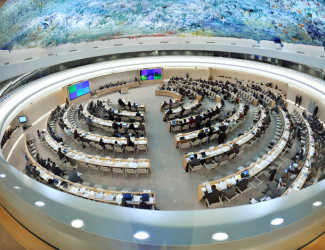
Le Conseil des droits de l'homme (CDH) est un organe intergouvernemental clé du système des Nations Unies, responsable de la promotion et la protection des droits humains autour du globe. Il se réunit trois fois par an en session ordinaire, en Mars, Juin et Septembre. Le Bureau du Haut-Commissariat des Nations Unies aux Droits de l’Homme (HCDH) constitue le secrétariat pour le CDH.
Le CDH :
-
Débat et adopte des résolutions sur les questions globales des droits humains ainsi que sur la situation des droits humains dans des pays particuliers
-
Examine les plaintes des victimes de violations des droits humains et des organisations activistes, au nom des victimes de violations des droits humains
-
Nomme des experts indépendants (que l'on connaît sous le nom de « Procédures Spéciales ») pour réviser les cas de violation des droits humains dans des pays spécifiques, ainsi que pour examiner et suivre des questions globales relatives aux droits humains
-
Prend part à des discussions avec les experts et les gouvernements sur les questions de droits humains
-
Évalue les bilans des États membres de l'ONU en matière de droits humains tous les quatre ans et demi, dans le cadre de l'examen périodique universel.
Session actuelle: CDH 44
La prochaine session du CDH a lieu à Genève, en Suisse, du 30 juin au 17 juillet 2020.
AWID travaille avec des partenaires féministes, progressistes et du domaine des droits humains pour partager nos connaissances clé, convoquer dialogues et évènements avec la société civile, et influencer les négociations et les résultats de la session.
Avec nos partenaires, notre travail consiste à :
◾️ Suivre, surveiller et analyser les acteurs, discours et stratégies anti-droits et leur impact sur les résolutions du CDH.
◾️ Co-développer un plaidoyer collectif pour contrer les acteurs anti-droits et discuter plus en détails les résultats du Rapport de tendances 2017 du OURs
◾️ Soutenir, coordoner et développer de manière collaborative le Caucus féministe qui émerge au CDH.
Contenu lié
AWID Community Jobs board - ES
Bolsa de Empleos Comunitaria
¿Estás buscando trabajo? Una de las ventajas de unirse a la Comunidad AWID es tener acceso a nuestra bolsa de empleos co-creada por la comunidad. Podrás explorar nuevas oportunidades y también tendrás la oportunidad de compartir vacantes y convocatorias de propuestas con todos los miembros.
Yelena Grigoriyeva
Yelena Grigoriyeva, a menudo conocida entre sus amigxs como Lena, fue una destacada defensora de los derechos LGBT en Rusia.
Formó parte de movimientos democráticos, anti-guerra y LGBT. En su activismo, fue una crítica feroz del Presidente Vladimir Putin y su administración, y expresó su oposición a la anexión por parte de Rusia de la península de Crimea de Ucrania y al maltrato de prisionerxs.
Yelena se declaró bisexual a principios de 2019. "Su salida del armario fue una sorpresa para mí, y no la aprobé. Le dije: ‘Escucha, Lena, ya estás en la mira por tu actividad política. Te acabas de clavar otro blanco en el pecho’". - Olga Smirnova
Yelena, de hecho, recibió múltiples amenazas de muerte y, según algunxs de sus conocidxs, figuraba en un sitio web homofóbico que instaba a sus visitantes a que persiguieran a las personas LGBT. Yelena denunció las amenazas a la policía, pero el Estado ruso no le proporcionó ningún tipo de protección.
Sin embargo, Yelena, a pesar de vivir en una sociedad en la que la oposición política, así como lxs integrantes de la comunidad LGBT y lxs defensores de sus derechos, se enfrentan a una violencia continua y creciente, siguió haciendo campaña por la justicia social y la igualdad.
"No se perdió ni una sola acción. Y la detuvieron tantas veces que hasta perdí la cuenta", Olga Smirnova (compañera activista de la oposición y amiga).
Yelena fue asesinada el 21 de julio de 2019, cerca de su casa. Las autoridades detuvieron a una persona sospechosa pero, según algunas fuentes, muchxs amigxs y compañerxs activistas creen que es un chivo expiatorio y que, en realidad, se trata de un asesinato político deliberado.
Para los familiares y amigxs de Yelena, su caso sigue sin resolverse aunque la persona sospechosa haya confesado.
En 2013, Rusia aprobó una ley que prohíbe la difusión de lo que describió como "propaganda gay". En 2014, Human Rights Watch publicó un informe al respecto.
Snippet FEA Principles of work Human Rights (FR)

DROITS HUMAINS
Mars 2015: publication de la version zéro du document final
Publication de la version zéro du document final, mars 2015
- La version zéro du document final (en anglais – datée du 16 mars), préparée par les co-facilitateurs, a été soumise à discussion pendant la seconde session de rédaction qui s’est tenue du 13 au 17 avril 2015.
- Pendant la session inaugurale, le WWG a insisté sur la nécessité de mentionner, dans la version zéro, les ressources qui seraient spécifiquement consacrées à l’égalité des genres et à l’autonomisation des femmes, comme cela avait été prévu dans le Consensus de Monterrey et la Déclaration de Doha.
Priority Areas - Homepage - Fr
Domaines prioritaires
AWID為何選擇台北作為此次國際論壇的舉辦地點呢?
AWID花了近兩年的時間尋找亞太區的論壇舉辦地點(每次論壇輪流在不同區域舉辦)。
我們先初步做了二手資料研究,徵詢盟友意見後,排除了這個區域的許多選擇,我們接著安排了一輪透徹的實地訪查,拜訪了尼泊爾、馬來西亞、斯里蘭卡、泰國、印尼及(之後的)台灣等地,我們每到一處,不只視察當地勤務基礎設施,還並與當地女性主義團體與運動者會面,深入了解當地環境以及運動者對於AWID國際論壇在當地舉行的潛在機會與風險。
實地訪問期間,我們見識了在地精彩蓬勃,多元的女性主義運動。
AWID國際論壇這樣能帶來能見度,對於這類活動能帶來的機會與風險,他們常常表達矛盾的感受。有場會議開始後半小時,我們聽到與會的運動者一致認為AWID國際論壇會遇上大力反彈,同志人權議題是政治上的燙手山芋,基本教義派的保守團體會傾巢出動阻撓活動。當我們回應:「好,所以你們認為這提議不好。」運動者卻也都口徑一致:「當然該在這,我們要改變社會論調!」不是每個地方都可以聽到或看到這麼多女性主義運動者想把握有能見度的大型論壇,還準備好要面對當地的風險。不過,作為主辦方,要舉辦近2000位來自世界各地參與者的論壇,就我們的考量來說,風險與可行性有不同的計算方法。
我們也在斟酌這些問題:按照包容、互利、自決原則所組織的女性主義論壇代表著什麼?同時政府政策與實務通常都與這些原則牴觸(雖然觀光當局的官員很努力地排除障礙)。
在基礎建設外,我們也考量是否有機會能在國家政治環境下,推動某些國家級女性主義議題規劃
在許多地方,要掌握當地脈絡感覺像在鐘擺上,前一刻女性主義辯論還是開放安全的,下一刻就擺向赤裸裸的壓迫與排外;把女性主義要事當成政治討價還價籌碼犧牲,安撫右翼和反人權勢力。
這是一個令人清醒的反思過程,我們發現在全球各地,女性人權與性別正義運動所處的環境艱難到難以置信。
我們在亞太區面臨的挑戰讓我們思考:是否將論壇轉移到一個不同的區域來舉辦會輕鬆一點?可是今時今日,我們無法已無法像2012年一樣,在伊斯坦堡舉行AWID論壇,也無法像2016年一樣,移師到巴西。
考量到這些複雜因素,AWID選擇台北作為論壇舉辦地點的原因如下:
- 台北可提供我們多元的論壇與會者一個相對穩定與保障人身安全的環境。
- 台北同時也具備穩健的勤務服務能力,方便許多旅客來往(提供國際論壇與會者便利的電子簽證流程)
- 在地的女性主義運動社群非常歡迎論壇到來,並熱切想與全球的女權主義者串連。
在籌備AWID論壇時,我們盡全力建立並維持一個空間,能讓我們多元表現團結、憤怒、希望、靈感,這是女性主義運動的核心。
此刻,我們認為在亞太區,台北是最適合的地方,能讓我們為全球女性主義社群打造那個安全造反的空間。
實際上,要舉行一個以女性主義理念實現為中心的論壇,現今的世界是找不到一個理想地點的。無論去哪,我們必須一起打造那個空間!
Intisar Al-Hasairi
Snippet - Join CSW69 Conversations Intro_FR
Rejoignez-nous en prenant part aux conversations #FreezeFascisms!
(#BloquerLesFascismes) !
Alors que nous affrontons de multiples crises dans le monde entier, nos mouvements œuvrent sans relâche à construire une influence qui dépasse les structures de pouvoir traditionnelles. La vague de décrets présidentiels américains vise à nous intimider, mais aucune idéologie fasciste, quelle que soit son ampleur, ne peut effacer notre existence et notre résistance.
Nous vous invitons à rejoindre la campagne de solidarité pour dénoncer et résister aux forces fascistes qui sapent les mouvements féministes et de justice de genre dans vos communautés !
- Déclenchez des conversations au sein d’un espace courageux : partagez vos initiatives de lutte et de résistance aux fascismes à votre échelle sur la plateforme de la Communauté AWID. Pas encore membre ? Rejoignez-nous ici.
- Soutenez les mouvements qui ont été touchés : relayez les collectes de fonds, les ressources disponibles, les efforts d’entraide en utilisant #FreezeFascisms #BloquerLesFascismes (nous sommes toujours sur X, Instagram, Facebook, LinkedIn, mais aussi sur Bluesky !)
- Mobilisez-vous autour d’alternatives : nous avons créé une communauté de pratiques à adopter pour des alternatives économiques féministes et un financement autonome. Inscrivez-vous pour en faire partie ici(en anglais)
Magaly Quintana
Magaly Quintana était connue de nombreuses personnes au Nicaragua comme « La Maga » (la magicienne). Historienne et activiste féministe, elle était une indéfectible défenseure des droits des femmes, réclamant justice pour les victimes de féminicides.
Magaly était fortement engagée dans la documentation et la collecte de statistiques sur les femmes et les filles tuées dans le cadre de la violence sexuelle dans le pays.
« Elle s’employait à reconstituer la vie de chacune d’entre elles, de leur famille, pour montrer ces vies qui avaient été détruites », Dora María Téllez.
Magaly avait également critiqué le gouvernement pour sa réforme de la loi 779 sur la violence à l’égard des femmes. Résultat du travail acharné des mouvements de femmes nicaraguayens, cette loi incluait – avant sa réforme – d’importantes dispositions criminalisant le féminicide. Elle avançait que les réformes législatives avaient affaibli la loi et restreint la définition des féminicides à des homicides, rendant ainsi « invisibles » les crimes violents perpétrés contre les femmes.
Magaly a commencé à mener des actions féministes au début des années 1980. Directrice du Catholic Women for the Right to Choose, elle a défendu le droit à l’avortement thérapeutique après son interdiction en 2006, de même que soutenu les manifestations contre le gouvernement de Daniel Ortega en 2018.
Née en mai 1952, Magaly est décédée en mai 2019.
« Nous nous reverrons plus tard, ma très chère Magaly Quintana. Merci beaucoup, merci pour l’héritage que tu nous laisses. Nous te reverrons, aussi forte et puissante que toujours. », Erika Guevara Rosas (Directrice américaine d’Amnesty International)
Snippet FEA Story 1 Maps Economies of Care (EN)

What is at stake for women’s rights?
Development financing has specific threats and opportunities for women's and all people’s human rights. Transformative development financing and policies can make an important contribution to the systemic changes that are needed to ensure the respect, protection and fulfillment of women’s human rights.
2015 is an important year for the FfD process. The Third International Conference on FfD took place from 13-16 July 2015 in Addis Ababa, Ethiopia and governments are finalising the post-2015 development agenda including agreements on how the new Sustainable Development Goals will be financed.
The current stage of the FfD process is an important opportunity to establish a financing framework that will ensure effective financing for the implementation of the post 2015 agenda and the Sustainable Development Goals (SDGs). It is also an opportunity to address the structural conditions, and systemic changes needed, for the full implementation of other agendas and commitments such as Human Rights Conventions, and the Beijing Platform for Action.
Over the last 13 years, women’s rights and feminist organizations have actively engaged in the FfD process.
FRMag - My queer Ramadan
My Queer Ramadan
by Amal Amer
I pray with my family for the first time in six years while wrapped in a keffiyah I scavenged from a dumpster. (...)
artwork: “Angels go out at night too” by Chloé Luu >
My Queer Ramadan
by Amal Amer, California, US
I pray with my family for the first time in six years while wrapped in a keffiyah I scavenged from a dumpster.
Since coming into myself, I have refused to pray in jamaat with my family. Joining in the ranks of hierarchy, “women” behind “men” irks me. It grates my skin and teeth to the degree where I can’t focus, and the standing, bowing, and kneeling feels like a battle against my true being. Each second listening, a betrayal of my nature. Instead, I pray by myself in my own way.
Yet this Ramadan, I feel different. Back in my childhood home after many years, I am choosing to fast. I choose suhoor with my family, and praying together feels like a natural extension of eating together. After eating, my mother, father, brother and I line up for fajr.
I pray behind Baba, but my prayer is my own. I close my eyes, staying with my breath and my body.
My eyes closed, I open my inner sight to a wide open window on a vista of mountains, bright sun spreading over a light mist of clouds. This was the view I had while praying in jamaat at a queer Muslim wedding I attended in the mountains of the South of France last September.
I lined up with the wedding guests, queer and trans folks of North and West African, Arab, and European descent. Folks of all faiths joined while some chose to stand in respect at the sides or behind. The groups did not fall along fault lines of “Muslim” or “non-Muslim,” “religious” or “non religious.” The two lovers marrying each led us in prayer, and so did the Muslim woman officiating the nikkah. Each of the three led us in two rounds of prayers, two raqat.
I showed up as I was, my body uncovered. I had not washed. I only passed my camera to a friend who chose to stand at the side.
In the first sujood, I broke down crying. I wore a jean dress that loves my body, one found at a thrift store my ex-girlfriend pointed me to.
The sobs come through my whole body during the prayer, and I put my head to the earth with my community like a homecoming. A return to the embrace of love both intensely personal and communal, and I am held.
It feels like swimming in the sea with multiple people: joyful togetherness. But when you go beneath the water, it’s just you and the current.
Like a dozen people buried in the same graveyard. Separate, but sharing the same soil. Becoming one with the growing earth.
That was how it felt to pray in communion at a queer Muslim wedding.
I welcomed the light of acceptance while showing up as myself that day, with a group of people who had also chosen to claim all the parts of themselves in love. That light made a home in me, and it illuminates my heart in the dark living room at fajr this Ramadan morning. Though I pray with my birth family who do not accept all of me, I see myself praying in jamaat at that glorious wedding with all of my queer Muslim ancestors, my queer angels, my lineage, my soul family, my queer Muslim family, all standing in prayer. Bowing as one.
My family’s home does not always feel like my own, though I am here now. I take the bukhoor from room to room, barefoot. Smolder from the censer, an incense that says, “Here I am.” Baraka, blessings from the source of all, Allah and the Goddess to each room in the house, bidding good and dispersing the unbidden.
As I write this the sky turns the same royal blue I am familiar with from exiting the club and pulling all-nighters. It is the gradient of morning I step into as I go to sleep.
Word meanings:
-
Ramadan: the Muslim holy month, traditionally observed with 29 days of fasting without food or water during daylight hours
-
Keffiyah: a patterned scarf common in the SWANA region. The black and white version referred to here is associated with the Palestinian liberation movement
-
Pray in jamaat: Islamic ritual prayer in a group. Participants follow one person, traditionally male, who calls the prayer aloud.
-
Suhoor: the meal before the fast starts at dawn
-
Fajr: the dawn prayer
-
Baba: father
-
Raqat: one round of prayer consisting of standing, bowing, kneeling, and pressing the head to the ground
-
Sujood:the prayer position when one presses one’s head to the earth
-
Nikkah: the religious marriage ceremony
-
Bukhoor: an Arabic incense, woodchips soaked in resin
-
Baraka: blessing
“Angels go out at night too”
by Chloé Luu (@Electrichildren), France
Pictures of angels in my life, just some women and non-binary people of color hanging out, taking care of themselves and expressing love to each other. It's these simplest moments that are the most empowering.


< Freeing the Church, Decolonizing the Bible for West Papuan Women
Sidney Abbott
Snippet - Feminist Mixer - FR
Rencontre féministe : speed dating pour féministes !
✉️ Sur inscription uniquement. Inscrivez-vous ici
📅 Mardi 11 mars 2025
🕒 18.00h-20.00h EST
🏢 Chef's Kitchen Loft with Terrace, 216 East 45th St 13th Floor New York
Organisé par : AWID
Doris Valenzuela Angulo
Doris Valenzuela Angulo was an Afro-descendant social activist, leader and human rights defender from Buenaventura, Colombia. She was part of Communities Building Peace in the Territories (CONPAZ), a national network of organizations in communities affected by armed conflict that advocate for non-violence and socio-environmental justice.
Doris defied constant paramilitary violence and pressures from mega projects to displace her community and state collusion. Faced with one of the most difficult contexts in her country, she played a leadership role in an unprecedented initiative of non-violent resistance called Puente Nayero Humanitarian Space, an urban place for community cohesion, safety, creativity and collective action.
This unique non-violent struggle of the families that belonged to Puente Nayero Humanitarian Space, attracted attention and support from both local and international agencies. By September 2014, the Inter-American Commission on Human Rights had granted precautionary protection measures to the community ordering the Colombian State to adopt necessary measures to preserve their lives and personal integrity. However, the threats and violence from the paramilitaries continued. Doris focused her energies on preventing forced recruitment of children and young people by the neo-paramilitaires, continuing on despite the murder of her son Cristian Dainer Aragón Valenzuela in July 2015. Doris also became a target, continuously receiving threats for her activism and the work she did.
The continued aggression and threats against her life forced Doris to leave Colombia. She was residing in Spain from February 2017 to February 2018, as part of the Amnesty International temporary protection program for human rights defenders at risk. In April 2018, Doris was murdered in Murcia, Spain by her ex-partner. She was only 39 years old.
Tributes:
"Doris, spending a whole year with you has taught us how a person can have the ability to transform and generate hope in the face of deeply negative and devastating events during your life...We continue with our commitment in the defense of all human rights. Your courage and your light will always guide us.” - Montserrat Román, Amnesty International Grupo La Palma
Excerpt from “Words for Doris Valenzuela Angulo” by Elsa López
"..You knew it. You always knew. And in spite of everything you stood firm against so many injustices, so many miseries, so much persecution. You stood up, haughty and fierce, against those who wanted to make you again abandon your hopes, humble yourself and surrender. Standing up you cried out for your freedom and ours that was yours. Nothing and no one paralyzed your efforts to change the world and make it more generous and livable. You, live among us, more alive today than ever among us despite death. Always live by your gestures, your courage, your greatness when crying for a promised land that you came to invoke with each of your cries for all the deserts you inhabited. You. Always alive. Doris Valenzuela Angulo.
They are only words. I know. I know it too. But the words unite us, protect us, give us strength and encouragement to continue walking towards the light that you defended so much…”
Snippet - That Feminist Fire Logo (ES)

什麼時候/如何提交會議場次提案?
FRMag - Ashawo Work na Work
"Ashawo Work na Work": Cómo lxs jóvenes feministas de Ghana están haciendo realidad los futuros feministas
por Fatima B. Derby
En 2017, la campaña de AWID #PracticaSolidaridad destacó cómo lxs jóvenes feministas podían construir un futuro feminista apoyándose mutuamente, participando en conversaciones interregionales entre ellxs, marchando en solidaridad con otrxs activistas y abriendo canales de colaboración entre los movimientos. (...)
< arte: «Let it Grow» [Déjalo crecer], Gucora Andu