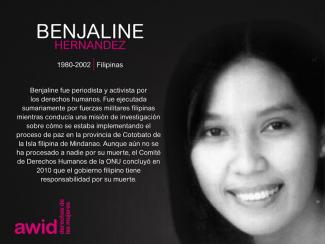
Benjaline Hernandez
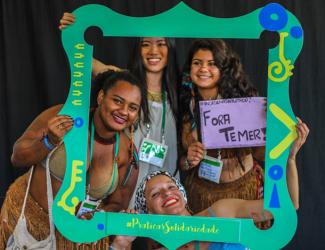
Les jeunes activistes féministes jouent un rôle crucial au sein des organisations et des mouvements pour les droits des femmes à travers le monde. Ce sont elles qui soulèvent les nouveaux problèmes auxquels les féministes sont confrontées aujourd'hui. Leur force, leur créativité et leur adaptabilité sont vitales pour assurer la viabilité des organisations féministes.
Pourtant, elles sont confrontées à toute une série d’obstacles particuliers, notamment l'accès limité au financement et au soutien, le manque de possibilités de renforcement des capacités et une augmentation considérable des agressions sur les jeunes défenseuses des droits humains. Ces obstacles entraînent un manque de visibilité qui rend leur intégration et leur participation effective au sein des mouvements pour les droits des femmes encore plus difficiles.
Le Programme d’activisme des jeunes féministes de l'AWID a été mis en place pour veiller à ce que les voix des jeunes femmes soient entendues et représentées dans le discours féministe. Nous voulons faire en sorte que les jeunes féministes aient un meilleur accès à du financement, à des opportunités de renforcer leurs capacités et aux processus internationaux.
En plus de soutenir directement les jeunes féministes, nous travaillons également avec des activistes des droits des femmes de tout âge pour élaborer des modèles et des stratégies d’organisation multigénérationnelles plus efficaces.
Nous souhaitons que les jeunes féministes puissent jouer un rôle actif dans les prises de décisions qui concernent leurs droits. Nos actions incluent :
Favoriser la mise en commun et le partage d'informations par la Plateforme de jeunes féministes. Étant donné l'importance des médias en ligne pour le travail des jeunes féministes, notre équipe a lancé la Plateforme de jeunes féministes en mai 2010. Elle a pour objectifs d’échanger des renseignements, de renforcer les capacités des membres par le truchement de webinaires et de discussions en ligne, et d'encourager la consolidation d’une communauté de jeunes féministes.
Soutenir la recherche et le renforcement des connaissances sur l'activisme des jeunes féministes, pour accroître la visibilité et l'influence de leur activisme au sein et entre les mouvements pour les droits des femmes et auprès d'autres acteurs-trices clés, tels les donateurs.
Faire la promotion de la collaboration multigénérationnelle, en explorant de meilleures façons de travailler ensemble.
Inciter les jeunes féministes à s’engager dans les processus internationaux relatifs au programme de développement, notamment ceux des Nations Unies.
S’assurer leur collaboration dans tous les domaines prioritaires de l'AWID, y compris le Forum, pour faire en sorte que leurs contributions, leurs perspectives, leurs besoins et leur activisme se traduisent dans les débats, les politiques et les programmes qui les concernent.
حلقة نقاش | النسوية “غير” الشاملة: فتيات بلا صوت في الحركة النسوية الهايتية
مع نايكي ليدان وفيدورا بيير-لوي
L’AWID rend hommage aux féministes et défenseur-e-s des droits humains qui ne sont plus parmi nous, et dont les contributions à l’avancement des droits humains nous font cruellement défaut.
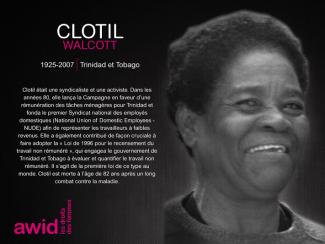
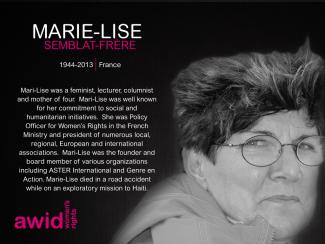
L’hommage se présente sous forme d’une exposition de portraits d’activistes du monde entier qui ne sont plus parmi nous qui ont lutté pour les droits des femmes et la justice sociale.
Célébré en 2012 à l’occasion du lancement du 12e Forum international de l’AWID en Turquie, le premier hommage aux défenseur-e-s des droits humains a pris la forme d’une exposition de portraits et de biographies de féministes et d’activistes disparu-e-s. Des participant-e-s au Forum ont décrit cette initiative comme « une manière à la fois unique, émouvante et vivifiante de célébrer notre histoire collective ».
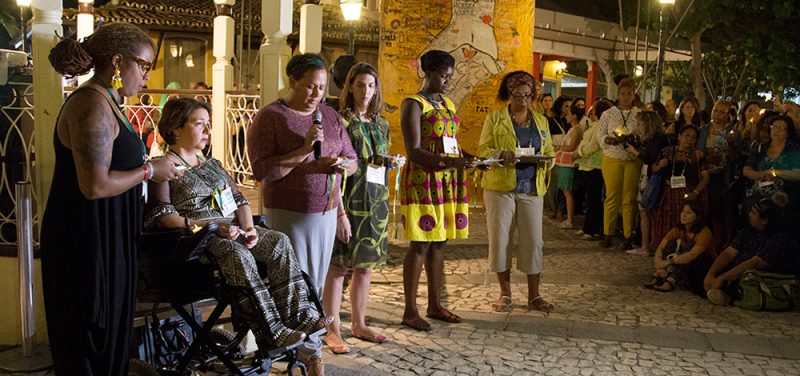
Lors du 13e Forum international au Brésil, nous avons célébré les activistes féministes et les défenseur-e-s des droits humains qui nous ont quitté-e-s ou qui ont été assassiné-e-s avec une cérémonie de dévoilement d’une peinture murale, un spectacle de danse et un rituel brésilien.
Entre la tenue de ces différents événements, l’hommage continue sous forme d’une galerie en ligne, mise à jour chaque année à l’occasion de la campagne de 16 jours d’action contre la violence basée sur le genre (25 novembre-10 décembre).
Depuis 2012, plus de 400 féministes et défenseur-e-s des droits humains issues de 11 régions et 80 pays ont été incluses dans notre Hommage.
L’AWID tient à remercier les familles et les organisations qui ont partagé leurs histoires personnelles et contribué à cette commémoration. Nous nous engageons auprès d’elles à poursuivre le travail remarquable de ces militant-e-s et nous ne ménagerons aucun effort pour que justice soit faite dans les cas qui demeurent impunis.
Visitez l’expo de l’hommage en ligne
Outre l’hommage rendu à ces incroyables activistes, nous souhaitons faire la lumière sur le sort de ces défenseur-e-s des droits humains qui ont disparu ou ont été assassin-é-es.
Un tiers des activistes présenté-e-s dans cet hommage ont été assassiné-e-s ou sont disparu-e-s dans des circonstances obscures. Iels ont été visé-e-s personnellement, en raison du travail qu’iels réalisaient afin de défier :
Ce fut notamment le cas d’Agnes Torres, du Mexique, assassinée en raison de son identité de genre et de son orientation sexuelle, de Cheryl Ananayo, une militante écologiste originaire des Philippines, assassinée alors qu’elle luttait contre une société minière, ou encore de Ruqia Hassan, une journaliste indépendante et bloggeuse syrienne, assassinée pour avoir critiqué l’Etat. Et de très nombreu-x-ses autres.
Avec cet hommage aux défenseur-e-s des droits humains, nous inscrivons tou-s-tes ces activistes dans notre mémoire collective et portons l’héritage de leurs luttes comme le flambeau qui éclaire les actions de nos mouvements féministes et en faveur des droits des femmes. Nous reconnaissons que la sécurité, la sûreté et le souci de soi doivent être des priorités dans l’ensemble de nos programmes politiques, et appelons ainsi tous les gouvernements et les organes internationaux à lutter contre la violence contre les féministes et les défenseur-e-s des droits humains.
تشينيلو أونوالو
في الثاني من أيلول/ سبتمير 2021، التمّ شمل مجموعة رائعة من الناشطات النسويات والمناديات بالعدالة الاجتماعية ضمن فعاليات مهرجان (AWID Crear | Résister | Transform). لم يقتصر هدف اجتماعهنّ على مشاركة استراتيجيات المقاومة وعمليات الابتكار الخلّاقة المشتركة التي ترمي إلى تغيير العالم. لقد اجتمعت الناشطات ليتبادلن الغزَل الإباحي على «تويتر».
This year we are honoring 19 Women Human Rights Defenders from the Latin America and the Caribbean region. 16 defenders were murdered, including 6 journalists and 4 LGBTQI rights defenders. Please join us in commemorating the life and work of these women by sharing the memes below with your colleagues, friends and networks and by tweeting using the hashtags #WHRDTribute and #16Days.
Please click on each image below to see a larger version and download as a file


The artwork is a photography and illustration collaboration between Siphumeze and Katia during lockdown. The work looks at black queer sex and plesure narratives, bondage, safe sex, toys, mental health and sex and many more. It was created to accompany the Anthology Touch.
Les trois défenseuses des droits humains de la région Pacifique auxquelles nous rendons hommage cette année ont travaillé dans les médias, fait campagne pour les droits des personnes handicapées ou plaidé en faveur des droits des femmes. Leur contribution restera irremplaçable et nous leur rendons honneur. Nous vous invitons à vous joindre à nous pour commémorer la vie de ces femmes, leur travail et l’héritage qu’elles nous ont laissé. Faites circuler ces mèmes auprès de vos collègues et amis ainsi que dans vos réseaux et twittez en utilisant les hashtags #WHRDTribute et #16Jours.
S'il vous plaît cliquez sur chaque image ci-dessous pour voir une version plus grande et pour télécharger comme un fichier


Nicole Barakat es una artista femme queer de SWANA, que nació y vive en las tierras de Gadigal (llamadas Sydney) en Australia. Trabaja con procesos intuitivos y de escucha profunda, con la intención de transformar las condiciones de la vida cotidiana. Su obra se desarrolla a través de métodos artísticos no convencionales, creando objetos intrincados que plasman el amor y la paciencia característicos de las prácticas textiles tradicionales.
Sí, por favor. El mundo ha cambiado desde 2021, y te invitamos a proponer una actividad que refleje tus realidades y prioridades actuales.

Este kit inclui mensagens modelo apropriadas para Twitter, Facebook e LinkedIn, além de imagens que podem ser usadas para acompanhar essas mensagens.
Este kit é muito simples de usar. Basta seguir estes passos para:
Combine estas mensagens com as imagens para Twitter
Eu vou para o #AWIDForum. O lugar para conectar com movimentos de direitos das mulheres & justiça social. Vamos!: http://forum.awid.org/forum16/pt-br
Contando os dias para re-imaginar #FuturosFeministas com outr@s ativistas por direitos das mulheres & justiça social @ #AWIDForum! Participe: http://forum.awid.org/forum16/pt-br
Estou muito animada/o para participar do #AWIDForum em Maio, e agora já podemos nosinscrever! Vamos! http://forum.awid.org/forum16/pt-br
As inscrições já estão abertas para o #AWIDForum! Costa do Sauípe, Brasil, 8 de 11 set. de 2016 http://forum.awid.org/forum16/pt-br
Participe do #AWIDForum, um encontro histórico entre ativistas de todo o mundo em defesa dos direitos das mulheres & justiça social http://forum.awid.org/forum16/pt-br
Participe do #AWIDForum para comemorar as conquistas dos movimentos sociais & analisar aprendizados para seguir em frente http://forum.awid.org/forum16/pt-br
#AWIDForum – mais que um evento, uma chance de romper com a opressão & avançar a justiça http://forum.awid.org/forum16/pt-br
Participe do #AWIDForum para comemorar, traçar estratégias, revigorar os movimentos sociais e a nós mesm@s http://forum.awid.org/forum16/pt-br
Vamos construir #FuturosFeministas junt@s. Inscreva-se no #AWIDForum 2016. Costa do Sauípe, Brasil http://forum.awid.org/forum16/pt-br
Una-se a nós para re-imaginar & co-criar #FuturosFeministas no #AWIDForum 2016. Inscreva-se http://forum.awid.org/forum16/pt-br
#FuturosFeministas: aproveite o momento @ #AWIDForum para avançar visões compartilhadas por um mundo mais justo http://forum.awid.org/forum16/pt-br
Seremos 2.000 ativistas de movimentos sociais @ #AWIDForum, traçando estratégias para nossos #FuturosFeministas http://forum.awid.org/forum16/pt-br
Nós somos mais do que uma luta por uma só bandeira. Una-se a nós no #AWIDForum http://forum.awid.org/forum16/pt-br
Participe do #AWIDForum, um espaço para criar estratégias entre movimentos sociais & alavancar o nosso poder coletivo http://forum.awid.org/forum16/pt-br
Mobilize solidariedade & poder coletivo entre movimentos sociais no #AWIDForum http://forum.awid.org/forum16/pt-br
Romperas barreiras entre os movimentos sociais. Re-imaginar & co-criar nossos futuros. Tudo isso no #AWIDForum http://forum.awid.org/forum16/pt-br
Solidariedade é um verbo. Vamos colocá-lo em ação no #AWIDForum http://forum.awid.org/forum16/pt-br
Doadores engajados com os direitos das mulheres e movimentos sociais no #AWIDForum: http://forum.awid.org/forum16/pt-br
Mídia e movimentos sociais: amplificando #FuturosFeministas no #AWIDForum: http://forum.awid.org/forum16/pt-br
Combine estas mensagens com as imagens para Facebook
Nota: estas mensagens também podem ser usadas no Twitter via Mensagens Diretas privadas, que não têm limite de caracteres. Você pode compartilhar as imagens preparadas e adicionar estas mensagens modelo.
A espera acabou! já podemos nos inscrever no Fórum AWID 2016. Será maravilhoso reconectar com companheiras/os ativistas e re-imaginar nossos futuros feministas. Vejo vocês lá em Sauípe! http://forum.awid.org/forum16/pt-br
Estou muito animada/o para participar do Fórum AWID em Maio, e agora já podemos nosinscrever! Vamos! http://forum.awid.org/forum16/pt-br
Estou curtindo a ideia de re-imaginar futuros feministas com 2.000 pessoas de inúmeros movimentos incríveis de direitos das mulheres e justiça social no Fórum AWID. Inscreva-se e a gente se vê por lá! http://forum.awid.org/forum16/pt-br
As inscrições já estão abertas para o Fórum AWID 2016 na Costa do Sauípe, Bahia! Este não é apenas qualquer evento – é um espaço único para ativistas em defesa dos direitos das mulheres e justiça social de todo o mundo se encontrarem e re-imaginarem nossos futuros feministas. Você não vai querer perder! http://forum.awid.org/forum16/pt-br
Una-se a nós no Fórum AWID 2016 na Bahia! Ativistas e movimentos de todo o mundo irão se encontrar para comemorar, criar estratégias, inspirar e renovar nossas lutas coletivas e a nós mesm@s. Inscreva-se agora! http://forum.awid.org/forum16/pt-br
O Fórum AWID 2016 será um encontro histórico entre ativistas de todo o mundo por direitos das mulheres & justiça social. Una-se a nós lá para romper as barreiras, fortalecer a solidariedade e alavancar nosso poder coletivo. Inscreva-se agora! http://forum.awid.org/forum16/pt-br
O Fórum AWID 2016 será um encontro histórico entre ativistas de todo o mundo em defesa direitos das mulheres & justiça social. Una-se a nós lá para romper as barreiras, fortalecer a solidariedade e alavancar nosso poder coletivo. Inscreva-se agora! http://forum.awid.org/forum16/pt-br
Download das suas imagens favoritas

Ce projet est le fruit d’une collaboration avec :