Activisme des jeunes féministes
S'organiser de manière créative face à des menaces croissantes
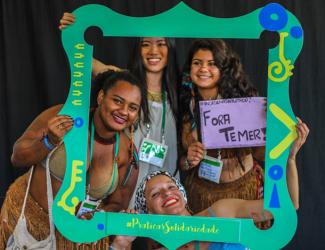
Les jeunes activistes féministes jouent un rôle crucial au sein des organisations et des mouvements pour les droits des femmes à travers le monde. Ce sont elles qui soulèvent les nouveaux problèmes auxquels les féministes sont confrontées aujourd'hui. Leur force, leur créativité et leur adaptabilité sont vitales pour assurer la viabilité des organisations féministes.
Pourtant, elles sont confrontées à toute une série d’obstacles particuliers, notamment l'accès limité au financement et au soutien, le manque de possibilités de renforcement des capacités et une augmentation considérable des agressions sur les jeunes défenseuses des droits humains. Ces obstacles entraînent un manque de visibilité qui rend leur intégration et leur participation effective au sein des mouvements pour les droits des femmes encore plus difficiles.
Une approche multigénérationnelle
Le Programme d’activisme des jeunes féministes de l'AWID a été mis en place pour veiller à ce que les voix des jeunes femmes soient entendues et représentées dans le discours féministe. Nous voulons faire en sorte que les jeunes féministes aient un meilleur accès à du financement, à des opportunités de renforcer leurs capacités et aux processus internationaux.
En plus de soutenir directement les jeunes féministes, nous travaillons également avec des activistes des droits des femmes de tout âge pour élaborer des modèles et des stratégies d’organisation multigénérationnelles plus efficaces.
Nos actions
Nous souhaitons que les jeunes féministes puissent jouer un rôle actif dans les prises de décisions qui concernent leurs droits. Nos actions incluent :
-
Favoriser la mise en commun et le partage d'informations par la Plateforme de jeunes féministes. Étant donné l'importance des médias en ligne pour le travail des jeunes féministes, notre équipe a lancé la Plateforme de jeunes féministes en mai 2010. Elle a pour objectifs d’échanger des renseignements, de renforcer les capacités des membres par le truchement de webinaires et de discussions en ligne, et d'encourager la consolidation d’une communauté de jeunes féministes.
-
Soutenir la recherche et le renforcement des connaissances sur l'activisme des jeunes féministes, pour accroître la visibilité et l'influence de leur activisme au sein et entre les mouvements pour les droits des femmes et auprès d'autres acteurs-trices clés, tels les donateurs.
-
Faire la promotion de la collaboration multigénérationnelle, en explorant de meilleures façons de travailler ensemble.
-
Inciter les jeunes féministes à s’engager dans les processus internationaux relatifs au programme de développement, notamment ceux des Nations Unies.
-
S’assurer leur collaboration dans tous les domaines prioritaires de l'AWID, y compris le Forum, pour faire en sorte que leurs contributions, leurs perspectives, leurs besoins et leur activisme se traduisent dans les débats, les politiques et les programmes qui les concernent.
Contenu lié
Snippet - WITM RESOURCES - AR
المصادر
(متوفرة باللغة الإنجليزية)
Defendiendo nuestra tierra del poder corporativo

Estas industrias 'extraen' materias primas de la tierra: minería, gas, petróleo y madera son algunos ejemplos.
Este modelo económico explota desenfrenadamente la naturaleza e intensifica las desigualdades norte, donde sus grandes corporaciones se benefician y sur, de donde extraen los recursos.
Contaminación del agua, daño irreparable al medioambiente, comunidades forzadas a desplazarse son algunas de las consecuencias inmediatas.
Lee nuestro reporte de INDUSTRIAS EXTRACTIVAS
Hay alternativas sostenibles para el medioambiente y los derechos humanos de la mujer.
Descubre además cómo nos afecta económicamente

Snippet FEA Georgia's minimum wage (EN)
Georgia's minimum wage is in the bottom percent of all countries in the world. This reality affects mostly women.
The country not only has a significant gender pay gap, but women also work longer, more unregulated hours before going home to take care of housework and their families. There is no maternity pay, no wage increase for overtime work, no unemployment insurance, and no pay for sick leave or other social protection. Pressured by Western organizations, Georgian oligarchic political parties have been implementing reforms that are destroying the welfare state, increasing austerity measures, and worsening worker exploitation - all for the benefits of big corporations which are applauding the country for its “ease of doing business”. Mass media, coerced by private and corporate interests, either remain silent or biased on these issues. Union organizing remains one of the very few options to fight for basic human rights, and for holding the State and corporations accountable in the face of daily, pervasive violations and persecutions, especially against women.
Sources: Minimum-Wage and Interview with Sopo Japaridze to OpenDemocracy
Benoîte Groult
Benoîte était une journaliste, écrivaine et militante féministe française.
Elle a publié plus de 20 romans et de nombreux essais sur le féminisme
Son premier livre « Ainsi Soit-Elle » a été publié en 1975. Le livre explore l’histoire des droits des femmes ainsi que la misogynie et la violence à l’égard des femmes.
Son dernier livre, « Ainsi Soit Olympe de Gouges», a exploré la question des droits des femmes pendant la Révolution française, se concentrant sur la figure de l’ancienne féministe française Olympe de Gouges. De Gouges fut guillotinée en 1793 pour avoir défié l'autorité des hommes et publié la « Déclaration des droits de la femme et de la citoyenne » deux ans auparavant.
Sunila Abeyseke
على من يجب تعبئة الاستطلاع؟
المجموعات، المنظمات والحركات التي تعمل خصوصاً وبالأساس على حقوق النساء، حقوق الفتيات، العدالة الجندرية، حقوق مجتمعات الميم - عين وحلفائها/يفاتها في جميع المناطق وعلى جميع المستويات، إن كانت مجموعات جديدة أو قديمة.
Framework & Theme
The theme of the 14th AWID International Forum is: “Feminist Realities: our power in action”.
In our 14th Forum, we will celebrate and amplify Feminist Realities that are around us, in all stages of development.
We want to make this Forum our Feminist Reality - a place where you can inhabit a different world, where you bring your victories, the solutions you have devised; what makes you feel stronger, hopeful and ready to go on. It will be different from any other convening you have previously attended.
We urge you to join us in co-creating this world. It will be worth it!
Each Forum has a theme that reflects the needs of our membership and movements, and responds to our analysis of the current context.
The global context
Currently fascisms, fundamentalisms, authoritarianism and unfettered corporate power are gaining momentum globally. We see these threats converging with the State to shape public norms, narratives, and policies, entrenching a culture of fear, hate and incitement to violence in public discourse. States, previously the target of advocacy and rights claims, in many cases no longer feel accountable and in some cases themselves don’t have the power to uphold rights.
This time of volatility, complexity and uncertainty requires creativity in how we organize across movements, coherence in what we demand and daring in what we propose.
From Feminist Futures to Feminist Realities
AWID’s 2016 Forum centered on Feminist Futures and the conditions needed to bring such futures about. It was clear then, and remains evident now, the enormous challenge for many social justice movements to think outside of the current system for structural solutions. Imaginations can become narrowed from long experiences of inequality and oppression. But what we also heard then and we see all around us is that feminist movements are indeed living and promoting rights-and justice-oriented realities and solutions in big and small ways.
Indeed we see an urgency to mobilize from a place of hope, rather than from a lowest common denominator - hope that is grounded in the certainty that across the globe, however imperfectly, are experiences and practices that embody more just ways of being in the world and that by sharing, strengthening and building on these experiences, we can help them grow their influence.
These are not impossible dreams, but lived realities. This sense of possibility is a spark to re-examine and re-appreciate the transformative dimensions in our work.
A few examples of Feminist Realities across the globe
At AWID, we understand feminist realities as the living, breathing examples of the worlds we know are possible. We understand these diverse feminist realities as reclamations and embodiments of hope and power. They are embedded in the multiple ways that show us that there is a different way of living, thinking and doing-- from the daily expressions of how we live and relate to each other, to alternative systems of governance and justice. Feminist Realities resist dominant power systems such as patriarchy, capitalism, and white supremacy.
These are powerful propositions that orient us toward a vision of what is possible, and show how feminist organizing is blazing a path toward justice in movements and communities around the world.
-
In a deeply marginalized Black community in Jackson, Mississippi, an experiment in solidarity and cooperative economics is taking place through Cooperation Jackson. An ambitious plan to build community ownership outside of capitalist modes of production.
-
In West Africa, women farmers are resisting land grabbing and refusing industrialized agriculture projects, boldy claiming We Are The Solution, in a campaign to build agro-ecological solutions that center women farmers and their knowledges as the solutions to feed communities and mitigate climate change
-
Similarly, in India, 5,000 women have come together to develop community-based food sovereignty systems based on local knowledge, including grain and seed banks
-
Women in Mexico have created a moneyless economy project created by and for women and everyone they know. In El Cambalache everything has the same value: people exchange things they no longer need for things they want as well as knowledge, abilities and mutual aid that people would like to share. El Cambalache was built on the anti-systemic, anti-capitalist values of local social movements
-
In Rojava, Kurdish people are building democracy without the state and Kurdish women offer Jineology as a framework for challenging patriarchy, capitalism and the state, creating systems and institutions to put this framework into practice
-
In the UK, Anarcho Agony Aunts are a sex and dating advice show, covered from a feminist, antifascist, anarchist perspective. Hosts Rowan and Marijam are reclaiming space from the alt-right in giving people (mostly men) a space to ask tricky questions in a judgment-free zone.
-
The African Feminist Judgment Project drafts and disseminates alternative judgments for important African landmark cases on a range of legal issues. At the heart of the project is propositional feminist judicial practice and alternative feminist judgments that contribute to African jurisprudence, legal practice and judicial decision-making
-
The Usha Cooperative in India was founded when mainstream banks refused services to sex workers in Sonagachi. Sex workers self-organized to prioritize their economic concerns and set up their own financial institution. The Usha Cooperative is cooperative bank of over 20,000 sex workers and has provided over USD 4.7M in loans to 7,231 sex workers in a span of one year. With a membership entirely of sex workers, the bank provides real ownership and influence over the cooperative’s governance and management, pioneering ways for individuals and communities on the margins to build economic power on their own terms.
-
In Puerto Rico, a community land trust is helping to transform an informal settlement around a polluted and flood prone river channel into a sustainable community. It provides a new model for improving informal settlements in cities without them then becoming unaffordable for the original residents.
-
In several Latin American countries activists are providing peer-to-peer counselling and accompaniment on medical abortion, reclaiming women´s right to decide over their bodies as well as to medical knowledgde. (for safety reasons, no links are provided.
The 14th AWID international Forum
The AWID Forum will be organized around 6 thematic anchors:
- Resources for Communities, Movements and Economic Justice
- Governance, accountability and justice
- Digital Realities
- Bodies, pleasure and wellbeing
- Planet and living beings
- Feminist organizing
Learn more about these anchors
Building on those realities, we expect the 2020 Forum to:
- Build the power of Feminist Realities, by naming, celebrating, amplifying and contributing to build momentum around experiences and propositions that shine light on what is possible and feed our collective imaginations
- Replenish wells of hope and energy as much needed fuel for rights and justice activism and resilience
- Strengthen connectivity, reciprocity and solidarity across the diversity of feminist movements and with other rights and justice-oriented movements
The Forum is a collaborative process
The Forum is more than a four-day convening. It is one more stop on a movement strengthening journey around Feminist Realities that has already begun and will continue well beyond the Forum dates.
Snippet FEA collaborator and allies Photo 4 (ES)

Stella Mukasa
Stella began her career at the Ministry of Gender and Community Development in Uganda engaging with policymakers for law reform, including the 1995 Ugandan Constitution, which established some of the most progressive reforms for women in the region.
She is revered throughout the region for her tireless efforts to create and enforce gender-responsive laws and policies. She played a key role in drafting Uganda’s Domestic Violence Act and in mobilizing support for gender-responsive constitutions in both Uganda and in Rwanda.
Through her work with International Center for Research on Women (ICRW), she worked on violence against children, and worked to strengthen the capacities of grassroots organizations addressing gender-based violence. She was a lecturer on gender rights and the law at Makerere University and served on the boards of Akina Mama wa Afrika, ActionAid International Uganda and the Open Society Initiative for Eastern Africa.
Cristina Morales Jose
Что подразумевается под внешним финансированием?
Внешнее финансирование включает гранты и другие формы финансирования от благотворительных фондов, правительств, двусторонних, многосторонних или корпоративных спонсоров и индивидуальных доноров – как внутри вашей страны, так и из-за рубежа. Сюда не входят ресурсы, которые группы, организации и/или движения генерируют самостоятельно, такие как, например, членские взносы, добровольные взносы "сотрудниц(-ков), участниц(-ков) и/или сторонниц(-ков), сборы через сообщество, сдача помещений в аренду или продажа услуг. Для удобства в опрос включены определения различных видов финансирования и краткие описания различных доноров.
El Fondo Acceso para el Foro de AWID
Nos esforzamos para hacer que el Foro de AWID sea un encuentro verdaderamente global, con participación de un conjunto diverso de movimientos, regiones y generaciones. Con este fin, AWID moviliza recursos para un Fondo Acceso (FA) limitado para ayudar a algunxs participantes con los costos de asistir al Foro.
El 14° Foro Internacional de AWID tendrá lugar entre el 11 y el 14 de enero de 2021 en Taipei, Taiwán.
¿Cómo será asignado el Fondo Acceso?
Para este Foro de AWID no habrá proceso de postulación.
Las becas del Fondo Acceso serán asignadas sólo por invitación para:
- Dos personas por actividad seleccionada para el programa del Foro (decididas por aquellas organizaciones, grupos o individuos que organizan la actividad)
- Participantes que se identifiquen como parte de Colectivos Prioritarios del Foro (CPF) recomendadxs por las organizaciones, redes y grupos que están creando el Foro junto con AWID. Los CPF son aquellos que consideramos que fortalecerían nuestro poder colectivo como movimientos, que no estén centrados en los movimientos feministas dominantes, y cuyas realidades feministas nos gustaría honrar, celebrar y visibilizar:
- Feministas negrxs
- Feministas indígenas
- Feministas trans, de género no convencional e intersex
- Feministas con discapacidades
- Feministas trabajadorxs sexuales y trabajadorxs informales, incluyendo trabajadorxs migrantes
- Feministas afectadxs por la migración
- Mujeres afectadas por la política de drogas
- Feministas de las regiones del Foro (con el foco en el Pacífico y en China continental)

Además, AWID va a financiar a aproximadamente 100 participantes del país anfitrión del Foro. Lxs integrantes de los Comités del Foro (Contenidos y Metodología, Acceso y Anfitrionxs así como el Grupo de Trabajo de Artistas también tendrán apoyo del Fondo Acceso.
¿Qué cubre el Fondo Acceso?
Para lxs participantes seleccionadxs, el Fondo Acceso cubrirá el costo de su:
- Vuelo
- Alojamiento
- Visa
- Transporte local en Taipei
- Seguro médico de viaje
El Fondo Acceso no cubrirá su:
- Inscripción al Foro, una pequeña suma de $100 dólares
- Transporte hacia y desde el aeropuerto en su ciudad de partida
- Otros costos eventuales
Aparte del Fondo Acceso, ¿cómo puedo financiar mi participación en el Foro?
Hemos preparado una lista con otras ideas sobre cómo puedes financiar tu participación en el Foro de AWID en la página de Ideas sobre financiamiento.
Snippet FEA different lines of work S4 (FR)
Lignes de travail :
CONTRE
Juana Ramírez Santiago
Juana fue una de las fundadoras y era actualmente integrante de la junta directiva de la Red de Mujeres Ixiles de Nebaj, una organización por los derechos de las mujeres indígenas que es parte de la Iniciativa Mesoamericana de Mujeres Defensoras de Derechos Humanos (IM-Defensoras).
También era partera y madre de siete hijxs. Había recibido amenazas de muerte que fueron denunciadas ante la Fiscalía. Juana es la tercera defensora de derechos humanos indígena asesinada en el área durante 2018. El Ombudsman de Guatemala informa que un total de 20 defensorxs de derechos humanos fueron asesinadxs este año en el país.
Juana Ramírez Santiago fue baleada de muerte por atacantes desconocidos mientras cruzaba un puente en Nebak, Quiché, Guatemala. Están en curso las investigaciones para identificar a los perpetradores.