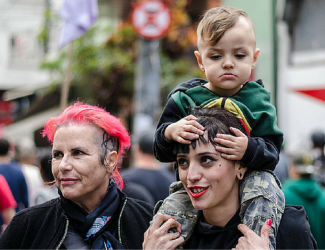
Flickr/Leonardo Veras (CC BY 2.0)

Análisis Especiales

AWID es un organización feminista internacional de membresía, que brinda apoyo a los movimientos que trabajan para lograr la justicia de género y los derechos de las mujeres en todo el mundo.

Protección de la familia

El contexto

Esta sección de análisis especial ofrece un análisis feminista crítico y acceso a los recursos clave relacionados con la «protección de la familia» en los espacios internacionales de derechos humanos.

Durante los últimos años, venimos observando una nueva y preocupante tendencia en el ámbito internacional de derechos humanos, donde se están empleando discursos sobre la «protección de la familia» para defender violaciones cometidas contra miembros de la familia, de modo de reforzar y justificar la impunidad y para coartar la igualdad de derechos en el seno de la familia y la vida familiar. 

La campaña para «proteger a la familia» es impulsada por proyectos conservadores que tienen como fin imponer interpretaciones «tradicionales» y patriarcales de familia; quitando los derechos de las manos de sus miembros para ponerlos en las de la institución «familia».

Los proyectos de «protección de la familia» tienen su origen en los siguientes fenómenos:

  • el auge del tradicionalismo,
  • el auge del conservadurismo cultural, social y religioso, y
  • posturas hostiles a los derechos humanos de las mujeres, los derechos sexuales, los derechos de las niñas y los niños y los derechos de las personas con identidades de género y orientaciones sexuales no normativas.  

Desde 2014 un grupo de estados opera como bloque en espacios de derechos humanos, bajo el nombre «Group of Friends of the Family» [Grupo de amigos de la familia], y a partir de entonces se han aprobado resoluciones sobre la «Protección de la familia» todos los años.

Esta agenda se ha extendido más allá del Consejo de Derechos Humanos (HRC, por sus siglas en inglés).  Hemos visto cómo el lenguaje regresivo sobre «la familia» se ha introducido en la Comisión de la Condición Jurídica y Social de las Mujeres (CSW, por sus siglas en inglés), y hemos asistido a intentos por incluir este lenguaje en las negociaciones sobre los Objetivos de Desarrollo Sostenible.


Nuestro enfoque

AWID trabaja con asociadxs y aliadxs para resistir conjuntamente las agendas regresivas de «Protección de la familia» y otras, y para defender la universalidad de los derechos humanos.

En respuesta a la creciente influencia de actores regresivos en los espacios de derechos humanos, AWID se ha unido con aliadxs para formar el Observatorio de la Universalidad de los Derechos (OURs, por sus siglas en inglés).  OURs es un proyecto colaborativo que monitorea, analiza y comparte información sobre iniciativas anti-derechos tales como la «Protección de la familia».

Derechos en Riesgo, el primer informe de OURs, traza un mapa de los actores que conforman el cabildeo global anti-derechos e identifica sus discursos y estrategias principales, señalando los efectos que estos discursos y estrategias están teniendo sobre nuestros derechos humanos.

El informe expone a la «Protección de la familia» como una agenda que ha promovido la colaboración entre una amplia gama de actores regresivos en las Naciones Unidas. La describe como un marco estratégico que aloja «múltiples posiciones patriarcales y anti-derechos, cuyo marco, a su vez, apunta a justificar e institucionalizar estas posiciones».
Contenido relacionado

Diakite Fatoumata Sire

Diakite s'est activement impliquée dans la défense des femmes dans la vie politique et publique au Mali.

Elle a travaillé pour soutenir la formation des candidates aux élections et s'est élevée contre les mutilations génitales féminines (MGF). Elle était un ardente défenseure de la santé et des droits reproductifs.


Diakite Fatoumata Sire, Mali

Snippet FEA Principles of Work (ES)

Principios

DE TRABAJO

ما هو عدد الردود الذي ترغبون بجمعها؟

نهدف للوصول الى 2000 رد، وهذا تقريباً ضعف الردود التي جمعناها من استطلاع "أين المال" الأخير عام 2021.

Questions (Forum page)

¿Preguntas?

¿Tienes preguntas sobre el Foro de AWID o sobre las actividades relacionadas? ¡Tenemos respuestas!

Encuentra las respuestas

Main image
cfa_header_v8.2.png
Body

Kunyit Asam: The Roots of Love and Resilience

By Prinka Saraswati, Gianyar, Bali

The menstrual cycle usually lasts between 27 and 30 days. During this time, the period itself would only go on for five to seven days. During the period, fatigue, mood swings, and cramps are the result of inflammation.

In traditional Javanese culture, this is the moment for women to rest and take care of themselves. During this moment, a woman would take Kunyit Asam, a jamu or herbal drink to soothe the inflammation. This elixir consists of turmeric and tamarind boiled together in a pot.

I still remember my first period - it was one day before graduation day in elementary school. I remember pedaling my bike feeling something warm running between my thighs. When I arrived home I did all I could to clean myself and then put on a menstrual pad. My mother came home from work about four hours later. I told her what had happened. She looked me in the eye and asked how I felt. I told her that it was painful, that my body was swollen in every place. Then she asked me to go with her to the backyard. I followed her to our little jungle, my mother sat down on the soil and smiled.

“See this slender leaf? This is the leaf of Kunyit, *empon-empon that leaves the yellow stain on your fingers. What’s most important is not the leaf, but the roots. You dig the soil and slowly grab the roots.”, my mother showed me how to pick Kunyit or Turmeric roots. Then we went to the kitchen where she boiled water along with some tamarind. While waiting for it to boil, she showed me how to wash and grate the orangey-yellow root. Then, we put the grated turmeric into the boiling tamarind water. “Tomorrow, you can make it for yourself. This will help you to feel better!”.

I remember the first time I tasted it - a slightly bitter taste but also sour. My mother always served it warm. She would also put some in a big bottle which I would place on my stomach or lower back for further relief. For days after, my mother’s hands and mine were yellow. My friends could always tell every time I got period because my hands would be yellow.

A year after my first period, I found out that you could get the bottled version in convenience stores. Still, I made my own Kunyit Asam every time I had my period because the one in the convenience stores was cold. It did not smell of wet soil and warm kitchen.

Fast forward, I am a 26 year old woman who casually makes this drink for friends when they have their periods. I’ve made some for my housemates and I’ve delivered some for friends who live in different towns. I do not grow turmeric roots in my garden, but I have grown and shared the love from my mom. What was once from garden to cup is now from *pasar to cup.

A couple of days ago, I asked my mother who taught her how to make the jamu.

“Who else? Yang Ti*! Your grandmother was not just a teacher”, said my mom. I was never close to my grandmother. She passed away when I was eight. All I knew from my mom was that she was a math teacher who had to teach courses after work. I had this image of my grandmother as a hard worker who was kind of distant with her children. My mom did not disagree with that but explained it came from her survival instinct as a mother. “She tried to make time. She tried. She taught me how to make jamu so I could take care of myself and my sisters”.

My mother is the second child out of seven, six of whom are girls. The reason my grandmother taught her is so that all of her children could take care of each other. While my mother was taught how to make the drink, my mother’s older sister was taught how to plant turmeric. Yang Ti knew which one loved the smell of soil more and which one loved the smell of the kitchen. My mother was the latter. She learned how to plant from my aunt, her older sister.

My grandfather worked in a bank but he got laid off when he was in his 40s. So, my grandmother had to do a side-hustle to support their children. My mother was in high school at that time when Yang Ti woke her and her older sister up at dawn. “Would you help me to pick some roots?”. Of course nobody said no. Especially if it was your mother, especially if you were born in Javanese culture where saying “no” sounded like a bad word. Together, the three of them went to the backyard, and they harvested empon - empon, rhizome, that was buried inside the soil. She grew many kinds of rhizome; temu lawak, temu putih, ginger, galangal, kunci, kencur, and kunyit. That was the day where my mother realized that her mother was never far away from her.

That was the day where she could spend more time with her mother. There, in the garden. There, in the kitchen.

“We’re sending these for Ibu Darti, the lady who lives across the river. Kunyit Asam for her and her daughters.”, said my grandmother to my mother and my aunt that day. They poured the Turmeric-Tamarind warm drink into a tall thermos and later my grandmother would deliver it on the way to school.

Over time, my grandmother got more orders for jamu. Everybody in the family helped her to make and deliver her jamu. The small business lasted only a few years, but that was what paid for my mother and her siblings’ education.

Today, my mother, who got laid off just a few days before I wrote this piece, harvested Turmeric and other roots. She’s making her Turmeric Tamarind drink from her kitchen.

My phone rang in the middle of this afternoon, a couple minutes after I boiled the rest of my grated turmeric. Today is one day after my period.

“Ingka, have you washed your pot after boiling those turmeric? It would forever be yellow if you don’t wash it right away!”


  • *empon-empon = roots like ginger, turmeric, etc. coming from the Javanese word “Empu” which means, something or someone that has deep knowledge.

  • *jamu = Indonesia’s traditional elixir made of roots, barks, flowers, seeds, leaves, and fruits.

  • *Yang Ti = Javanese term for grandmother, taken from the term “Eyang Putri” the female you look up to.

  • *pasar = the word for traditional market in Indonesian.


“Feminist Movement”

by Karina Tungari, Hamburg, Germany  (@_katung_)

The more women support other women, the quicker we’ll see progress. Together we are stronger and make even more impact.

Karina Tungari, Hamburg, Germany  (@_katung_)


Andaiye

« Andaiye » signifie « une fille revient à la maison » en swahili. Née Sandra Williams le 11 septembre 1942 à Georgetown, Guyane, Andaiye adopte ce nouveau nom en 1970 alors que le mouvement des Black Panthers balaie son pays et toute la région des Caraïbes.

Perçue comme une figure transformatrice sur les fronts de la lutte pour la libération et pour la liberté, Andaiye a été l’une des premières membres de l’Alliance du peuple travailleur (WPA), un parti socialiste en Guyane de lutte contre le régime autoritaire et participait activement à sa direction. Tout au long de sa vie, Andaiye a placé la justice pour la classe ouvrière et les droits des femmes vivant en milieu rural au centre de son action militante, et s’est battue pour l’élimination des obstacles ethniques entre les femmes indo-guyaniennes et celles afro-guyaniennes.

Andaiye fut l’une des membres fondatrices des Red Thread Women, une organisation de défense pour la juste rémunération du travail en soins réalisé par les femmes, en plus d’avoir travaillé à l’Université des Indes occidentales et avec l’organisation CARICOM. N’hésitant jamais à défier les gouvernements, elle a pointé du doigt les déséquilibres en matière de genre dans les conseils de l’État, les lois discriminatoires à l’égard des travailleur·euse·s du sexe, réclamé le droit à l’avortement en Jamaïque et s’est érigée contre les accords commerciaux, tels que le Marché unique des Caraïbes (CSME) qui permettait la libre circulation des travailleuses domestiques migrantes mais n’octroyait pas ce même droit à leurs enfants.

Elle a publié plusieurs essais universitaires, rédigé des articles d’opinion et révisé les derniers ouvrages de Walter Rodney, l’activiste politique guyanien et coleader du WPA assassiné en 1980. Survivante du cancer, Andaiye a été l’une des fondatrices de la Ligue guyanienne contre le cancer et du Groupe d’action des survivant·e·s du cancer. Elle a également siégé au conseil exécutif de l’Association caribéenne pour la recherche et l’action féministes (CAFRA), dirigé le Help and Shelter et été membre du conseil de la Commission nationale guyanienne pour les femmes. Elle a par ailleurs reçu de nombreux prix, dont le prestigieux Golden Arrow of Achievement (quatrième prix le plus important du Guyana).

Andaiye est décédée le 31 mai 2019, à l’âge de 77 ans. Les nombreux hommages que lui ont rendus des activistes, ami·e·s et celles et ceux que sa vie aura inspiré·e·s ont parlé avec éloquence de son incroyable héritage et de la grandeur de son humanité.

En voici quelques-uns :

“« Andaiye m’a profondément marquée... elle représenttait tellement de choses pour moi : une éducatrice, une combattante, elle m’a appris l’autocritique, à réfléchir plus clairement, elle m’a enseigné la survie, ce qu’est le courage sans limite, la compassion, à dépasser les apparences et traiter les gens comme des gens, sans se laisser impressionner par le statut, la classe, la race... rien de tout ça. » Peggy Antrobus, activiste féministe, auteure, universitaire, La Barbade

« Le genre d’idéalisme confiant que démontrait Andaiye, cette disposition à affronter le monde et une croyance tenace qu’on pouvait vraiment le changer... Cette politique de l’espoir... Comment honorer sa vie, son héritage et sa mémoire autrement qu’en poursuivant le travail éthiquement et en continuant à s’autocritiquer? Et de faire en sorte de placer le travail de soins des femmes au centre. » - Tonya Haynes, La Barbade

« Je peux l’entendre se moquer de notre engouement collectif. Donc, je ris tout en pleurant. Chapeau bas, chère Andaiye, et merci pour tout. Que le voyage de ton esprit soit aimant et lumineux. Passe le bonjour à Walter et aux ancêtres. » - Carol Narcisse, La Jamaïque​​

Lire d’autres hommages à Andaiye (en anglais)

Snippet FEA Principles of work Education and Learning (FR)

Une pile de livres dans une couverture rose et un mortier de graduation noir sur le dessus.

ÉDUCATION ET APPRENTISSAGE CONSTANT

Snippet - AWID Community - EN

AWID Community

AWID Community is an online social networking platform for specifically for AWID members. It’s a feminist space for connection, resistance and celebration. A space for critical  feminist conversations, collective power and solidarity. It is also a space for post-event dialogues, navigating difficult political learnings and community care

FRMag - Editors Note

Note éditoriale

Les Réalités féministes consistent en une invitation chaleureuse et bienveillante, une sorte d’acte de préservation et de soins massifs (versus un soin individuel), une invitation à archiver et à faire l’inventaire de tout le travail réalisé, sous peine de le voir disparaître.     (...)

Lire

Body

Pleasure Garden Exhibition

The artwork is a photography and illustration collaboration between Siphumeze and Katia during lockdown. The work looks at black queer sex and plesure narratives, bondage, safe sex, toys, mental health and sex and many more. It was created to accompany the Anthology Touch.

Mental Health
Mental Health
Sex and Spirtuality
Sex and Spirtuality
Orgasm
Orgasm

About the Artists:

Siphumeze Khundayi portrait
Siphumeze Khundayi is an art-maker, photographer and facilitator interested in creative ways of bringing together dialogue and artistic practice in relation to African Queer identity.

She is creative director of HOLAAfrica! a pan-Africanist womanist online collective.

Her solo and collaborative performance work has been featured in a number of festivals and theatre spaces such as Ricca Ricca Festival in Japan

She directed two Naledi nominated productions in 2017 and 2018. She directed a show that won a Standard Bank Ovation award in 2020.

As a photographer she was part of a group exhibition titled Flowers of my Soul in Italy organised by the Misfit Project. Produced three publications for HOLAAfrica and was published in and provided the cover for volume two: As You Like of the Gerald Kraak Anthologies.
katia portrait
Katia Herrera is a 21-year-old  Digital visual artist from the noisy city of  Santo Domingo in the Dominican Republic. Despite Herrera being a self-proclaimed introvert, her artwork is remarkably loud in a world trying to quiet black voices. With titles like Black Woman, You Own the Moon, Earth Goddess, Forever,  and Universe Protector, Herrera’s legacy will be marked by her passion for highlighting the endurance and perseverance of black folks of old and present to contrast the narrative that black skin should only be associated with slavery.

One of her most lovely and vivaciously titled works, Universe Protector, portrays the black soul as a divine entity full of strength, power, and greatness. In her youth, her love of graphic design was stimulated by her parents’ artistry and the Photoshop they had downloaded on their computer for their professional photography.

Yelena Grigoriyeva

Yelena Grigoriyeva, often called Lena by friends, was a prominent LGBT rights campaigner in Russia.

She was part of democratic, anti-war and LGBT movements. In her activism, Yelena was a fierce critic of President Vladimir Putin and his administration, expressing her opposition against Russia’s annexation of Ukraine’s Crimea peninsula and the ill-treatment of prisoners. 

Yelena came out as bisexual earlier in 2019.

"Her coming out was a surprise to me, and I didn't approve of it. I told her 'Listen, Lena, you already have a target painted on you because of your political activity. You've just pinned another to your chest."
- Olga Smirnova

Yelena did receive multiple death threats and according to some of her acquaintances, was listed on a homophobic website that called on its visitors to hunt down LGBT persons. She reported the threats to the police, however the Russian state failed to provide protection. 

But even in a society where political opposition, as well as members of the LGBT community and advocates for their rights, face continuous and increasing violence, Yelena kept campaigning for social justice and equality.

“She did not miss a single action. And they detained her so often that I already lost count,”
- Olga Smirnova (fellow opposition activist and friend).

Yelena was murdered on 21 July 2019, not far from home. A suspect was arrested but according to some sources, many friends and fellow activists believe that the suspect is a scapegoat and that this was a targeted political killing. 

For Yelena’s relatives and friends, her case remains unsolved even though the suspect confessed. 

In 2013, Russia passed legislation banning the spreading of what it described as ‘gay propaganda’. In 2014, Human Rights Watch published a report relating to this. 

Snippet FEA We are living in a world left (EN)

We are living in a world where the destruction of Nature fuels our current global economy.

What Our Members Say - ES

Lo que dicen nuestrxs miembrxs

FRMag - Roots of Love and Resilience

Kunyit Asam: The Roots of Love and Resilience

by Prinka Saraswati

The menstrual cycle usually lasts between 27 and 30 days. During this time, the period itself would only go on for five to seven days. During the period, fatigue, mood swings, and cramps are the result of inflammation. (...)

Read

< artwork: “Feminist Movement” by Karina Tungari 

Colectivo Morivivi

El Colectivo Moriviví es una colectiva de solo mujeres. Nuestra producción artística consiste en muralismo, muralismo comunitario y acciones/performances de protesta. Nuestro trabajo tiene como objetivo democratizar el arte y llevar a la esfera pública las narrativas de las comunidades de Puerto Rico, para generar espacios en donde sean validadas. Creemos que, a través del artivismo, podemos promover conciencia sobre temas sociales y fortalecer nuestra memoria colectiva.

“Cacibajagua” 2017, Mural Project. Jiangxi, China
“Cacibajagua” 2017, proyecto de mural, Jiangxi, China
“Cacibajagua” 2017, Mural Project. Jiangxi, China
“Cacibajagua” 2017, proyecto de mural, Jiangxi, China
“Paz para la Mujer” 2015, collaboration with Coordinadora Paz para la Mujer Organization. Santurce,
“Paz para la Mujer” 2015, colaboración con la organización Coordinadora Paz para la Mujer, Santurce, Puerto Rico


“Paz para la Mujer” 2015, collaboration with Coordinadora Paz para la Mujer Organization. Santurce, Puerto Rico
“Paz para la Mujer” 2015, colaboración con la organización Coordinadora Paz para la Mujer, Santurce, Puerto Rico
Collectivo Moriri Artwork

En el marco de su participación en el Grupo de Trabajo Artístico de AWID, el Colectivo Moriviví convocó a un grupo diverso de afiliadxs, asociadxs y personal de AWID y facilitó un proceso colaborativo de imaginación, configuración y decisión sobre el contenido para la creación de un mural comunitario, a través de un proceso de creación conjunta en múltiples etapas. El proyecto comenzó con una conceptualización remota con feministas de diferentes zonas del planeta reunidxs por AWID, y luego evolucionó hacia su recontextualización y realización en Puerto Rico. Nos honra haber contado con la contribución de las artistas locales Las Nietas de Nonó (@lasnietasdenono), la participación de mujeres locales en la Sesión de Pintura Comunitaria, el apoyo logístico de la Municipalidad de Caguas, y el apoyo adicional al colectivo, brindado por FRIDA Young Feminist Fund.
 
El mural explora la trascendencia de las fronteras, al presentar cuerpos como un mapa en un abrazo que realza la intersección de las distintas manifestaciones, prácticas y realidades feministas.
 
Agradecemos también a Kelvin Rodríguez, quien documentó y captó las diferentes etapas de este proyecto en Puerto Rico:

Collectivo Moriri Artwork

Sobre el Colectivo Moriviví

Colectivo Morivivi portrait

Moriviví es un colectivo de jóvenes artistas mujeres que trabajan en arte público desde abril de 2013. Con sede en Puerto Rico, hemos obtenido reconocimiento por la creación de murales y de arte comunitario.
 
El grupo se inició en festivales locales de arte urbano. A medida que nuestro trabajo se fue haciendo más conocido, algunas organizaciones y líderes comunitarias comenzaron a contactarnos. Al principio éramos solo ocho estudiantes de secundaria que querían pintar juntas un mural. Y en estos ocho años de duro trabajo hemos enfrentado muchos desafíos. Ahora estamos en un período de transición. Queremos reestructurar internamente el colectivo durante el próximo año. Nuestro objetivo es abrir nuevas oportunidades de colaboración y respaldar nuestro proceso de toma de decisiones con un nuevo sistema de evaluación. Aspiramos, en el largo plazo, a convertirnos en una escuela alternativa para la práctica artística, destinada a  aquellas personas interesadas en sumergirse en la producción de arte comunitario.