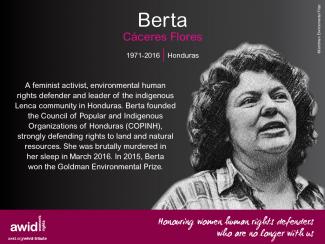
Berta Cáceres Flores
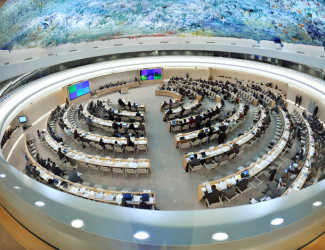
El Consejo de Derechos Humanos (CDH) es el cuerpo intergubernamental del sistema de las Naciones Unidas responsable de la promoción y protección de todos los derechos humanos en todo el mundo. El HRC se reúne en sesión ordinaria tres veces al año, en marzo, junio y septiembre. La La Oficina del Alto Comisionado para los Derechos Humanos (ACNUDH) es la secretaría del Consejo de Derechos Humanos.
Debate y aprueba resoluciones sobre cuestiones mundiales de derechos humanos y el estado de los derechos humanos en determinados países
Examina las denuncias de víctimas de violaciones a los derechos humanos o las de organizaciones activistas, quienes interponen estas denuncias representando a lxs víctimas.
Nombra a expertos independientes que ejecutarán los «Procedimientos Especiales» revisando y presentado informes sobre las violaciones a los derechos humanos desde una perspectiva temática o en relación a un país específico
Participa en discusiones con expertos y gobiernos respecto a cuestiones de derechos humanos.
A través del Examen Periódico Universal, cada cuatro años y medio, se evalúan los expedientes de derechos humanos de todos los Estados Miembro de las Naciones Unidas
Se está llevarando a cabo en Ginebra, Suiza del 30 de junio al 17 de julio de 2020.
AWID trabaja con socios feministas, progresistas y de derechos humanos para compartir conocimientos clave, convocar diálogos y eventos de la sociedad civil, e influir en las negociaciones y los resultados de la sesión.

Panel : Dans le cadre d'une table ronde, explorez une question ou un défi sous différents angles, ou partagez un apprentissage ou une expérience, puis posez des questions à l'auditoire, si le temps le permet.
Talk-show : Organisez une conversation plus spontanée dans le cadre d'un talk-show. Les talk-shows peuvent être une conversation entre plusieurs personnes, animée par un.e présentatrice.eur de talk-show. Les questions du public peuvent déterminer l'orientation de la conversation.
Discussion : Elles peuvent prendre la forme de cafés du monde, de cercles restreints ou fishbowl et d'autres méthodologies qui facilitent l'implication active des participant.e.s dans les conversations. Il s’agit d’un format très participatif.
Atelier : Sessions interactives qui invitent les participant.e.s à acquérir de nouvelles compétences dans tous les domaines de la vie et de l'activisme.
Session stratégique : Il s'agit d'une invitation à réfléchir à une question ou à une stratégie, en profondeur, avec d'autres personnes. Un espace pour apprendre les un.e.s des autres : ce qui fonctionne, ce qui ne fonctionne pas, et comment développer de nouvelles stratégies collectives pour créer les mondes dont nous rêvons.
Cercle de partages (également connu sous le nom de Birds of a Feather) : Idéal pour les petits groupes, dans un cadre plus intime, afin d'écouter les un.e.s et les autres, de susciter la discussion et d'aborder avec soin des sujets qui peuvent être spécifiques, sensibles et complexes.
Arts - Atelier participatif : Activités participatives impliquant les arts et l'expression créative. Qu'il s'agisse d'art visuel, de théâtre, de film, de peinture murale, de danse, de musique, d'artisanat collectif ou de création artistique, etc., nous accueillons toutes les idées célébrant l'art et la créativité féministes en tant que formes de changement social, de guérison, d'expression et de transformation.
Arts - Performances, installations et expositions : Nous accueillons les propositions qui offrent aux participant.e.s du Forum de nouvelles expériences et perspectives, qui élargissent nos horizons et qui nous incitent à penser, ressentir et organiser d'une nouvelle manière.
Guérison : Diverses activités adaptées à la fois aux groupes et aux individus, allant de l'apprentissage de techniques de relaxation à la discussion sur la prévention de l'épuisement professionnel, des pratiques de soins du corps, de l'esprit et de l'âme tenant compte des traumatismes à la guérison et des failles au sein de nos mouvements.
L’AWID a commencé à préparer ce rapport annuel au moment même où la pandémie mondiale commençait à bouleverser nos modes de rassemblement, d’organisation et de vie. Nous ne pouvons donc passer en revue notre travail sans prendre en compte l’influence de la COVID-19 dans notre évaluation.
Téléchargez le rapport annuel 2019 complet (PDF)
Elle est une affirmation urgente de l’existence d’autres façons, plus justes, d’organiser nos vies. En 2019, des centaines de groupes ont partagé avec nous leurs expériences et leurs propositions : des réseaux radicaux de soutien communautaire en Amérique latine, qui facilitent l’avortement autogéré, aux pratiques économiques centrées sur les communautés en Indonésie et aux systèmes alimentaires communautaires en Inde et aux États-Unis, en passant par une réinvention et une nouvelle pratique de rites de passage sans danger en Sierra Leone. Ce sont ces expériences qui traceront la voie d’une « nouvelle norme ».
Pour autant, les historiques d'oppression et de violence peuvent rendre l'imagination des possibles compliquée. Un élément clé de notre travail en 2019 a été d’initier ces pistes via la boîte à outils visant à soutenir les groupes qui cherchent à dénicher des histoires et des aspirations, piliers de propositions féministes.
Au sein de l'Observatoire de l'universalité des droits (OURs), de Feminists for a Bing Treaty (Féministes pour un traité contraignant), de Count Me In ! (Comptez sur moi!) et d’autres alliances, l’AWID n’a pas cessé de contrer le pouvoir débridé des entreprises et les agendas fascistes et fondamentalistes qui mettent à mal les droits des femmes et la justice de genre. Dans un contexte de perspectives sombres pour un changement transformateur par les processus multilatéraux et de capacités limitées à réagir pour la plupart des États, nous redoublons d'efforts pour nous assurer que les mouvements féministes, dans toute leur diversité, soient dotés de ressources adaptées aux rôles majeurs qu'ils jouent – en soutenant leurs communautés, en réclamant des droits et en répondant aux crises. En 2019, nous avons introduit des principes et des approches féministes aux fonds révolutionnaires tels que l'Initiative Spotlight et le Fonds Égalité. Nous avons de plus réussi à mobiliser des ressources via des aides à l’amorçage de réalités féministes, financées par des bailleurs féministes.
À l’heure où nous nous penchons vers l'avenir, le contexte appelle clairement à une transformation de nos stratégies d'organisation :
L’AWID se lance dans un nouveau modèle d'adhésion qui permet un meilleur accès et met l'accent sur les opportunités d'engagement et de connexion entre membres. Nous continuerons d'expérimenter différents outils et processus en ligne pour renforcer notre communauté. Et l'engagement inter-mouvements restera au cœur de notre travail. Nos actions solidaires envers les mouvements et les identités opprimées, même et surtout lorsqu’ils sont marginalisés, sont importantes pour conduire le changement et soutenir des mouvements, inclusifs pour tou·te·s.
Nous sommes résilient·e·s, nous nous adaptons et nous sommes présent·e·s les un·e·s pour les autres. Nous devrons continuer à faire encore mieux. Merci à toutes les personnes qui nous accompagnent dans cette aventure.
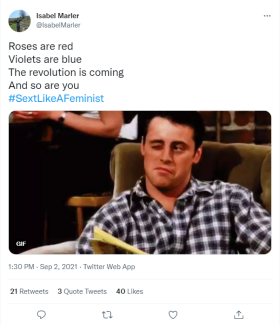
Les fleurs sont en bouton
Le printemps est ici
La révolution gronde
Et toi tu gémis
Pour la première fois, le Forum de l'AWID propose trois modes de participation :
Les participant.e.s se réuniront à Bangkok, en Thaïlande. Nous sommes impatient.e.s de vous y retrouver!
La montée de la droite dans nombre de pays et le déluge de coupes dans les financements frappent durement la société civile de la Majorité mondiale ; le génocide en cours à Gaza, l’intensification des conflits violents au Soudan, la crise climatique à de nombreux endroits de notre planète : nous faisons face à des fascismes qui reviennent en force et un ordre mondial de l’impunité.
Téléchargez le rapport annuel 2024
Ensemble, nous pouvons construire un monde où la justice, la libération et la bienveillance ne sont pas des aspirations, mais des réalités.

Nous vous encourageons à utiliser ce matériel pour soutenir votre plaidoyer.
نرحب بالطلبات عبر مجموعة كاملة من المواضيع والتقاطعات المهمة للحركات النسوية وحركات العدالة الجندرية.
Isabel es una feminista del Reino Unido con más de 10 años de experiencia en respuestas feministas a los fascismos, los fundamentalismos y las tendencias antiderechos. En AWID, su trabajo se centra en la construcción de conocimientos, y ha incluido la conducción de la producción de la serie Derechos en riesgo en colaboración con el Observatorio de la Universalidad de los Derechos. Posee una maestría en Estudios de Género de la Escuela de Estudios Orientales y Africanos (SOAS) y, con anterioridad, trabajó con Women Living Under Muslim Laws (Mujeres que viven bajo leyes musulmanas). Es una apasionada del trabajo entre movimientos, la construcción de conocimientos centrados en los movimientos y el uso de la expresión creativa para desmantelar los sistemas de opresión. Fuera del trabajo, Isabel se mantiene activa en distintos espacios dedicados a la justicia para las personas con discapacidad para el cuidado colectivo, el aprendizaje y la incidencia política.
Zuhour Mahmoud es la estratega de comunicación de Kohl. Es una escritora y editora y una DJ ocasional radicada en Berlín. Su trabajo se centra en los enfoques críticos a la música, la tecnología y la política y sus ciclos de vida en la esfera digital.
Marianne Mesfin Asfaw est une féministe panafricaine qui se consacre à la justice sociale et à la construction communautaire. Elle est titulaire d'une licence en études de genre et en relations internationales de l'Université de la Colombie-Britannique (UBC) et d'un master en études de genre et de droit de l'Université SOAS de Londres. Auparavant, elle travaillait dans l'administration universitaire et le soutien aux étudiant·e·s internationaux·ales, de même qu’à titre de chercheuse et d’animatrice dans des espaces féministes à but non lucratif. Elle a également travaillé et été bénévole auprès d'organisations non gouvernementales, notamment Plan International, dans des rôles administratifs. Avant d'occuper son poste actuel, elle a travaillé dans le soutien logistique et administratif à l'AWID. Elle est originaire d'Éthiopie, a grandi au Rwanda et est actuellement basée à Tkaronto/Toronto, au Canada. Elle aime lire, voyager et passer du temps avec sa famille et ses ami·e·s. Pendant les mois les plus chauds, on peut la trouver en train de se promener dans des quartiers familiers à la recherche de cafés et de librairies obscurs dans lesquels flâner.
On pense souvent que la communication de notre désir se cantonne à l’intimité des quatre murs de nos chambres et à nos relations personnelles. Mais est-il également possible d’envisager ce genre de communication comme étant structurelle, une pratique qui éclairerait notre travail et la manière dont nous sommes, dont nous existons dans le monde?
Obtén más información sobre los próximos eventos de la CSW69 que AWID está coorganizando