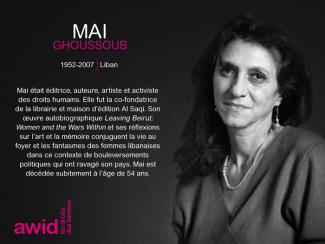
Mai Ghoussoub
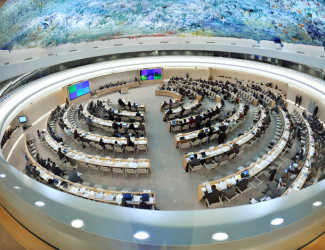
The Human Rights Council (HRC) is the key intergovernmental body within the United Nations system responsible for the promotion and protection of all human rights around the globe. It holds three regular sessions a year: in March, June and September. The Office of the UN High Commissioner for Human Rights (OHCHR) is the secretariat for the HRC.
Debating and passing resolutions on global human rights issues and human rights situations in particular countries
Examining complaints from victims of human rights violations or activist organizations on behalf of victims of human rights violations
Appointing independent experts (known as “Special Procedures”) to review human rights violations in specific countries and examine and further global human rights issues
Engaging in discussions with experts and governments on human rights issues
Assessing the human rights records of all UN Member States every four and a half years through the Universal Periodic Review
AWID works with feminist, progressive and human rights partners to share key knowledge, convene civil society dialogues and events, and influence negotiations and outcomes of the session.
Additional consultation sessions on the Draft Outcome Document


Para fortalecer nuestra voz y poder colectivos para obtener más y mejor financiamiento para las organizaciones feministas, por los derechos de las mujeres y de las personas LBTQI+ y demás organizaciones aliadas de todo el mundo.
Súmate al Women’s Working Group on Financing for Development [Grupo de Trabajo de Mujeres sobre Financiación para el Desarrollo, WWG on FfD en inglés] y entérate de cuáles son sus aportes al proceso de la FpD (también puedes enviar un mensaje electrónico a: wwgonffd@gmail.com).
Únete al Grupo de las OSC en la Conferencia Internacional sobre la FpD (en inglés) o envía un mensaje electrónico a addiscoordinatinggroup@gmail.com pidiendo sumarte: https://groups.google.com/forum/#!forum/global-social-economy).
Otros enlaces importantes para mantenerse informada/o:
We are living in a world where the destruction of Nature fuels our current global economy. |
Even in times of climate crisis, governments continue to encourage large-scale agriculture industries to expand. These activities poison the land, threaten biodiversity, and destroy local food production and livelihoods. Meanwhile, while women produce the majority of our food in the world, they own almost none of the land. |
|
What if we perceived land and Nature not as private property to exploit, but as a whole to live in, learn from, and harmoniously coexist with? What if we repaired our relationships with the land and embraced more sustainable alternatives that nurture both the planet and its communities? Nous Sommes la Solution (We Are the Solution, NSS) is one of many women-led movements striving to do this. This is their story. |
|
Le 11 juillet 2024, nous avons eu une conversation étonnante avec de grandes féministes sur l'état de l'écosystème du financement et le pouvoir du recherche « Où est l'argent ? ».
Un merci spécial à Cindy Clark (Thousand Currents), Sachini Perera (RESURJ), Vanessa Thomas (Black Feminist Fund), Lisa Mossberg (SIDA) et Althea Anderson (Fondation Hewlett).
N'oubliez pas que l'enquête restera ouverte jusqu'au 31 août 2024 !
對於與“論壇活動徵集”有關的任何問題,請與我們聯繫,請使用“論壇活動徵集”作為您電子郵件的主題。
AGROECOLOGY AND FOOD SOVEREIGNTY AS RESISTANCE |
Today, large-scale industrial food production uses single-crop plantations, genetically modified organisms and other pesticides that destroy the land and knowledge of local communities. |
Agroecology is a resistance to corporate-driven agriculture. It prioritizes smaller scale agriculture, multiple crops and diversified food production, and the centering of local knowledge and practices. Agroecology goes hand-in-hand with demands for food sovereignty, or the “right of peoples to healthy and culturally appropriate food produced through ecologically sound and sustainable methods, and their right to define their own food and agriculture systems”(Via Campesina, Declaration of Nyéléni).
The role of women, indigenous and rural communities and people of color from the Global South is absolutely essential when it comes to food systems. Feminist agroecologists are working to dismantle oppressive gender roles and systems of patriarchy embedded within food production. As shown by the heroines of NSS, they are generating a liberatory agroecology by strengthening community resilience, empowering women peasants and farmers, and preserving local traditions, territories, and knowledge of food-producing communities.
開放報名時會公布。

Related content
The Guardian: Kate Millett Obituary
New York Times: Kate Millett, Ground-Breaking Feminist Writer, Is Dead at 82
The New Yorker: A Last Interview with Kate Millett

Non, nous reconnaissons l’importance de votre travail, mais nous ne collectons pas les réponses fournies à titre individuel à l’heure actuelle.