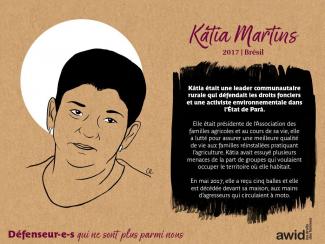
Kátia Martins
Dans le monde entier, les femmes défenseuses des droits humains défendent leurs terres, leurs moyens de subsistance et leurs communautés contre le pouvoir des entreprises et des industries extractives. Elles se mobilisent et défient de puissants intérêts économiques et politiques qui motivent la spoliation de terres, le déplacement de communautés, la perte des moyens de subsistance et la dégradation de l'environnement.
L’extractivisme est un modèle économique et politique de développement qui œuvre à la marchandisation de la nature et privilégie le profit au détriment des droits humains et de l'environnement. Enraciné dans l'histoire coloniale, il creuse les inégalités sociales et économiques au niveau local et mondial. Le plus souvent, les femmes rurales, noires ou autochtones sont les plus touchées par l’extractivisme et sont largement exclues des espaces de prise de décision en la matière. Les femmes se mobilisent pour défier ces forces patriarcales et néocoloniales et défendre les droits, les terres, les personnes et la nature.
Les femmes qui s’opposent aux industries extractives vivent une série de risques, de menaces et de violations de leurs droits comme la criminalisation, la stigmatisation, la violence et l'intimidation. Leurs histoires révèlent des aspects évidents de violences sexuelles et basées sur le genre. Parmi les auteurs de ces abus se trouvent les autorités locales et fédérales, les entreprises, la police, les militaires, les forces de sécurité paramilitaires et privées, et parfois mêmes leurs propres communautés.
L'AWID et la Coalition internationale des femmes défenseures des droits humains (WHRDIC) ont le plaisir d'annoncer la sortie de leur publication « Les défenseuses des droits humains résistent à l’extractivisme et aux pouvoir des entreprises », un rapport basé sur un projet de recherche transrégional qui relate les expériences vécues par des défenseuses en provenance d'Asie, d'Afrique et d'Amérique latine.
Nous encourageons les activistes, les membres de mouvements sociaux, la société civile, les donateurs et les décideurs à lire et à faire usage des documents suivants pour leur travail de plaidoyer, comme outil pédagogique et comme source d’inspiration :
« Les défenseuses des droits humains résistent aux industries extractives : Aperçu des principaux risques et des obligations en matière de droits humains » est une analyse de la situation d’un point de vue du genre. Ce rapport (en anglais, bientôt disponible en français) analyse les formes de violations et les types d'auteurs de ces violations, il reprend les obligations les plus pertinentes en matière de droits humains et formule une série de recommandations politiques à l’intention des États, des entreprises, de la société civile et des donateurs.
« Arrimer la résistance à l'action : Les stratégies des défenseuses des droits humains qui résistent aux industries extractives » est un guide pratique qui décrit des formes créatives et stratégiques d'action, des stratégies qui ont porté leurs fruits et des histoires de résistance inspirantes.
La vidéo « Protéger les personnes et la planète: les femmes qui résistent aux industries extractives. » met en lumière le courage des défenseur-e-s des droits humains d'Afrique, d'Asie et d'Amérique latine. Elles partagent leurs luttes pour la terre et la vie et parlent des risques et des défis auxquels elles sont confrontées dans leur activisme.
« Contester le pouvoir corporatif : Les luttes pour les droits des femmes, la justice économique et la justice de genre » est un rapport de recherche qui décrit les effets du pouvoir des entreprises et offre des perspectives sur des stratégies de résistance.
Faites-nous part de vos commentaires
C’est avec gratitude que l’AWID reconnaît les contributions précieuses de chaque défenseur-e des droits humains qui a participé à ce projet. Cette recherche a été rendue possible grâce à votre volonté à partager vos expériences. Votre courage, créativité et résilience est une source d’inspiration pour nous toutes et tous. Merci !
The estimated time to complete the survey is 30 minutes.
Absolutamente; esas preguntas son opcionales y valoramos tu derecho a la anonimidad. Te pedimos que respondas la encuesta independientemente de tu decisión de compartir el nombre de tu agrupación, organización o movimiento y la información de contacto con AWID.
EN CHIFFRES
Lors de ce 14e Forum, nous célébrerons et amplifierons les réalités féministes autour de nous, à tous les stades de déveoppement !
Nous voulons faire de ce Forum une réalité féministe : un lieu où vous pouvez habiter un monde différent, où vous pouvez rapporter vos victoires et les solutions que vous avez élaborées ; ce qui vous rend plus fortes, pleines d’espoir et prêtes à continuer. Ce rassemblement sera différent de tous ceux auxquels vous avez pu assister par le passé.
Nous vous encourageons fortement à vous joindre à nous pour co-créer ce monde. Cela en vaut la peine !
Chaque Forum a un thème qui reflète les besoins de nos membres et de nos mouvements, et répond à notre analyse du contexte actuel.
Actuellement, les fascismes, les fondamentalismes, les autoritarismes et le pouvoir illimité des entreprises prennent de l’ampleur au niveau mondial. Nous voyons ces menaces converger avec l’État pour façonner les normes publiques, les récits et les politiques, ancrant une culture de la peur, de la haine et de l’incitation à la violence dans les discours publics. Les États, qui étaient autrefois une cible de plaidoyer et de réclamation de droits, n’éprouvent plus de sentiment de responsabilité dans la plupart des cas, et peuvent parfois même être dans l’incapacité de faire respecter les droits.
Le Forum de l'AWID de 2016 s’était focalisé sur les horizons féministes et les conditions prérequises à leur établissement. Il était devenu clair, et reste évident aujourd’hui, que le défi majeur de nombreux mouvements de justice sociale est de réfléchir en dehors du système actuel sur des solutions structurelles. L’imaginaire peut ainsi devenir restreint en raison de longues expériences d’inégalités et d’oppression. Mais ce que nous avions aussi entendu, et que nous observons autour de nous, c’est que les mouvements féministes sont bel et bien en train de vivre et de promouvoir des réalités orientées sur les droits et la justice, ainsi que des solutions à petite et grande échelles.
En l’occurrence, nous voyons l’urgence de mobiliser à partir d’un lieu d’espoir, plutôt qu’à partir d’un plus petit dénominateur commun – un espoir qui se fonde sur la certitude qu’à travers le monde, même imparfaites, existent des expériences et des pratiques qui recouvrent des façons d’être plus justes, et qu’en partageant, renforçant et consolidant ces expériences, nous pouvons contribuer à augmenter leur influence.
Il ne s’agit pas de rêves impossibles, mais de réalités vécues. Ce sens des possibilités déclenche le réexamen et l’appréciation nouvelle des dimensions transformatives de notre travail.
À l’AWID, nous concevons ces réalités féministes comme les exemples vivants des mondes que nous savons possibles. Nous concevons ces diverses réalités féministes comme des revendications et des incarnations d’espoir et de pouvoir. Elles sont ancrées dans les multiples manières de vivre, de penser et de faire autrement, que ce soit au niveau des expressions quotidiennes de nos modes de vie ou nos manières d'être en relations les un.e.s avec les autres ou au niveau de systèmes alternatifs de gouvernance et de justice. Les réalités féministes combattent les systèmes de pouvoir dominants tels que le patriarcat, le capitalisme et la suprématie blanche.
Il s’agit là de propositions puissantes qui nous orientent vers une vision établie de possibilités, et qui nous montrent comment les organisations féministes ouvrent la voie à la justice dans les mouvements et les communautés à travers le monde.
Dans une communauté noire extrêmement marginalisée de Jackson, dans l'État du Mississippi, se tient une expérimentation d’économie solidaire et coopérative via la Cooperation Jackson (Coopération de Jackson). Il s’agit d’un plan ambitieux qui vise à construire une propriété communautaire en dehors des modes de production capitalistes. (en anglais)
En Afrique de l’Ouest, les agricultrices résistent à l’accaparement des terres et refusent les projets d’industrialisation agricole. Elles affirment audacieusement « Nous sommes la solution » à travers une campagne de renforcement des solutions agro-écologiques qui se centre sur les agricultrices et leurs savoirs comme solutions pour nourrir les communautés et atténuer le changement climatique.
Parallèlement en Inde, 5 000 femmes se sont rassemblées pour développer des systèmes communautaires de souveraineté alimentaire basés sur les savoirs locaux, comprenant des banques de céréales et de semences
Les femmes au Mexique ont créé un projet d’économie non monétaire, par et pour les femmes, ainsi que pour toute personne qu’elles connaissent. A El Cambalache, la valeur est équivalente pour tout : les gens échangent des choses dont ils n’ont plus besoin contre d’autres choses désirées comme les savoirs, les compétences et l’entraide que les personnes veulent partager. El Cambalache a été créé sur des valeurs anti-systémiques et anticapitalistes des mouvements sociaux locaux (en anglais et en espagnol)
À Rojava, les Kurdes construisent une démocratie sans État et les femmes kurdes offrent la jinéologie comme cadre de remise en question du patriarcat, du capitalisme et de l’État, et créent des systèmes et des institutions permettant de mettre ce cadre en pratique
Au Royaume-Uni, Arnacho Agony Aunts (Tantes anarcho-agonie) est une émission de conseil sur le sexe et les rencontres, réalisée à partir d’une perspective féministe, antifasciste et anarchiste. Les animatrices Rowan et Marijam récupèrent un espace de l’ultra droite en donnant aux gens (principalement des hommes) un espace pour poser des questions délicates dans un cadre sans jugement (en anglais)
Le projet African Feminist Judgement (Jugement féministe africain) élabore et diffuse des jugements alternatifs pour des cas importants de jurisprudence en Afrique sur une variété de cas juridiques. Le cœur du projet consiste à s’appuyer sur une pratique judiciaire féministe et des jugements féministes alternatifs pour contribuer à la jurisprudence africaine, aux pratiques légales et aux décisions judiciaires (en anglais)
La coopérative Usha en Inde a été fondée à un moment où les banques conventionnelles refusaient de fournir des services aux travailleurs·ses du sexe à Sonagachi. Les travailleurs·ses du sexe se sont organisé·e·s pour prioriser leurs préoccupations économiques et mettre en place leur propre institution financière. La coopérative Usha est une banque coopérative qui réunit plus de 20 000 travailleurs·ses du sexe et a fourni plus de 4,7 millions d’USD de prêts à 7 231 travailleurs·ses du sexe sur une année. Les membres sont tou·te·s des travailleurs·ses du sexe et la banque procure une réelle possession et influence sur la gouvernance et la gestion de la coopérative, innovant en matière de moyens offerts aux individus et communautés marginalisés pour renforcer leur pouvoir économique, selon leurs propres conditions.
À Porto Rico, une fiducie foncière communautaire aide à transformer une installation informelle située à proximité d’un canal pollué et propice aux inondations, en une communauté durable. Cela fournit un nouveau modèle d’amélioration des installations informelles dans les villes, sans pour autant les rendre hors d’atteinte pour les résident·e·s d’origine.
Dans de nombreux pays d’Amérique latine, les activistes fournissent des conseils et de l’accompagnement entre pairs sur l’avortement médical, réclamant le droit des femmes à disposer de leur corps et des savoirs médicaux. (pour des raisons de sécurité, aucun lien n’est fourni)
En savoir plus sur ces point d'ancrage thématiques
Nous attendons du Forum 2020 qu’il :
Construise le pouvoir des réalités féministes en nommant, célébrant, amplifiant et contribuant à créer un élan autour des expériences et des propositions qui mettent en lumière ce qui est possible tout en nourrissant nos imaginaires collectifs.
Réapprovisionne les sources d’espoir et d’énergie en tant que carburants nécessaires à l’activisme pour les droits et la justice, et à la résilience.
Renforce la connectivité, la réciprocité et la solidarité entre une diversité de mouvements féministes ainsi qu’avec d’autres mouvements orientés vers les droits et la justice.
Le Forum se veut bien plus qu’un événement de quatre jours. C’est un arrêt de plus dans un parcours de renforcement de mouvement autour des réalités féministes, lequel a déjà commencé et continuera bien au-delà des dates du Forum.
L’analyse des réponses nous permettra de tirer des conclusions et de définir des tendances. Les résultats seront présentés à l’occasion du 15e Forum international de l’AWID à Bangkok, et en ligne, en décembre 2024. Inscrivez-vous ici pour participer au Forum!
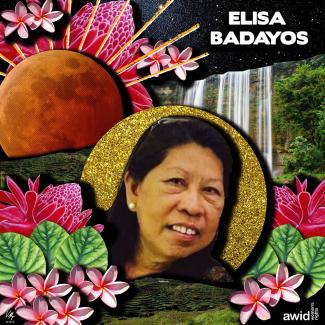
También era organizadora de comunidades urbanas empobrecidas de la Provincia de Cebú, y trabajaba con Desaparecidos, una organización de familiares de personas desaparecidas.
Elisa y dos de sus colegas fueron asesinadxs el 28 de noviembre de 2017 por dos hombres no identificados en Barangay San Ramón, en la ciudad de Bayawan de la Provincia de Negros Oriental, durante una misión que investigaba presuntas violaciones de derechos territoriales en la zona.
La sobreviven cuatro hijxs.
AWID正在努力使論壇成為一個真正的全球性聚會,保障來自不同運動、地區和年齡層的參會者都可以參與。鑑於此,AWID為參與者調集資源並提供有限數量的機會補助金,以幫助她們支付參加論壇的費用。
第14屆AWID國際論壇將於2021年1月11日至14日在台灣台北舉行。
對於此AWID論壇來說,機會補助金不需要任何額外申請的過程。

此外,AWID將補助論壇所在地區近100名參與者之論壇參與經費。本論壇的各委員會之成員(內容與方法委員會、障礙消弭委員會和在地委員會)和藝術工作群組,也將是我們參與經費補助的被補助者之一。
我們在資助建議頁面上列出了有關如何資助您參加AWID論壇的其他資源。