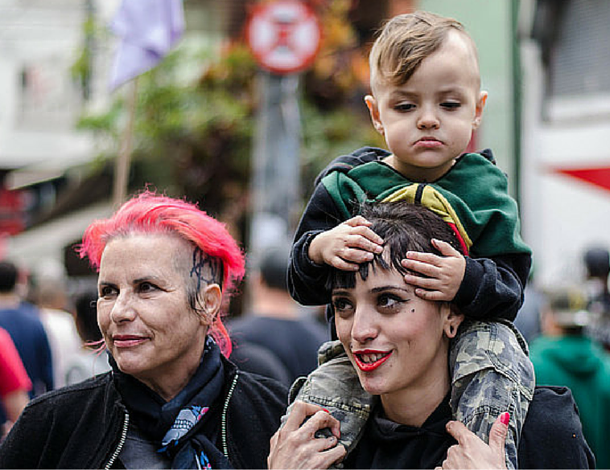
Flickr/Leonardo Veras (CC BY 2.0)

Analyses Spéciales

L´AWID est une organisation féministe mondiale qui consacre ses efforts à la justice de genre, au développement durable et aux droits humains des femmes

Protection de la famille

Contexte

Au cours des dernières années, nous avons observé une nouvelle tendance inquiétante dans les espaces internationaux consacrés aux droits humains. Les discours axés sur « la protection de la famille » sont en effet utilisés pour défendre des violations des droits de membres de la famille, pour renforcer et justifier l’impunité des auteurs de ces violations et pour restreindre l’égalité des droits au niveau de la vie familiale. 

La campagne en faveur de la « Protection de la famille » est motivée par une volonté conservatrice d’imposer des conceptions « traditionnelles » et patriarcales de la famille et de priver les membres de la famille de leurs droits pour les transférer à « l’institution familiale ».

Les initiatives visant à la « Protection de la famille » reposent sur :

  • la montée du traditionalisme,
  • la montée du conservatisme culturel, social et religieux,
  • l’existence d’une hostilité vis-à-vis des droits humains des femmes, des droits sexuels, des droits des enfants et enfin des droits des personnes dont l’identité de genre et l’orientation sexuelle ne sont pas conformes aux normes.

Depuis 2014, un groupe d’Etats travaille de front dans les espaces dédiés aux droits humains sous le nom de « Group of Friends of the Family » (Groupe des ami-e-s de la famille) ; des résolutions sur la « Protection de la famille » ont été adoptées chaque année depuis 2014.

Ce programme s’est propagé au-delà du Conseil des droits humains. Nous avons observé l’introduction d’un discours régressif autour de la « famille » à la Commission sur la condition de la femme, ainsi que des tentatives d’introduction dans les négociations sur les Objectifs de développement durable.


Notre approche

L’AWID travaille avec des partenaires et des allié-e-s pour s’opposer ensemble à la « Protection de la famille » et à d’autres programmes régressifs et défendre l’universalité des droits humains.

En réponse à l’influence croissante d’acteurs régressifs au sein des espaces dédiés aux droits humains, l’AWID a rejoint des allié-e-s afin de créer l’Observatoire sur l'Universalité des droits (OURs) (site en anglais). L’OURs est un projet de collaboration qui surveille, analyse et diffuse les informations concernant les initiatives anti-droits telles que la « Protection de la famille ».

Le premier rapport de l’OURs, Nos droits en danger, trace une cartographie des acteurs et actrices qui constituent le lobby mondial anti-droits et identifie leur réthorique et stratégies clés ainsi que leur impact sur les droits humains.  

Le rapport précise que le programme de « Protection de la famille » a développé une collaboration entre un large éventail d’acteurs régressifs aux Nations Unies, qu’il décrit comme « un cadre stratégique abritant des positions anti-droits et patriarcales multiples, où le cadre vise entre autres à légitimer et institutionnaliser ces positions. »
Contenu lié

Références intéressantes

Découvrez ces projets élaborés par les équipes de l'AWID pour promouvoir le plaidoyer et les perspectives féministes.

Our neighbourhood, our network, our strength

by Marta Plaza Fernández, Madrid, Spain (@gacela1980)

The feminist reality that I want to share is about weaving networks in which we uphold one another. Networks which come together in different ways, which emerge from our shared vulnerability, and which make all of us stronger.


The streets of Chamberí, my neighbourhood in Madrid, became much more of a home following the gatherings in the plazas organized by the citizens movement that originated in a rally on May 15, 2011. I think about how, during those years, we met each other and were able to associate faces, voices, smiles with so many neighbours who previously were only silhouettes without names or pasts, and who we passed by without seeing or hearing each other. I think about how we’ve become involved and dedicated; how we’ve woven a palpable, tangible community; how we’ve been advancing hand in hand towards building a new more inhabitable world, which we want and that we urgently need to create.

A group of activists and utopian neighbours, (in the best sense of the word utopian) – that moves us to action to do something real – that group for me was practically the first that reacted differently when I shared a part of my history and identity with them. With these women I shared my psychiatric diagnosis, my multiple hospital stays, the number of daily pills that accompanied me, my disability certificate, my difficulty in preserving that vital link that periodically disintegrates in my hands.

These neighbours, friends, comrades, links, loves –did not only not distance themselves from me once they got to know someone who many others had labelled as problematic, manipulator, egotistical – but became my principal network of affection and mutual support. They decided to navigate with me when the sea became agitated with storms. These people have given a different meaning to my days.

Building our feminist reality also encompasses carrying the “I believe you, sister” that we use when a friend has suffered a macho attack to the violence experienced by psychiatrized women at the hands of the very psychiatric system and institutions that are supposed to help us (and instead are often the new abuser who traumatizes and hurts us all over again). And this reality must include respect for our decisions, without taking away our agency and capacity to direct our own steps to one space or another; to listen to our narratives, desires, needs…without trying to impose others that are alien to us. It means not delegitimizing our discourse, not alluding to the label of our diagnosis, nor our madness.

With these transformation, each stay in the psychiatric institute did erase the ties that we had been able to build, but instead this network stayed by my side, its members took turns so that each day there would be no lull in calls, in visits, so that I could feel them as close as one can feel another person separated by locked doors (but unfortunately open for abuse) within the confines of the psychiatric ward. Through the warmth and kindness from my people I could rebuild that vital link that had once again been broken.

The even bigger leap happened when I was already aware of the numerous violent acts and abuse (where among other assaults, I spent days strapped to a bed, relieving myself where I lay),  I decided that I would not go back to being interned.

This network of care, these women neighbours-friends-loves-comrades, they respected my refusal to return to the hospital and supported me through each crisis I’ve been through since then. Without being interned, without violence.

They took turns accompanying me when my link to life was so broken that I felt such a huge risk which I couldn’t handle on my own. They organized WhatsApp group check-ins. They coordinated care and responsibilities so that no one would feel overwhelmed - because when an individual feels overloaded, they make decisions based on fear and the need for control instead of prioritizing accompaniment and care.

That first crisis that we were able to surmount together in this way – without being admitted to the psychiatric institute, represented a dramatic change in my life. There were months when my life was at risk, of intense suffering and of so much fear for my people and for me. But we overcame it together, and all that I thought was that if we could get over that crisis, then we could also find ways to face all the difficulties and crises that may come.

These feminist realities that we’re building day by day keep expanding, growing and taking different forms. We’re learning together, we’re growing together. Distancing ourselves from a welfare mentality, one of the first lessons was that, in reality, there wouldn’t be anyone receiving care (because of a psychiatric label) or anyone helping, from the other side of the sanity/insanity line. We learnt – we’re learning – to move to a different key – that of mutual support, of providing care and being cared for, of caring for each other.

We’ve also explored the limits of self care and the strength of collectivizing care and redistributing it so it’s not a burden that paralyzes us; we learnt – and we keep learning today – about joy and enjoying care that is chosen.

Another recent learning is about how difficult it was to start integrating money as another component of mutual support that we all give and receive. It was hard for us to realize how internalized capitalism kept on reverberating in our relationship with money, and that even though no one expected any payment for the containers of lentils we cooked amongst us when eating and cooking were difficult tasks, our expectation regarding money was different. Phrases like “how much you have is how much you’re worth” become stuck inside of us without critically analyzing them. It’s easy to keep thinking that the money each one has is related to the effort made to earn it, and not due to other social conditioning distant from personal merit. In fact, within this well-established mutual support network – redistributing money based on needs without questioning – was still a remote reality for our day to day. That’s why this is something that we’ve recently started to work on and think through as a group.

We want to get closer to that anti-capitalist world where mutual support is the way that we have chosen to be in the world; and that entails deconstructing our personal and collective relationship with money and internalized capitalism.

In these feminist realities we also know that learning never stops, and that the road continues to be shaped as we travel upon it. There is still much to do to keep caring for ourselves, to keep expanding perspectives and to make ourselves more aware of the persistent power imbalances, of privileges that we hold and continue to exercise, without realizing the violence that they reproduce.

Though we’ve already travelled so far, we still have a long way to go to get closer to that new world that we hold in our hearts (and for some within our crazy little heads too). Racism, classism, adult-centrism, fat-phobia, and machismo that persists among our partners.

Among the pending lessons, we’ve needed for a long time already to build a liveable future in which feminism is really intersectional and in which we all have space, in which the realities and oppressions of other sisters are just as important as our own. We also need to move forward horizontally when we build collectively – getting rid of egos, of protagonisms, to live together and deal with the need for recognition in a different way. And to also keep making strides grounded in the awareness that the personal is always, always political.

How we relate to and link with each other cannot be relegated to the private domain, nor kept silent: other loves are possible, other connections and other families are necessary, and we are also inventing them as we go.

This new world which we want to create, and that we need to believe in – is this kind world – in which we can love, and feel pride in ourselves – and in which all worlds will fit. We’ll keep at it.


“Healing Together”

by Upasana Agarwal, Kolkata, India (@upasana_a)

Looking at activists and feminists as healers and nourishers of the world, in the midst of battling growing right wing presence, white supremacy and climate change. This piece highlights how our feminist reality puts kindness, solidarity, and empathy into action by showing up and challenging the status quo to liberate us all. 

Upasana Agarwal (@upasana_a)


Body

Y aura-t-il des mesures d’accessibilité au Forum ?

En un mot : oui ! L’AWID collabore actuellement avec un Comité d’accessibilité pour veiller à ce que le Forum soit aussi accessible que possible. Nous évaluons actuellement également l’accessibilité du lieu où se tiendra le Forum, des hôtels alentours et des transports. Des informations détaillées sur l’accessibilité lors du Forum de l’AWID seront disponibles dans cette section avant l’ouverture des inscriptions. Si vous avez des questions d’ici là, n’hésitez pas à nous contacter.

Snippet The revolution will be feminist_Fest (EN)

Plenary session:

The revolution will be feminist—or it won’t be a revolution

Manal Tamimi Palestine
Bubulina Moreno, Colombia
Karolina Więckiewicz, Poland
Anwulika Ngozi Okonjo, Nigeria

watch plenary


Exposition Pleasure Garden

Cette œuvre est la collaboration photographique et illustrative réalisée par Siphumeze et Katia pendant le confinement. Elle se penche sur les récits de sexe et de plaisir des queers noirs, le bondage, le sexe protégé, les jouets, la santé mentale et le sexe et bien d'autres choses encore. Elle a été créée pour accompagner l'anthologie Touch.

Mental Health
Mental Health (Santé mentale)
Sex and Spirtuality
Sex and Spirtuality (Sexe et spiritualité)
Orgasm
Orgasm (Orgasme)

À propos des artistes

Siphumeze Khundayi portrait

Siphumeze Khundayi est une créatrice d'art, photographe et animatrice qui s'intéresse aux moyens créatifs de réunir le dialogue et la pratique artistique en relation avec l'identité queer africaine. 

Elle est directrice créative de HOLAAfrica!, un collectif panafricaniste féministe en ligne.

Ses travaux de performance en solo et collaboratifs ont été présentés dans un certain nombre de festivals et d'espaces théâtraux tels que le festival Ricca Ricca au Japon.

Elle a mis en scène deux productions nominées aux Naledi Awards en 2017 et 2018. Elle a aussi mis en scène un spectacle qui a remporté un prix Standard Bank Ovation en 2020.
En tant que photographe, elle a participé à une exposition de groupe intitulée Flowers of my Soul (Fleurs de mon âme) en Italie, organisée par le Misfit Project. Elle a produit trois publications pour HOLAAfrica et a été publiée dans le deuxième volume, pour lequel elle a fourni la couverture: As You Like des Gerald Kraak Anthologies.

katia portrait

Katia Herrera est une artiste visuelle numérique de 21 ans originaire de la ville bruyante de Saint-Domingue, en République dominicaine. Bien que Herrera soit une introvertie autoproclamée, ses œuvres d'art sont remarquablement fortes dans un monde qui tente de faire taire les voix des personnes noires. Avec des titres comme Black Woman (Femme Noire), You Own the Moon (La Lune t’Appartient), Earth Goddess (Déesse de la Terre), Forever (Pour Toujours) et Universe Protector (Protecteur.rice de l’Univers), l'héritage de Herrera sera marqué par sa volonté passionnée de mettre en lumière l'endurance et la persévérance des Noir·e·s d'hier et d'aujourd'hui, afin de contrer le discours selon lequel la peau noire ne devrait être associée qu'à l'esclavage.

L'une de ses œuvres la plus belle et la plus vivante, Universe Protector, dépeint l'âme noire comme une entité divine pleine de force, de puissance et de grandeur. C’est dans sa jeunesse que son amour du graphisme a été stimulé grâce à l'art de ses parents et le Photoshop qu'ils avaient téléchargé sur leur ordinateur pour leur photographie professionnelle.

أنا ممول/ة أو مانح/ة فردي/ة. كيف يمكنني دعم منتدى جمعية حقوق المرأة في التنمية؟

ندعوك للتواصل معنا بشأن طرق المشاركة الهادفة في المنتدى.

Snippet Festival Day 5, 6 Fest (ES)

Day, jour, día 5 festival - Sept. 11, 2021
Asamblea Placentera: Tejiendo Proyectos Feministas Colaborativos

Ghiwa Sayegh, Kohl: A Journal for Body and Gender Research
J. Daniel Luther 
Jessa Jordan
María Florencia Alcaraz
Nazlee Saif Arbee


De brujeria, chamanismo y otros conocimientos insurrectos contra el patriarcado

Sofía Blanco Sixtos, Colectiva Feminista MAPAS


Day, jour, día 5 - Sept. 12, 2021
Imaginarios feministas:
un taller para jóvenes feministas

Nino Ugrekhelidze, AWID
Jorge Davila Akinyi Osanjo


Artivismo: un arma de resistencia política feminista en el contexto haitiano

Pascale Solages, Nègès Mawon
Souzen Joseph, Nègès Mawon
Gaëlle Bien-Aimé, Nègès Mawon


ver video (inglés)


Taller
Poesía del placer

by Wana Udobang


Taller
La prisión no es feminista:
Una exploración del impacto y las alternativas a la dependencia de la policía y el encarcelamiento

Chanelle Gallant
Kai Cheng Thom

ver video (inglés)

Nicole Barakat

nicole barakat -verge exhibition april 2018
We transcend time and place, Hand cut found paper (2017)
nicole barakat -verge exhibition april 2018
We will remember who we are and We will persist Cotton embroidered hand cut lamé on wool silk cloth (2018)
nicole barakat -verge exhibition april 2018
​​We will return home, Silk embroidered hand cut lamé on cotton velveteen (2018)
verge march 18 - document photography
We will heal in the now, Hand cut silk, wool, lamé, cotton, direct digital print silk satin on linen (2018)


we are infinite

An exhibition by Nicole Barakat, embodying her reconnection with the diaspora of objects from her ancestral homelands in the South West Asia and North Africa (SWANA) region.
 
Barakat presents a collection of textile works as manifestations of her practice of engaging with displaced, and often stolen objects held within Western museum collections including the Louvre, British Museum and Nicholson Museum. 
 
To by-pass the gatekeepers and breach the vitrines holding these ancestral objects, Barakat reclaims pre-colonial, non-linear, receptive forms of knowing that are often devalued and dismissed by colonial and patriarchal institutions - engaging with coffee cup divination, dream-work, intuitive listening and conversations with the objects themselves (source).

About Nicole Barakat

Nicole Barakat portrait
Nicole Barakat is a queer femme, SWANA artist born and living on Gadigal Country (so-called Sydney, Australia). She works with deep listening and intuitive processes with intentions to transform the conditions of everyday life. Her work engages unconventional approaches to art-making, creating intricate works that embody the love and patience that characterises traditional textile practices. 

Her works include hand-stitched and hand-cut cloth and paper drawings, sculptural forms made with her own hair, cloth and plant materials as well as live work where she uses her voice as a material. 

Nicole’s creative practice is rooted in re-membering and re-gathering her ancestral knowing, including coffee divination and more recently working with plants and flower essences for community care and healing. 
Main image
AWID-CSW_header.png
Body

هل تقدم جمعية حقوق المرأة في التنمية منح لحضور المنتدى؟

سيقدم صندوق الوصول الخاص بنا عددًا محدودًا من المنح الدراسية لتمويل مشاركة النشطاء/ الناشطات الذين/ اللواتي لا يستطيعون القيام بذلك، وليس لديهم/ن علاقات مع الممولين/ات الذين/ اللواتي يمكنهم/ن تغطية مشاركتهم/ن. لذلك إذا كان لديك احتمالات أخرى، يرجى استكشافها. سنبذل قصارى جهدنا لتقديم أكبر عدد ممكن من المنح الدراسية، وسنشارك المزيد من المعلومات حول هذه العملية وكيفية التقديم لاحقًا في أوائل العام 2024.

Snippet Festival Days 8-13_Fest (FR)

Day, jour, día 8 festival - Sept. 16, 2021
Panneau
Plaisir corporel pour les grosses 

Amy Lin

regardez la vidéo


Atelier
Élargir le plaisir

Hedone

regardez l'atelier


Atelier
La campagne #emptychairs (chaises vides)

Caroline Tagny, Coalition of African Lesbians
Carrie Shelver, Sexual Rights Initiative
Emeline Dupuis, Sexual Rights Initiative
Pooja Badarinath, Sexual Rights Initiative
Pooja Patel, International Service for Human Rights
Antje Schupp


Atelier
Réalités féministes:
Maisons de repos et de soin pour les défenseures

Ana María Hernández Cárdenas, Consorcio Oaxaca
Nallely Tello Méndez, Red Nacional de Defensoras de Derechos Humanos en México
Jelena Dordevic Liana Funes, National Network of Women Human Rights Defenders in Honduras
Rebeca Girón
Tania Lopes Muri, Movimento de Mulheres da Região dos Lagos
Rogéria Peixinho


Fem Movement:
Soirée dansante Extravaganza pour les membres

DJ Cozmic Cat


Day, jour, día 9 festival - Sept. 17, 2021
Conte
Conte- Education sans entraves:
L’histoire de Fatoumata

Lina Baaziz

regardez la vidéo


Instagram Live:

L’éducation sexuelle

Oloricoitus

apprendre encore plus


Atelier
Les voix du premier rang:
Renforcer le pouvoir collectif pour en finir avec l’incarcération des femmes à travers le monde


Claudia A. Cardona, Mujeres Libres Colombia
Phyllis Hardy, National Council for Incarcerated and Formerly Incarcerated Women and Girls
Grace Natalia, Womxn’s Voice and Women and Harm Reduction International Network
Mónica Marginet Flinch, Metzineres
Kenya Cuevas, Casa de las Muñecas Tiresias A.C.
Dawn Harrington, Free Hearts

regardez l'atelier


Atelier
Le mouvement comme guérison
Guérison pour les mouvements


Kimalee Phillip
Luz Stella Uspina Murillo, Fondo Acción Urgente para América Latina y el Caribe
Sara Munarriz-Awad, Fondo Acción Urgente para América Latina y el Caribe
Tai Pelli
Everdith (Evie) Landrau


Atelier
Leadership féministe émergent :
la réussite solidaire

Deborah A, Black LGBTQ Migrant Project (BLMP)
Anima Adjepong, Silent Majority
Maame Adwoa Marfo, FRIDA
Debbie Owusu-Akyeeah, Canadian Centre for Gender and Sexual Diversity


Day, jour, día 10 festival
Panneau
Le plaisir au-delà des frontières

Lindiwe Rasekoala
Lizzie Kiama
Jovana Drodevic
Malaka Grant

regardez la vidéo


Panneau
Réalités de l’avortement :
Stratégies pour combattre l’injustice reproductive

Lindiwe Rasekoala
Lizzie Kiama
Jovana Drodevic
Malaka Grant


Day, jour, día 11, festival
Atelier
Construction de réseaux et de solidarité parmi les jeunes organisatrices féministes

Nino Ugrekhelidze, AWID
Anwulika Ngozi
Okonjo Pooja Singh


Panneau
Survivre à la guerre contre la drogue

Ganna Dovbakh, Eurasian Harm Reduction Association (EHRA)
Priscila Gadelha, Rede Nacional de Feministas Antiproibicionistas (RENFA)
Veronica Russo, Red Latinoamericana y del Caribe de Personas que Usan Drogas (LANPUD)
Diana Edem, Heartland Alliance International
Judy Chang, International Network of People who Use Drugs (INPUD)
Louise Vincent, NC Urban Survivors Union
Aura Roig, Metzineres
Malicia, Live Artist

regardez la vidéo


Panneau
Les jeunes féministes pour le climat créant des avenirs radicaux: Lancement vidéo et conversation

Sanam Amin, Asia Pacific Forum on Women, Law and Development
Maggie Mapondera, Womin African Alliance
Maria Alejandra Escalente, FRIDA
Patricia Miranda Wattimena, Asia Indigenous Peoples Pact
Mara Dolan, WEDO
Andrea Vega Troncoso, WEDO

regardez la vidéo


Atelier
Antal: univers non binaire

Malicia Sabina, Resistencia No Binarix
Andras Yareth Hernández, Resistencia No Binarix

regardez la vidéo


Day, jour, día 12, festival
Panneau
Merci, je peux prendre mes propres décisions

Grace Chang, Taiwan Association for Disability Rights
Angel Hsu, Taiwan Association for Disability Rights
Joyann Peng, Taiwan Association for Disability Rights
Amy Wu, Taiwan Association for Disability Rights

regardez la vidéo


Panneau
Apprentissages féministes sur la sécurité numérique en temps de crise sociopolitique et sanitaire

Paul Nail Ojeda
Paola Moss


Atelier
L’état actuel des forêts:
quel est le problème et pourquoi est-ce si important?

Camila Romero, VientoSur
Kanta Marathe, Navrachna Samaj Sevi Sansthan
Jeanette Sequeira, Global Forest Coalition

Download Resources  Descargar Recursos  Télécharger les Ressourceses

Visite du salon des membres de l’AWID

Jessica Whitbread, AWID


Day, jour, día 13 festival
Atelier
Soutenir l’autogestion: 
doulas, accompagnantes, assistance téléphonique et réseaux radicaux de soutien à l’avortement

Aditi Pinto, Inroads
Daniela Tellez Del Valle, Di RAMONA
Sandra Cardona, Necesito Abortar México
Mickreen Adhiambo, Aunty Jane Hotline and MAMA Network
Zachi Brewster, Dopo Abortion Support
Ika Ayi, Samsara

regardez la vidéo


Atelier
Partage de compétences de jeunes féministes: 
comment financer vos idées

Nino Ugrekhelidze, AWID
Cassie Denbow
Nida Mushtaq


"Yo Imposible"
Projection & Discussion avec des cinéastes d'Amérique latine et d'Amérique centrale du Club de cinéma féministe de l'AWID

Alejandra Laprea
Patricia Ortega
Alejandra Henriquez
Maria Torrellas
Carolina Reynoso
Camila Rodó
Micol Mtzener
Giovana Garcia

Tendencias anti-derechos en los sistemas regionales de derechos humanos

Chapter 6

En la Comisión Africana y en el Sistema Interamericano, los actores antiderechos impulsan nociones esencialistas de cultura y género para impedir el avance de los derechos y socavar las responsabilidades. Como vemos, los actores anti-derechos están ejerciendo su influencia sobre los sistemas regionales de derechos humanos, así como en los espacios internacionales.

2019 JUN 27 Meeting of the Summit Implementation Review Group in Colombia
© Juan Manuel Herrera/OAS/Flickr
2019 JUN 27 Reunión del Grupo de Revisión de la Implementación de Cumbres en Colombia

La Comisión Africana de Derechos Humanos y de los Pueblos ha comenzado a definir a los derechos sexuales y de las mujeres como un menoscabo a su capacidad de ocuparse de los «derechos reales» y como contrarios a los «valores africanos», con lo cual se establece un precedente anti-derechos preocupante. La anulación del estatus de observador de la Coalición de Lesbianas Africanas es un ejemplo de esta tendencia y muestra la forma en que el espacio para el involucramiento feminista panafricanista está siendo restringido.

En la Organización de Estados Americanos (OEA) y en el Sistema Interamericano de Protección de los Derechos Humanos, las estrategias anti-derechos incluyen la oenegización de grupos religiosos, la utilización de discursos seculares, y la cooptación de marcos de discriminación. La influencia antiderechos se ha materializado de diversas maneras, que incluyen la intimidación de activistas trans y la obstrucción de la introducción de lenguaje progresista en las resoluciones.

Índice de contenidos

  • Silenciamiento de feministas en el Sistema Africano de Derechos Humanos
  • Grupos anti-derechos en América Latina: Asamblea General de la Organización de Estados Americanos (OEA) y el Sistema Interamericano de Protección de los Derechos Humanos

Leer el capítulo completo

لقد تقدمت بطلب للمشاركة في المنتدى السابق، هل أحتاج إلى إعادة التقديم؟

نعم من فضلك. لقد تغير العالم منذ عام 2021 ونحن ندعوك لتقديم مقترح يعكس واقعك وأولوياتك الحالية.