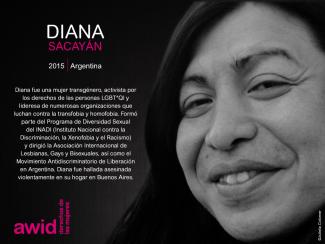
Diana Sacayan
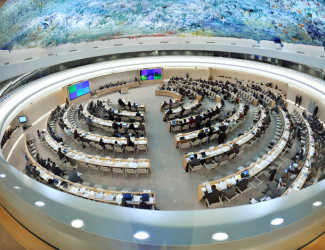
Le Conseil des droits de l'homme (CDH) est un organe intergouvernemental clé du système des Nations Unies, responsable de la promotion et la protection des droits humains autour du globe. Il se réunit trois fois par an en session ordinaire, en Mars, Juin et Septembre. Le Bureau du Haut-Commissariat des Nations Unies aux Droits de l’Homme (HCDH) constitue le secrétariat pour le CDH.
Débat et adopte des résolutions sur les questions globales des droits humains ainsi que sur la situation des droits humains dans des pays particuliers
Examine les plaintes des victimes de violations des droits humains et des organisations activistes, au nom des victimes de violations des droits humains
Nomme des experts indépendants (que l'on connaît sous le nom de « Procédures Spéciales ») pour réviser les cas de violation des droits humains dans des pays spécifiques, ainsi que pour examiner et suivre des questions globales relatives aux droits humains
Prend part à des discussions avec les experts et les gouvernements sur les questions de droits humains
Évalue les bilans des États membres de l'ONU en matière de droits humains tous les quatre ans et demi, dans le cadre de l'examen périodique universel.
La prochaine session du CDH a lieu à Genève, en Suisse, du 30 juin au 17 juillet 2020.
AWID travaille avec des partenaires féministes, progressistes et du domaine des droits humains pour partager nos connaissances clé, convoquer dialogues et évènements avec la société civile, et influencer les négociations et les résultats de la session.
Voulez-vous vous inspirer des stratégies de résistance créatives des féministes du monde entier ? Souhaitez-vous découvrir des initiatives féministes qui nous montrent comment nous pouvons tou.te.s vivre dans un monde plus juste ? Voulez-vous en savoir plus sur les modèles de soins et de guérison féministes à apporter à votre propre communauté ? Est-ce un oui retentissant que nous entendons ? OUI!
Alors consultez Crear | Résister | Transform : un festival pour les mouvements féministes. Ce festival s'est déroulé virtuellement tout au long du mois de septembre 2021 sur toutes les plateformes de l'AWID, et vous pouvez désormais en faire l'expérience à votre rythme.
Les sessions ci-dessous sont pour vous et tou.te.s les incroyables militant.e.s féministes et de justice sociale que vous connaissez. Rassemblons-nous pour partager nos stratégies de résistance, co-créer de la magie féministe et transformer ce monde ensemble.
Nous constatons une implication sans précédent des acteurs anti-droits dans les espaces internationaux consacrés aux droits humains. Pour être plus efficaces et plus audibles, les acteurs anti-droits œuvrent à la constitution d’alliances tactiques qui regroupent différents secteurs et confessions et franchissent les frontières régionales et nationales.
Cette « alliance impie » entre des acteurs traditionalistes issus de milieux catholiques, évangéliques, mormons, orthodoxes russes et musulmans s’est construite autour d’une cause commune qui se concrétise dans un certain nombre de thèmes de discussion et d’efforts communs de plaidoyer visant à réduire à néant les progrès obtenus par les féministes en matière de droits sexuels au niveau international.
Activités clés : en tant que gouvernement de l’Église catholique romaine, le « Saint-Siège » utilise son statut unique d’État observateur permanent auprès de l’ONU pour faire pression en faveur de visions conservatrices, patriarcales et hétéronormatives de la féminité, de l’identité de genre et de la « famille ». Il promeut des politiques anti-avortement et anti-contraception.
Basé à : la Cité du Vatican, Rome, Italie.
Affiliation religieuse : catholique.
Connexions avec d’autres acteurs anti-droits : groupes chrétiens américains ; alliances interreligieuses orthodoxes ; OSC catholiques.
Activités clés : l’OCI se définit comme la « voix collective du monde musulman » et agit comme un bloc d’États au sein des Nations Unies. Elle tente d’ouvrir des brèches dans le système de protection des droits humains en s’appuyant sur des références à la religion, à la culture ou à la souveraineté nationale. Elle promeut le concept de « famille traditionnelle » et contribue à la mise en place d’un régime parallèle de droits humains doté d’un caractère plus restrictif (voir par exemple la Déclaration du Caire de 1990 sur les droits humains dans l’Islam).
Basé à : Djeddah, Arabie Saoudite.
Affiliation religieuse : musulmane.
Connexions à d’autres acteurs anti-droits : missions des États ultraconservateurs auprès de l’ONU, par exemple la Russie.
Activités clés : conférences internationales et régionales ; production et diffusion de recherches et de connaissances ; lobbying auprès des Nations Unies pour « défendre la vie, la foi et la famille ».
Basé à : Rockford, Illinois, États-Unis.
Affiliation religieuse : prédominance catholique et chrétienne évangélique.
Connexions à d’autres acteurs anti-droits : le Sutherland Institute, un groupe de réflexion conservateur ; l’Église des Saints des Derniers Jours ; le département de la famille et de la vie de l’Église orthodoxe russe ; les prêtres catholiques anti-avortement et pro-vie ; la Fondation pour la culture et le patrimoine africains ; la Fédération polonaise des mouvements pro-vie ; la Fédération européenne des associations de familles catholiques ; le Comité des ONG de l’ONU sur la famille ; le Réseau politique pour les valeurs ; la Société démographique géorgienne ; des parlementaires polonais, moldaves, etc. ; FamilyPolicy ; l’Institut russe d’études stratégiques ; HatzeOir ; C-fam ; et d’autres encore.
Activités clés : lobbying auprès des Nations Unies, en particulier auprès la Commission de la condition de la femme, pour la « défense de la vie et de la famille » ; diffusion d’informations diverses (par ex. les bulletins faxés du vendredi) ; travail de construction du mouvement ; formations à l’intention des militants conservateurs.
Basé à : New York et Washington D.C., États-Unis.
Affiliation religieuse : catholique.
Connexions avec d’autres acteurs anti-droits : l’International Youth Coalition (Coalition internationale de la jeunesse) ; l’Alliance mondiale pour la jeunesse ; Human Life International ; le Saint-Siège ; coordination de la Civil Society for the Family ; le Family Research Council (États-Unis) et d’autres OSC anti-droits chrétiennes/catholiques ; délégation des États-Unis auprès de la CSW.
Activités clés : lobbying dans les espaces internationaux consacrés aux droits humains pour des politiques pro-famille, anti-LGBT*Q et anti-ESC (éducation sexuelle complète) ; formations à l’intention des acteurs de la société civile et des délégués d’États membres (par exemple « Le Guide des ressources sur la langue consensuelle des Nations Unies sur les questions familiales ») ; diffusion d’informations ; production de savoirs et d’analyses ; campagnes en ligne.
Basé à : Gilbert, Arizona, États-Unis.
Affiliation religieuse : Mormone.
Connexions avec d’autres acteurs anti-droits : en charge du Caucus sur les droits de la famille à l’ONU ; C-fam ; JONAH (Juifs offrant de nouvelles alternatives à l’homosexualité)[Béné1] ; NARTH, l’Association nationale pour la recherche et la thérapie de l’homosexualité (USA) ; le Congrès mondial des familles ; CitizenGo ; l’Institut Magdalen ; l’Associación La Familia Importa ; le Groupe des amis de la famille (bloc de 25 États).
Activités clés : plaidoyer pour « la famille » et contre les droits sexuels et reproductifs dans les espaces politiques internationaux, y compris les Nations Unies, l’Union européenne et l’Organisation des États américains ; formation des jeunes membres à l’art de la diplomatie et de la négociation, aux relations internationales, aux activités de terrain et au développement d’une communication efficace ; programme de stage pour encourager la participation des jeunes aux activités de l’alliance ; conférences régulière des leaders émergents ; production et diffusion de savoirs.
Basé à : New York (États-Unis) avec des bureaux régionaux à Nairobi (Kenya), Quezon (Philippines), Bruxelles (Belgique), Mexico (Mexique) et Beyrouth (Liban).
Affiliation religieuse : principalement catholique, mais vise l’affiliation interreligieuse.
Connexions avec d’autres acteurs anti-droits : C-Fam ; Human Life International ; le Saint-Siège ; la campagne Life Coalition.
Activités clés : l’Église orthodoxe russe, en capitalisant sur ses liens étroits avec l’État russe, fonctionne comme un « entrepreneur de normes » dans le cadre des débats sur les droits humains. La Russie et l’Église orthodoxe russe ont coopté le langage des droits humains pour souligner l’importance de la « moralité » et des « valeurs traditionnelles » définies comme des fondements prétendument essentiels des droits humains. La Russie a mené une série d’actions pour que le Conseil de l’Europe adopte des résolutions fondées sur les « valeurs traditionnelles » et a été en première ligne du travail visant à proposer des amendements hostiles aux résolutions progressistes dans des domaines tels que la mortalité maternelle, la protection du champ d’action de la société civile et le droit de manifester pacifiquement.


Trouvez et créez des connexions. L’AWID compte plus de 9 000 membres, qui s’efforcent tou·te·s de résoudre des questions complémentaires et interconnectées. Cette diversité favorise la pérennité des mouvements et acteures féministes.
Lors de ce 14e Forum, nous célébrerons et amplifierons les réalités féministes autour de nous, à tous les stades de déveoppement !
Nous voulons faire de ce Forum une réalité féministe : un lieu où vous pouvez habiter un monde différent, où vous pouvez rapporter vos victoires et les solutions que vous avez élaborées ; ce qui vous rend plus fortes, pleines d’espoir et prêtes à continuer. Ce rassemblement sera différent de tous ceux auxquels vous avez pu assister par le passé.
Nous vous encourageons fortement à vous joindre à nous pour co-créer ce monde. Cela en vaut la peine !
Chaque Forum a un thème qui reflète les besoins de nos membres et de nos mouvements, et répond à notre analyse du contexte actuel.
Actuellement, les fascismes, les fondamentalismes, les autoritarismes et le pouvoir illimité des entreprises prennent de l’ampleur au niveau mondial. Nous voyons ces menaces converger avec l’État pour façonner les normes publiques, les récits et les politiques, ancrant une culture de la peur, de la haine et de l’incitation à la violence dans les discours publics. Les États, qui étaient autrefois une cible de plaidoyer et de réclamation de droits, n’éprouvent plus de sentiment de responsabilité dans la plupart des cas, et peuvent parfois même être dans l’incapacité de faire respecter les droits.
Le Forum de l'AWID de 2016 s’était focalisé sur les horizons féministes et les conditions prérequises à leur établissement. Il était devenu clair, et reste évident aujourd’hui, que le défi majeur de nombreux mouvements de justice sociale est de réfléchir en dehors du système actuel sur des solutions structurelles. L’imaginaire peut ainsi devenir restreint en raison de longues expériences d’inégalités et d’oppression. Mais ce que nous avions aussi entendu, et que nous observons autour de nous, c’est que les mouvements féministes sont bel et bien en train de vivre et de promouvoir des réalités orientées sur les droits et la justice, ainsi que des solutions à petite et grande échelles.
En l’occurrence, nous voyons l’urgence de mobiliser à partir d’un lieu d’espoir, plutôt qu’à partir d’un plus petit dénominateur commun – un espoir qui se fonde sur la certitude qu’à travers le monde, même imparfaites, existent des expériences et des pratiques qui recouvrent des façons d’être plus justes, et qu’en partageant, renforçant et consolidant ces expériences, nous pouvons contribuer à augmenter leur influence.
Il ne s’agit pas de rêves impossibles, mais de réalités vécues. Ce sens des possibilités déclenche le réexamen et l’appréciation nouvelle des dimensions transformatives de notre travail.
À l’AWID, nous concevons ces réalités féministes comme les exemples vivants des mondes que nous savons possibles. Nous concevons ces diverses réalités féministes comme des revendications et des incarnations d’espoir et de pouvoir. Elles sont ancrées dans les multiples manières de vivre, de penser et de faire autrement, que ce soit au niveau des expressions quotidiennes de nos modes de vie ou nos manières d'être en relations les un.e.s avec les autres ou au niveau de systèmes alternatifs de gouvernance et de justice. Les réalités féministes combattent les systèmes de pouvoir dominants tels que le patriarcat, le capitalisme et la suprématie blanche.
Il s’agit là de propositions puissantes qui nous orientent vers une vision établie de possibilités, et qui nous montrent comment les organisations féministes ouvrent la voie à la justice dans les mouvements et les communautés à travers le monde.
Dans une communauté noire extrêmement marginalisée de Jackson, dans l'État du Mississippi, se tient une expérimentation d’économie solidaire et coopérative via la Cooperation Jackson (Coopération de Jackson). Il s’agit d’un plan ambitieux qui vise à construire une propriété communautaire en dehors des modes de production capitalistes. (en anglais)
En Afrique de l’Ouest, les agricultrices résistent à l’accaparement des terres et refusent les projets d’industrialisation agricole. Elles affirment audacieusement « Nous sommes la solution » à travers une campagne de renforcement des solutions agro-écologiques qui se centre sur les agricultrices et leurs savoirs comme solutions pour nourrir les communautés et atténuer le changement climatique.
Parallèlement en Inde, 5 000 femmes se sont rassemblées pour développer des systèmes communautaires de souveraineté alimentaire basés sur les savoirs locaux, comprenant des banques de céréales et de semences
Les femmes au Mexique ont créé un projet d’économie non monétaire, par et pour les femmes, ainsi que pour toute personne qu’elles connaissent. A El Cambalache, la valeur est équivalente pour tout : les gens échangent des choses dont ils n’ont plus besoin contre d’autres choses désirées comme les savoirs, les compétences et l’entraide que les personnes veulent partager. El Cambalache a été créé sur des valeurs anti-systémiques et anticapitalistes des mouvements sociaux locaux (en anglais et en espagnol)
À Rojava, les Kurdes construisent une démocratie sans État et les femmes kurdes offrent la jinéologie comme cadre de remise en question du patriarcat, du capitalisme et de l’État, et créent des systèmes et des institutions permettant de mettre ce cadre en pratique
Au Royaume-Uni, Arnacho Agony Aunts (Tantes anarcho-agonie) est une émission de conseil sur le sexe et les rencontres, réalisée à partir d’une perspective féministe, antifasciste et anarchiste. Les animatrices Rowan et Marijam récupèrent un espace de l’ultra droite en donnant aux gens (principalement des hommes) un espace pour poser des questions délicates dans un cadre sans jugement (en anglais)
Le projet African Feminist Judgement (Jugement féministe africain) élabore et diffuse des jugements alternatifs pour des cas importants de jurisprudence en Afrique sur une variété de cas juridiques. Le cœur du projet consiste à s’appuyer sur une pratique judiciaire féministe et des jugements féministes alternatifs pour contribuer à la jurisprudence africaine, aux pratiques légales et aux décisions judiciaires (en anglais)
La coopérative Usha en Inde a été fondée à un moment où les banques conventionnelles refusaient de fournir des services aux travailleurs·ses du sexe à Sonagachi. Les travailleurs·ses du sexe se sont organisé·e·s pour prioriser leurs préoccupations économiques et mettre en place leur propre institution financière. La coopérative Usha est une banque coopérative qui réunit plus de 20 000 travailleurs·ses du sexe et a fourni plus de 4,7 millions d’USD de prêts à 7 231 travailleurs·ses du sexe sur une année. Les membres sont tou·te·s des travailleurs·ses du sexe et la banque procure une réelle possession et influence sur la gouvernance et la gestion de la coopérative, innovant en matière de moyens offerts aux individus et communautés marginalisés pour renforcer leur pouvoir économique, selon leurs propres conditions.
À Porto Rico, une fiducie foncière communautaire aide à transformer une installation informelle située à proximité d’un canal pollué et propice aux inondations, en une communauté durable. Cela fournit un nouveau modèle d’amélioration des installations informelles dans les villes, sans pour autant les rendre hors d’atteinte pour les résident·e·s d’origine.
Dans de nombreux pays d’Amérique latine, les activistes fournissent des conseils et de l’accompagnement entre pairs sur l’avortement médical, réclamant le droit des femmes à disposer de leur corps et des savoirs médicaux. (pour des raisons de sécurité, aucun lien n’est fourni)
En savoir plus sur ces point d'ancrage thématiques
Nous attendons du Forum 2020 qu’il :
Construise le pouvoir des réalités féministes en nommant, célébrant, amplifiant et contribuant à créer un élan autour des expériences et des propositions qui mettent en lumière ce qui est possible tout en nourrissant nos imaginaires collectifs.
Réapprovisionne les sources d’espoir et d’énergie en tant que carburants nécessaires à l’activisme pour les droits et la justice, et à la résilience.
Renforce la connectivité, la réciprocité et la solidarité entre une diversité de mouvements féministes ainsi qu’avec d’autres mouvements orientés vers les droits et la justice.
Le Forum se veut bien plus qu’un événement de quatre jours. C’est un arrêt de plus dans un parcours de renforcement de mouvement autour des réalités féministes, lequel a déjà commencé et continuera bien au-delà des dates du Forum.
Te animamos a usar este material para fortalecer tu labor de incidencia.
Sindicato OTRAS
We believe that for feminist movements to be transformative and strong we must continue to work across our similarities and differences. We also must interrogate power and privilege both within and outside our movements.