None On Record

Analyses Spéciales

L´AWID est une organisation féministe mondiale qui consacre ses efforts à la justice de genre, au développement durable et aux droits humains des femmes

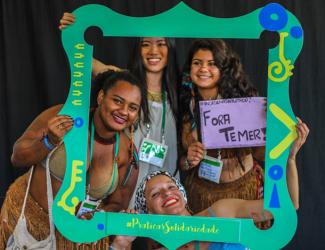
Activisme des jeunes féministes

S'organiser de manière créative face à des menaces croissantes

Les jeunes activistes féministes jouent un rôle crucial au sein des organisations et des mouvements pour les droits des femmes à travers le monde. Ce sont elles qui soulèvent les nouveaux problèmes auxquels les féministes sont confrontées aujourd'hui. Leur force, leur créativité et leur adaptabilité sont vitales pour assurer la viabilité des organisations féministes.

Pourtant,  elles sont confrontées à toute une série d’obstacles particuliers, notamment l'accès limité au financement et au soutien, le manque de possibilités de renforcement des capacités et une augmentation considérable des agressions sur les jeunes défenseuses des droits humains. Ces obstacles entraînent un manque de visibilité qui rend leur intégration et leur participation effective au sein des mouvements pour les droits des femmes encore plus difficiles.

Une approche multigénérationnelle

Le Programme d’activisme des jeunes féministes de l'AWID a été mis en place pour veiller à ce que les voix des jeunes femmes soient entendues et représentées dans le discours féministe. Nous voulons faire en sorte que les jeunes féministes aient un meilleur accès à du financement, à des opportunités de renforcer leurs capacités et aux processus internationaux.

En plus de soutenir directement les jeunes féministes, nous travaillons également avec des activistes des droits des femmes de tout âge pour élaborer des modèles et des stratégies d’organisation multigénérationnelles plus efficaces.

Nos actions

Nous souhaitons que les jeunes féministes puissent jouer un rôle actif dans les prises de décisions qui concernent leurs droits. Nos actions incluent :

  • Favoriser la mise en commun et le partage d'informations par la Plateforme de jeunes féministes. Étant donné l'importance des médias en ligne pour le travail des jeunes féministes, notre équipe a lancé la Plateforme de jeunes féministes en mai 2010. Elle a pour objectifs d’échanger des renseignements, de renforcer les capacités des membres par le truchement de webinaires et de  discussions en ligne, et d'encourager la consolidation d’une communauté de jeunes féministes.

  • Soutenir la recherche et le renforcement des connaissances sur l'activisme des jeunes féministes, pour accroître la visibilité et l'influence de leur activisme au sein et entre les mouvements pour les droits des femmes et auprès d'autres acteurs-trices clés, tels les donateurs.

  • Faire la promotion de la collaboration multigénérationnelle, en explorant de meilleures façons de travailler ensemble.

  • Inciter les jeunes féministes à s’engager dans les processus internationaux relatifs au programme de développement, notamment ceux des Nations Unies.

  • S’assurer leur collaboration dans tous les domaines prioritaires de l'AWID, y compris le Forum, pour faire en sorte que leurs contributions, leurs perspectives, leurs besoins et leur activisme se traduisent dans les débats, les politiques et les programmes qui les concernent.

Contenu lié

لماذا عليّ أن أفكر بتعبئة الاستطلاع؟

هنالك العديد من الأسباب لتعبئة الاستطلاع منها أنه لديك الفرصة لمشاركة تجربتك المعاشة المتعلقة بحشد الموارد لدعم تنظيمك، أن تعمل/ين من منطلق قوة كخبير/ة بما يتعلق بالأموال ولأين تتحرك ولأين تصل وبذلك المشاركة بالجهد المشترك والمناصرة لتحريك التمويلات الأكبر والأفضل. لقد أثبت استطلاع "أين المال" في العشرين عام الأخيرة أنه مصدر أساسي للشركاء/ الشريكات وكذلك للممولين/ات. ندعوك من كل قلبنا للمشاركة بالنسخة الثالثة لتسليط الضوء على الوضع الفعلي للموارد، وتحد الحلول الخاطئة، والإشارة إلى كيفية تغيير التمويل حتى تزدهر الحركات وتواجه التحديات المعقدة في عصرنا.

Snippet FEA Map of Georgia (FR)

Cette image montre les pays de la Géorgie et de l'Espagne en rose corail turquoise avec des épingles jaunes indiquant l'Espagne, l'Union OTRAS, et l'Union du réseau de solidarité de la Géorgie sur les cartes.

When development initiatives, religious fundamentalisms and the state of women’s rights collide

Notre nouveau rapport de recherche Le Diable est dans les détails aborde les lacunes du secteur du développement en termes de connaissance des fondamentalismes religieux et vise à améliorer la compréhension de la façon dont les fondamentalismes religieux entravent le développement et les droits des femmes en particulier. Il offre des recommandations aux acteurs-trices du développement quant aux manières d’éviter de renforcer les fondamentalismes par inadvertance et sur les stratégies pour les contrer. [CTA download link: Lire le document]


Seven pointers to consider


Graphic1 1. Control of women’s bodies, sexuality, and choice are “warning signs” of rising fundamentalisms.
2. Neoliberal economic policies have a particularly negative impact on women, and fuel the growth of religious fundamentalisms. Graphic2
Graphic3 3. Choosing religious organizations as default for partnerships builds their legitimacy and access to resources, and supports their ideology, including gender ideology.
4.Everyone has multiple identities and should be defined by more than just their religion. Foregrounding religious identities tends to reinforce the power of religious fundamentalists. Graphic4
Graphic5 5. Religion, culture, and tradition are constantly changing, being reinterpreted and challenged. What is dominant is always a question of power.
6. Racism, exclusion, and marginalization all add to the appeal of fundamentalists’ offer of a sense of belonging and a “cause”. Graphic6
Graphic7 7. There is strong evidence that the single most important factor in promoting women’s rights and gender equality is an autonomous women’s movement.


L'influence des acteurs fondamentalistes religieux ont augmenté à l'échelle mondiale

Le Diable est dans les détails détaille les violations graves à l’encontre des droits humains, et ceux des femmes en particulier, légitimées par des fondamentalismes parrainés par les États ainsi que par des acteurs fondamentalistes non étatiques, tels que les milices, les organisations communautaires religieuses et les particuliers. Le renforcement fondamentaliste de normes sociales patriarcales régressives conduit à la montée de la violence contre les femmes, les filles et les femmes défenseuses des droits humains (WHRDs).   La rapport met en avant ces éléments-clé pour comprendre et affronter la situation :

  • [icon] Les fondamentalismes religieux gagnent du terrain au sein des collectivités
  • [icon] Des systèmes politiques
  • [icon] Des espaces internationaux, avec des effets dévastateurs pour les gens ordinaires et pour les femmes en particulier.


Les acteurs du développement doivent d'urgence d'agir.

Les acteurs du développement sont en mesure de jouer un rôle important dans ce contexte. La capacité collective des acteurs du développement à reconnaître les fondamentalismes religieux et à les affronter de manière concertée est essentielle pour faire progresser la justice sociale, économique et de genre et les droits humains pour tous, dans un contexte de développement durable.   En donnant la priorité à des partenaires progressistes dans le cadre de leurs activités, les acteurs du développement peuvent éviter d’octroyer des ressources ou de la légitimité aux fondamentalistes religieux. Les organisations de femmes ont de l’expertise sur le sujet et ont développé des stratégies pour lutter contre les fondamentalismes : Les acteurs du développement pourraient s’appuyer sur ces connaissances et s’engager à leurs côtés au sein de coalitions intersectorielles pour faciliter leur diffusion

Jacqueline Coulibaly Ki-Zerbo

Jacqueline was a pioneering Malian/Burkinabe feminist, nationalist and educator.

She taught English in Senegal, before being recruited in 1961 as an English teacher at the Lycée Philippe Zinda Kaboré in Ouagadougou, Burkina Faso. Through her activism, she was involved in the popular uprising of January 3, 1966. Between 1961 and 1966, Jacqueline was also responsible for the trade union press, Voices of the Teachers. She was appointed as the head of the Normal Course for Young Girls (now known as Nelson Mandela High School) until 1974, and dedicated herself to girls’ education and advancing women’s rights.

In 1984 she was awarded the Paul G. Hoffmann Award for outstanding work in national and international development.


Jacqueline Coulibaly Ki-Zerbo, Mali/ Burkina Faso

Snippet FEA collaborator and allies Photo 1 (EN)

The photo shows Sopo Japaridze, one of the co-founders of the Solidarity Network Union. Sopo has long brown hair, with bangs, and brown eyes, and wears a red mask of the Solidarity Network Union. The picture is taken at night.

Defending human rights at the UN

Keeping an eye on anti-rights actor at the Human Rights Council

Anti-rights mobilization at the United Nations constitutes a response to the significant feminist and progressive organizing. It involves a constant threat for women's rights, especially when it comes to sexual and reproductive rights and an open door to racism, xenophobia and all kinds of discrimination.

Get to know all their tactics and discourses worldwide.

Read our full report


Main resolutions and organizations to follow on the 38th session

We’re looking at an attack on the human rights system, and all of these fundamentalisms are coming together to try to weaken the fabric of multilateralism, and that’s happening in large part at the expense of marginalized groups of people. It’s happening at the expense of women, and it’s happening through tactics that are often about gender and sexuality.

Cynthia Rothschild

Independent human rights expert, OURs member

We’ve experienced a lot of pushback from different states, from different civil society actors, from private corporations and large donors who are funding the activities of these anti-rights actors.

Meghan Doherty

Director of Global Policy and Advocacy with Action Canada

Read more on what we do at the Human Rights Council


More interviews at HRC38

Zhan Chiam

ILGA's Gender Identity and Gender Expression Senior Programme Officer

Paola Salwan Daher

Global Advocacy Adviser at the Center for Reproductive Rights

Ottilie Abrahams

Ottilie fue una activista feminista, educadora y política de Namibia.

Fue una de las fundadoras de la Organización Popular del Sudoeste Africano (SWAPO), del Club Yu Chi Chan (un grupo armado revolucionario) y del Frente Nacional de Liberación del Sudoeste Africano (SWANLIF). También fue una de las fundadoras de la Asociación de Mujeres de Namibia y del Proyecto Niñas. A lo largo de su vida, Ottilie defendió el derecho a discutir, a pensar, a disputar y a exigir. Movilizó a las mujeres, organizó a estudiantes y docentes y criticó a otrxs camaradas por su elitismo y su corrupción.

Ottilie trabajó intensamente para desmantelar el patriarcado y para crear una democracia participativa concreta, feminista, transformadora y liberadora.

A menudo decía: «Descansaré cuando muera».


Ottilie Abrahams, Namibia

Posso aceder a e realizar o inquérito no meu telemóvel?

Sim, o inquérito pode ser acedido através de um smartphone.

Snippet FEA Workers demonstrations in Georgia 2 (ES)

La imagen muestra una protesta en la que una multitud sostiene una pancarta en georgiano que dice: "8 de marzo para las mujeres trabajadoras".
Body

Thematic Anchors

Six thematic anchors hold the Feminist Realities framework of the Forum. Each anchor centers feminist realities, experiences and visions, on the continuum between resistance and proposition, struggle and alternative. We seek to explore together what our feminist realities are made of and what enables them to flourish in different spheres of our life.

These realities may be fully articulated ways of living, dreams and ideas in the making, or precious experiences and moments. 


The anchors are not isolated themes, but rather interconnected containers for activities at the Forum. We envision many activities to be at the intersection of these themes, at the intersection of different struggles, communities and movements. The descriptions are preliminary, and continue to evolve as the Feminist Realities journey continues.

Resources for Communities and Movements & Economic Justice

This anchor centers questions of how we -- as individuals, communities, and movements -- meet our basic needs and secure the resources that we need to thrive, in ways that center care for people and nature. By “resources” we mean food, water, clean air, as well as money, labor, information, knowledge, time, and more. 

Drawing on feminist resistance to the dominant economic system of exploitation and extractivism, the anchor highlights the powerful and inspiring feminist proposals, experiences and practices of organizing our economic and social life. Food and seed sovereignty, feminist visions of work and labor, just and sustainable systems of trade, are just some of the questions to explore. We will bravely face the contradictions that emerge from the need to survive in oppressive economic systems. 
This anchor positions funding and resourcing for organizations and movements in a broad feminist analysis of economic justice and wealth creation. It explores how to move resources where they are needed, from tax justice and basic income to different models of philanthropy and creative & autonomous resourcing for movements.

Governance, Accountability and Justice

We seek to build new visions and amplify existing realities and experiences of feminist governance, justice and accountability. In the face of the global crisis and rising fascisms and fundamentalisms, this anchor centers feminist, radical and emancipatory models, practices and ideas of organizing society and political life, - locally and globally.

The anchor will explore what feminist governance looks like, from feminist experiences of municipalism to building institutions outside of nation-states, to our visions of multilateralism. We will exchange experiences of justice and accountability processes in our communities, organizations and movements, including models of restorative, community-based and transformative justice that reject state violence and the prison-industrial complex.

Centering experiences of travel, migration and refuge as well as feminist organizing, we seek a world without deadly border regimes; a world of free movement and exciting journeys.

Digital Realities

The role of technology in our lives is ever increasing and the line between online and offline realities blurred. Feminists make widespread use of technologies and online space to build community, learn from each other, and mobilise action. With online spaces, we can expand the boundaries of our physical world. On the flip side, digital communications are largely owned by corporations with minimal accountability to users: data mining, surveillance and security breaches have become the norm, as well as online violence and harassment. 

This anchor explores the feminist opportunities and challenges within digital realities. We’ll look at alternatives to privately owned platforms that dominate the digital landscape, well-being strategies for navigating online spaces, and uses of technology to overcome accessibility challenges. We’ll explore the potentials of technology in relation to pleasure, trust and relationships.

Bodies, Pleasure and Wellbeing

We hold feminist realities also within ourselves -- the embodied experience. Control of our labour, mobility, reproduction, and sexuality continues to be central to patriarchal, cis-heteronormative and capitalist structures. Defying this oppression, people of diverse genders, sexualities and abilities create encounters, spaces and sub-cultures of joy, care, pleasure and deep appreciation for ourselves and each other.  

This anchor will explore multiple ideas, narratives, imaginations, and cultural expressions of consent, agency and desire as held by women, trans, non-binary, gender non-conforming and intersex people in different societies and cultures. 

We will exchange strategies for winning reproductive rights and justice, and articulate social practices that enable and respect bodily autonomy, integrity and freedom. The anchor links different struggles and movements to inform each other’s perceptions and experiences of wellbeing and pleasure.

Planet and Living Beings

Imagine a feminist planet. What is the sound of the water, the smell of the air, the touch of the earth? What is the relationship between the planet and its living beings, humans included? Feminist realities are realities of environmental and climate justice. Feminist, indigenous, decolonial and ecological struggles are often rooted in transformative visions and relations among people and nature. 

This anchor centers the wellbeing of our planet, and reflects on the ways in which humans have interacted with and reshaped our planet. We seek to explore aspects of traditional knowledge and biodiversity as part of sustaining a feminist planet, and learn about feminist practices around degrowth, commoning, models of parallel economies, agro-ecology, food and energy sovereignty initiatives.

Feminist organizing

While we see all the anchors as related, this one is truly cross-cutting so we invite you to add an organizing dimension to whatever anchor(s) your proposed activity links to.

How is feminist organizing happening in the world today? This question turns our attention to actors, power dynamics, resources, leadership, to the economies we are embedded within, to our understanding of justice and accountability, to the digital age, to our experiences of autonomy, wellbeing and collective care. Across all anchors, we hope to create a space for honest reflection on power and resources distribution and negotiation within our own movements.


The Forum is a collaborative process

The Forum is more than a four-day convening. It is one more stop on a movement strengthening journey around Feminist Realities that has already begun and will continue well beyond the Forum dates.

Join us on this journey!

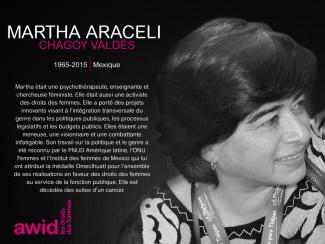
Mary Assaad

Experte en développement social et anthropologue de formation, Mary était surtout connue pour être une pionnière de la lutte contre les mutilations génitales féminines (MGF).

Née au Caire en 1922, les travaux de Mary en matière de développement ont commencé tôt, dès son adhésion à la YWCA (Association chrétienne des jeunes femmes). Mary était membre du Conseil œcuménique des Églises et s'est progressivement intéressée aux questions relatives à la santé des femmes. Sa longue lutte contre les MGF a porté ses fruits en 2008, lorsque l'Egypte a finalement criminalisé cette pratique.

On se souvient d'elle comme d'une mentor pour de nombreuses féministes et militant-e-s égyptien-ne-s


Mary Assad, Egypt

هل ستكون لي الفرصة بمشاركة افكاري بأمور لا تغطيها أسئلة الاستطلاع؟

نعم. ندعوكم/ن لمشاركتنا بالأمور التي تجدونها مهمة بالنسبة لكم/ن عن طريق الإجابة على الأسئلة المفتوحة في نهاية الاستطلاع.

Snippet FEA Workers Persecution S4 (FR)

Un agent des forces de l'ordre en tenue anti-émeute rose tenant un bâton

LA PERSÉCUTION DES TRAVAILLEUR·EUSES

Main image
ours web tile.png
Body