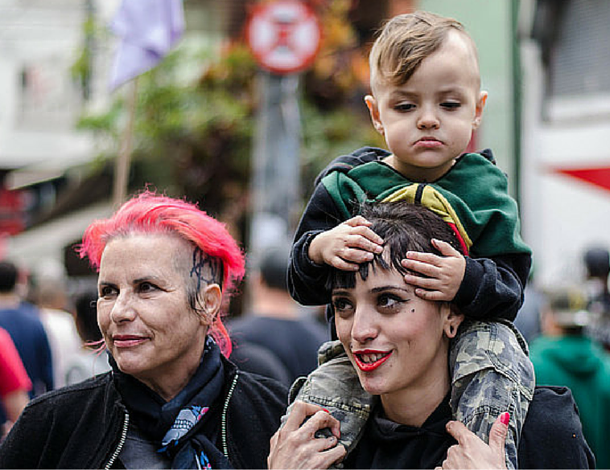
Flickr/Leonardo Veras (CC BY 2.0)

Analyses Spéciales

L´AWID est une organisation féministe mondiale qui consacre ses efforts à la justice de genre, au développement durable et aux droits humains des femmes

Protection de la famille

Contexte

Au cours des dernières années, nous avons observé une nouvelle tendance inquiétante dans les espaces internationaux consacrés aux droits humains. Les discours axés sur « la protection de la famille » sont en effet utilisés pour défendre des violations des droits de membres de la famille, pour renforcer et justifier l’impunité des auteurs de ces violations et pour restreindre l’égalité des droits au niveau de la vie familiale. 

La campagne en faveur de la « Protection de la famille » est motivée par une volonté conservatrice d’imposer des conceptions « traditionnelles » et patriarcales de la famille et de priver les membres de la famille de leurs droits pour les transférer à « l’institution familiale ».

Les initiatives visant à la « Protection de la famille » reposent sur :

  • la montée du traditionalisme,
  • la montée du conservatisme culturel, social et religieux,
  • l’existence d’une hostilité vis-à-vis des droits humains des femmes, des droits sexuels, des droits des enfants et enfin des droits des personnes dont l’identité de genre et l’orientation sexuelle ne sont pas conformes aux normes.

Depuis 2014, un groupe d’Etats travaille de front dans les espaces dédiés aux droits humains sous le nom de « Group of Friends of the Family » (Groupe des ami-e-s de la famille) ; des résolutions sur la « Protection de la famille » ont été adoptées chaque année depuis 2014.

Ce programme s’est propagé au-delà du Conseil des droits humains. Nous avons observé l’introduction d’un discours régressif autour de la « famille » à la Commission sur la condition de la femme, ainsi que des tentatives d’introduction dans les négociations sur les Objectifs de développement durable.


Notre approche

L’AWID travaille avec des partenaires et des allié-e-s pour s’opposer ensemble à la « Protection de la famille » et à d’autres programmes régressifs et défendre l’universalité des droits humains.

En réponse à l’influence croissante d’acteurs régressifs au sein des espaces dédiés aux droits humains, l’AWID a rejoint des allié-e-s afin de créer l’Observatoire sur l'Universalité des droits (OURs) (site en anglais). L’OURs est un projet de collaboration qui surveille, analyse et diffuse les informations concernant les initiatives anti-droits telles que la « Protection de la famille ».

Le premier rapport de l’OURs, Nos droits en danger, trace une cartographie des acteurs et actrices qui constituent le lobby mondial anti-droits et identifie leur réthorique et stratégies clés ainsi que leur impact sur les droits humains.  

Le rapport précise que le programme de « Protection de la famille » a développé une collaboration entre un large éventail d’acteurs régressifs aux Nations Unies, qu’il décrit comme « un cadre stratégique abritant des positions anti-droits et patriarcales multiples, où le cadre vise entre autres à légitimer et institutionnaliser ces positions. »

Contenu lié

5. Realiza las entrevistas

Las entrevistas generan información en profundidad que no puedes obtener fácilmente de la encuesta. Mientras que la encuesta se centra sobre todo en información cuantificable y preguntas cerradas, las entrevistas son el espacio para las opiniones expertas de activistas y donantes, así como para las preguntas abiertas que pueden poner en contexto los resultados de la encuesta.

En esta sección

Consejos generales

1. Antes de realizar las entrevistas

Envía una nota conceptual a las personas que vas a entrevistar, explicando tus objetivos para la entrevista y para la investigación en general, así como una lista de preguntas.

Esto les permitirá prepararse para responder a las preguntas más complicadas y buscar información que tal vez no tengan a mano sin previo aviso.

2. Durante las entrevistas

  • Puedes realizar las entrevistas mientras tienes la encuesta abierta para recibir respuestas, como forma de ahorrar tiempo.
  • Trata de que las entrevistas sean lo más consistentes posible entre sí para facilitar un análisis sistemático de los resultados. Para esto, debes formular siempre las mismas preguntas. Cuando codifiques las respuestas, podrás descubrir tendencias ocultas.
  • Las entrevistas también pueden ser útiles para aportarle más contenido a algunos de los resultados de la encuesta.

No bases las preguntas en supuestos acerca de lo que saben las personas a las que entrevistas. Por el contrario, averigua primero qué saben, porque eso también te aportará información.

  • NO: «Considerando las tendencias actuales en el financiamiento en Suiza, ¿podrías identificar oportunidades de colaboración?». Esta pregunta da por sentado que la persona entrevistada conoce y evalúa las tendencias en el financiamiento en la misma medida que tú.
  • SÍ: Pregunta primero «¿Qué piensas de las tendencias actuales del financiamiento en Suiza?», y luego «¿Conoces alguna oportunidad de colaboración?». Esto te revela lo que la persona sabe, y te aporta información ya desde la primera pregunta.

Volver al comienzo


Entrevistas especializadas

1. Entrevistas con donantes

Las entrevistas con donantes te permitirán forjar vínculos más profundos con ellxs, lo que te será útil cuando hagas incidencia una vez concluida la investigación. También te ayudarán a conocer mejor los procesos de toma de decisiones de las financiadoras.

Preguntas sugeridas para las entrevistas con donantes:

  • ¿Cuáles son sus prioridades para el para el financiamiento? ¿Por qué y cómo decidieron esas prioridades? Por ejemplo: ¿por qué optaron por financiar proyectos y no dar apoyo organizacional, o viceversa?
  • ¿Qué monto asignan cada año a impulsar los derechos humanos de las mujeres? Esta respuesta le dará mayor confiabilidad a la información general que consigas.
  • ¿Perciben alguna tendencia en el financiamiento? ¿Cómo creen que se originó y a qué dinámica política responde?
  • ¿Cuál es su teoría del cambio social y qué impacto tiene sobre sus vínculos con las organizaciones por los derechos de las mujeres?

Ver ejemplos de entrevistas con donantes

2. Entrevistas con organizaciones y activistas por los derechos de las mujeres

Las entrevistas con organizaciones y activistas por los derechos de las mujeres te ayudarán a conocer mejor las realidades sobre el terreno. También te permitirán profundizar tus vínculos con ellas y luego tal vez integrarlas al trabajo de incidencia, sobre todo para alentar la colaboración entre donantes y activistas.

Temas que sugerimos abordar durante las entrevistas con organizaciones y activistas por los derechos de las mujeres:

  • Tendencias a largo plazo en cuanto a prioridades para el financiamiento que perciben las organizaciones de mujeres y su impacto.
  • Ejemplos exitosos de estrategias conjuntas de movilización de recursos por parte de feministas, que ayuden a construir movimientos fuertes y complementarios.
  • Sus argumentos acerca de por qué es importante apoyar a las organizaciones de mujeres y sus procesos organizativos.
  • Cómo entienden los diferentes actores el proceso de cambio social y su rol en cuanto a impulsar/alcanzar la igualdad de género y los derechos de las mujeres.

Ver ejemplos de entrevistas con organizaciones y activistas por los derechos de las mujeres

Volver al comienzo


Resultados preliminares

Te recomendamos analizar resultados preliminares durante toda la investigación WITM. Presentar los resultados preliminares te da la oportunidad de realizar más entrevistas y escuchar opiniones sobre el proceso de investigación y los resultados iniciales. Esas opiniones las puedes incorporar a la investigación en su formato final.

AWID organiza «reuniones de WITM» durante las que comparte los resultados preliminares de la encuesta y las entrevistas. En estas reuniones, activistas, organizaciones por los derechos de las mujeres y donantes pueden debatir y discutir los resultados, esclarecer el contexto, sentir la investigación como propia y hacer aportes para la versión final de la investigación.

Por ejemplo, en la Cumbre Mundial de la IFP sobre Filantropía Indígena (en inglés), se utilizó el Centro de Movilización de Recursos por los Derechos de las Mujeres Indígenas como espacio para presentar los resultados preliminares.

Ver la presentación de esa reunión (en inglés)

Volver al comienzo


Paso previo

4. Recoge la información y analízala

Paso siguiente

6. Realiza una investigación secundaria


Duración estimada

• 1,5 - 3 meses

Personas que se necesitan

• 1 persona (o más) de investigación

Recursos necesarios

• Lista de los donantes, organizaciones y activistas para las encuestas
• Preguntas preparadas
• Documento de Síntesis (que creó en la sección "Prepara el marco")

Recursos con que cuento

Ejemplo de preguntas: Financiadores
Ejemplo de preguntas: Activistas y organizaciones


Paso previo

4. Recoge la información y analízala

Paso siguiente

6. Realiza una investigación secundaria


Planilla «¿Estoy listx?»

Descargar el manual en PDF

Forum 2024 - FAQ - General Information ES

Información general

¿Cuánto cuesta inscribirse?

Esta información estará disponible recién cuando abramos el proceso de inscripción.


La comunicación del deseo | Small Snippet ES

La comunicación del deseo

y otras praxis políticas del cuerpo

Tendemos a pensar en la comunicación del deseo como algo circunscrito a la intimidad de la alcoba y nuestras relaciones personales. Sin embargo, ¿podemos también pensar este tipo de comunicación como una estructura, una práctica que nutre nuestro trabajo, y cómo somos, y cómo actuamos en el mundo?

Leer más

Snippet 4 - What's happening at HRC61 Intro

Panels Relevant to Gender and Sexuality

  • High-level panel discussion on the commemoration of the twenty-fifth anniversary of the adoption of the Durban Declaration and Programme of Action                                                                                     Concept note

  • Annual high-level panel discussion on human rights mainstreaming
    Theme: Role of new and emerging digital technologies in preventing and eliminating female genital mutilation                                       Concept note

  • Panel discussion on human rights and a culture of peace                 Concept note

  • Panel discussion on financing sustainable development in line with economic, social and cultural rights obligations.                              Concept note

  • Annual interactive debate on the rights of persons with disabilities
    Theme: Disability-inclusive infrastructure, including transport and housing                                                                                        Concept note

  • Anual full-day meeting on the rights of the child                          Theme: Rights of the child and violations of the human rights of children in armed conflicts                                                                       Concept note

Merci d'avoir participé à la création de nos Horizons féministes

Un grand MERCI d'avoir pris part au 13ème Forum international de l'AWID !

Toute l'équipe de l'AWID vous remercie de nous avoir rejoint pour ces quatre jours d'apprentissage et de célébrations, pour envisager, rêver et co-créer nos Horizons féministes.

Nous avons été incroyablement inspiré-e-s et enthousiasmé-e-s par tout ce travail collectif que nous avons accompli ensemble !

Pour plus d'images, d'inspiration et de ressources :

Visitez le site du Forum

Bonne lecture !


Connectez-vous au #AWIDForum

¿Qué idiomas estarán incluidos en el Foro?

Inglés, francés, español, y chino mandarín.

Illumination by the Light of the Full Moon | Snippet Small ES

Luz de Plenilunio: Una experiencia BDSM africana

Más que una divertida excentricidad para explorar las sensaciones, el BDSM puede ser una forma de abordar el dolor y el trauma emocionales. Ha sido un medio de sanación sexual para mí, pues me ha permitido una forma radical de liberación. 

Leer más

Snippet - WD2026 - Fiji_Georgia Link - ES

Durante Women Deliver, los Movement Hubs en Fiji y Georgia están diseñando su propio programa basado en su comunidad para conectarse virtualmente a la Conferencia Women Deliver. ¡Conoce su programa!

¿Te interesa organizar Movement Hubs para otros eventos de movimientos globales y espacios de políticas públicas? Ponte en contacto con el equipo de membresía de AWID: membership @ awid.org

Agroecology and Food Sovereignty

Context

The search for alternative means of food production based on environmental sustainability is gaining ground across regions. This worldwide search comes with a common characteristic: the need to involve rural people and particularly women, building on their local priorities and knowledge by employing the principle of agroecology.

Definition

Agroecology is a way of practicing agriculture or using technologies that do not harm the environment. It proposes breaking with the hegemonic rural development model based on large landed estates and single-crop plantations that benefit mostly agricultural businesses and entrenches social exclusion.   

In family farming, agroecology manifests as a resistance to the current development model and its social, cultural, environmental, and economic problems. It opposes the lack of the farmer’s financial capital autonomy; and it symbolizes a resistance to the current agribusiness model.

Feminist perspective

Efforts based solely on agroecology may not be sufficient to solve all problems of women’s marginalization and invisibility. A feminist perspective is then crucial to analyze the norms associated with the idea of family as currently constituted as the perfect institution, as well as with the condition of women’s subordination.

In simpler terms, it is important to include in this debate a reflection on socially constructed gender roles to advance the emancipatory potential of agroecology.


Learn more about this proposition

Part of our series of


  Feminist Propositions for a Just Economy

¿Qué ocurre con las propuestas enviadas a través del Llamado actividades?

  1. La primera selección de actividades la realizará el personal de AWID.
  2. A quienes propusieron las actividades que pasen esa primera selección lxs invitaremos a participar de un proceso de votación. Las propuestas más votadas se incluirán en el programa del Foro. AWID podrá hacer algunos ajustes a la selección final para garantizar que nuestro programa guarde un equilibrio adecuado entre regiones, colectivos, temáticas y metodologías.  
  3. El Comité de Contenidos y Metodología del Foro se pondrá en contacto con lxs organizadorxs de las actividades seleccionadas para apoyarlxs en el desarrollo de sus actividades.

Actualizaremos los resultados de este proceso en el sitio web a su debido tiempo.

Disintegration | Content Snippet

On Wednesday a note arrives
with an address on the back.

    5 pm, tonight.

The handwriting on the invitation—
coily and brusque—
I’ve seen it five times in five years.

My body rouses,
feverish.

I need to fuck myself first.

The tide is high tonight and
I get 
off.

I want to slow everything down,
taste time and space, etch them 
into memory.

*

I’ve never been to this part of town before.
Unknown places excite me,
the way limbs and veins and bones
resist decay, 
their fate uncertain.

At the door, I think twice.
The hallway is pitch black 
and it makes me pause.

On the other side,
a portal of smell and color 
opens like a curse,  
into a sunny afternoon.

The breeze
makes my hair dance,
piques its curiosity,
compels it to move.

I hear the wheelchair whirring, 
shaping the shadows.
Then I see them:
a lynx face
and a body like mine
and I find myself desiring both
again.
 
The creature motions me closer.

Their gestures write a sentence;
as I move toward them,
I notice its details:


    wither, flesh, bliss

On their command, the vine that covers the hallway
hugging warm stones,
snakes up the wall.

It becomes a verb,
“to climb,”
and I’m reorientated when their claws point 
to the vine-bed in the center.

I hear the wheels behind me, 
then that sound. 
It reverberates
like no other.
Their long black wings
elevate toward the ceiling
then they lunge forward.

The feline vision scans every detail,
every change,
every longing.

Can desire liquefy your muscles? 

    Can it act sweeter than the strongest 
of tranquilizers?

A lynx sews the world
across our differences,
weaving lace around my knees.

Can desire crush the distance of the world, 
compressing the seconds?

They come closer still,
lynx eye meeting human eye,
sniffing the air,
turning body into
urgency.

They beat down their wings.
Stirred,
the vines tangle around my waist/waste.

Their tongue thins time,
shifting grounds,
soothes, with their magic,
what stirs beneath.

    I see the world in you, and the 
world is exhausted.

Then they plead:

    Let me feast on you. 
 

Snippet - WD2026 - Title Movement Hubs - ES

Espacios de articulación en Fiji y Georgia

AWID Members Engaging at CSW61

Member states and women's rights advocates and organisations are gathering at the United Nations Headquarters in New York from 13 - 24 March for the 61st Commission on the Status of Women to address ‘women’s economic empowerment’ in the context of Sustainable Development Goal 5.

Whilst AWID is looking forward to physically meeting those of you who will be in New York, we want to engage with all those who cannot attend CSW, and as much as possible, amplify your voices in relevant spaces.

Continue reading to find out how to engage with AWID around CSW, whether you are attending physically or not.


Participate in an artistic takeover!

We are thrilled that AWID member Nayani Thiyagarajah is attending CSW this year and will take over the AWID Instagram. She will be available onsite to connect with other members for a possible feature on our Instagram. She will also explore possibilities of including some AWID members in a short film on the theme, ‘The personal is political’, a story of Nayani’s participation in this year’s CSW.

Nayani Thiyagarajah

Who is Nayani?

Nayani Thiyagarajah is a director, producer, and writer, dedicated to stories for the screen. A daughter of the Tamil diaspora, she calls Toronto home. For over 10 years, Nayani has worked in the arts and cultural industries. Her first independent feature documentary Shadeism: Digging Deeper (2015) had its World Premiere at the 2015 Zanzibar International Film Festival, where it won a Special Jury Prize. Nayani recently launched [RE]FRAME, with her producing partner Camaro West, a production company based out of Atlanta and Toronto, focused on re-framing the narratives around Black, Indigenous, and other people of colour through storytelling on screen.

On a more serious note, it should be noted that Nayani has a strange laugh, she's quite awkward, and her head is always in the clouds. She feels blessed beyond belief to create stories for the screen and play make believe for a living. Above all else, she believes in love.

(Biography submitted by Nayani)

Interested in meeting Nayani and being considered for inclusion in the film?

  • Send an email to membership@awid.org with the subject line “CSW Artistic Takeover”

  • By 13 March 2017

  • Please include your full name and country information.


Can't attend? Voice it!

If you are not able to attend CSW61 because of a travel ban, either due to the one imposed by the Trump administration or one you are facing from your own government, please share your story with us.

Send us messages you want heard in the United Nations spaces concerning funding, the impact of the reinstatement of the Global Gag Rule, and the need to push back against all types of religious fundamentalisms. You can send these in the following formats:

  • Video: no longer than two minutes and sent through a file sharing folder (for example dropbox, google drive) 

  • Audio: no longer than two minutes and sent through a file sharing folder (for example dropbox, google drive)

  • Image: you can share a photo or a poster of your message 

  • Text: no longer than 200 words and sent in the body of an email or in a word document

Share your message with us


Meet other members @CSW61

AWID members tell us that connecting with other members at CSW is valuable. In such a huge advocacy space, it is useful to connect with others including activists working on similar issues, or originating from the same country or region. Recognising the importance of connecting for movement building, we invite you to:

Interested in connecting with other members @CSW61?

  • Email membership@awid.org with the subject line “CSW AWID Members

  • NOTE: Please let us know your full name and country, and if we can share your email address with other members interested in meeting at CSW. 

Meet current AWID members


Take a picture!

If you are attending the CSW, we’d love to see what’s going on through your eyes!

Show us by capturing a moment you find speaks to the energy in the CSW space, be it on or off site. We hope to publish some of your ‘images’ on our social media channels and share on awid.org

You can send us: 

  • colour and/ or black and white photographs with a title (if you wish) and 

  • a caption (no longer than 100 words) about the story your image tells.

​Please also include:

  • your full name and country of origin and

  • let us know if we can publish the information you shared (in part or in full).

Send your images:

  • Email membership@awid.org with the subject line “CSW: Take a Picture!

  • During the whole CSW or shortly after until Tuesday 28 March 2017. 

¿Necesito visa para asistir al Foro de Taipéi?

Si tienes pasaporte de alguno de los siguientes países (el tiempo de estadía permitido varía según el país), NO necesitas visa para asistir al Foro de Taipéi:

Alemania, Andorra, Australia, Austria, Bélgica, Belice, Bulgaria, Brunei, Canadá, Chile, Ciudad del Vaticano, Croacia, Chipre, Dinamarca, Eslovaquia, Eslovenia, Estados Unidos de América, Estonia, España, Esuatini, Filipinas, Finlandia, Francia, Grecia, Guatemala, Haití, Honduras, Hungría, Irlanda, Islandia, Israel, Italia, Japón*, Letonia, Liechtenstein, Lituania, Luxemburgo, Malasia, Malta, Islas Marshall, Mónaco, Nauru, Nueva Zelanda, Nicaragua, Noruega, Países Bajos, Palaos, Paraguay, Polonia, Portugal, Reino Unido, República Checa, República de Corea, República Dominicana, Rumania, Rusia, San Cristóbal y Nieves, San Marino, Santa Lucía, San Vicente y las Granadinas, Singapur, Suecia, Suiza y Tuvalu.

Las personas con cualquier otro pasaporte NECESITARÁN VISA para ir a Taipéi.


Por favor ten en cuenta:

Es probable que, una vez que te hayas inscripto para asistir al Foro, te llegue un código relacionado con el evento que te permitirá tramitar tu visa en forma electrónica, cualquiera sea tu ciudadanía.

Brindaremos más información sobre este tema cuando se abra el proceso de inscripción.

A Joy to the World: Six Questions with Naike Ledan | Small Snippet FR

La joie dans le monde : six questions à Naïké Ledan

Ce qui m’a aidée, c’est que j’adorais le travail qui consiste à aller dans les terres et à documenter les connaissances des gens. Donc j’ai quitté le confort...

Illustration of two hands holding a photo of mother and baby

Lire plus