
Petite Jasmine

Au cours des dernières années, nous avons observé une nouvelle tendance inquiétante dans les espaces internationaux consacrés aux droits humains. Les discours axés sur « la protection de la famille » sont en effet utilisés pour défendre des violations des droits de membres de la famille, pour renforcer et justifier l’impunité des auteurs de ces violations et pour restreindre l’égalité des droits au niveau de la vie familiale.
La campagne en faveur de la « Protection de la famille » est motivée par une volonté conservatrice d’imposer des conceptions « traditionnelles » et patriarcales de la famille et de priver les membres de la famille de leurs droits pour les transférer à « l’institution familiale ».
Depuis 2014, un groupe d’Etats travaille de front dans les espaces dédiés aux droits humains sous le nom de « Group of Friends of the Family » (Groupe des ami-e-s de la famille) ; des résolutions sur la « Protection de la famille » ont été adoptées chaque année depuis 2014.
Ce programme s’est propagé au-delà du Conseil des droits humains. Nous avons observé l’introduction d’un discours régressif autour de la « famille » à la Commission sur la condition de la femme, ainsi que des tentatives d’introduction dans les négociations sur les Objectifs de développement durable.
L’AWID travaille avec des partenaires et des allié-e-s pour s’opposer ensemble à la « Protection de la famille » et à d’autres programmes régressifs et défendre l’universalité des droits humains.
En réponse à l’influence croissante d’acteurs régressifs au sein des espaces dédiés aux droits humains, l’AWID a rejoint des allié-e-s afin de créer l’Observatoire sur l'Universalité des droits (OURs) (site en anglais). L’OURs est un projet de collaboration qui surveille, analyse et diffuse les informations concernant les initiatives anti-droits telles que la « Protection de la famille ».
Le premier rapport de l’OURs, Nos droits en danger, trace une cartographie des acteurs et actrices qui constituent le lobby mondial anti-droits et identifie leur réthorique et stratégies clés ainsi que leur impact sur les droits humains.
Le rapport précise que le programme de « Protection de la famille » a développé une collaboration entre un large éventail d’acteurs régressifs aux Nations Unies, qu’il décrit comme « un cadre stratégique abritant des positions anti-droits et patriarcales multiples, où le cadre vise entre autres à légitimer et institutionnaliser ces positions. »

Née à Bahia, dans le nord-est du Brésil, Carmen est une immigrante, militante sociale et mère de 8 enfants.
Carmen a connu l'itinérance à l'âge de 35 ans, après avoir émigré seule à São Paulo. Cela l'a amenée à devenir une ardente défenseuse des communautés vulnérables, marginalisées et invisibles les plus touchées par la crise du logement. Elle est finalement devenue l'une des fondatrices de MSTC en 2000.
En tant qu'organisatrice politique visionnaire et actuelle dirigeante du MSTC, le travail de Carmen a révélé la crise du logement de la ville de São Paulo et inspiré d'autres personnes sur différentes façons d'organiser et de gérer les occupations.
Carmen a été fermement à l'avant-garde de diverses occupations. L'une d'elles est l’Ocupação 9 de Julho, qui sert désormais de scène à la démocratie directe et d'espace où chacun·e peut être soigné·e, entendu·e, apprécié·e et travailler ensemble.
Carmen a longtemps été célébrée pour son audace à redonner vie à des bâtiments abandonnés au cœur de São Paulo.
Pour en savoir plus sur sa vie, vous pouvez la suivre sur Instagram!
Pour toutes questions liées à l’Appel aux propositions d'activités, merci de nous contacter via notre formulaire de contact en choisissant « Proposition d'activité » comme sujet de votre message.
The Call for Activities lists a number of suggested formats and methodologies. Be creative and make sure to read the section “What you need to know”.
 |
Human and ethnic-territorial rights Ensuring the defense of human rights and Nature’s rights through alliance-building with local, national, regional and global actors and organizations. |
 |
Sustainable development Ensuring all economic, cultural and environmental activities contribute to sustainable development, food security and income generation, while respecting the self-determination and self-government of Afro-descendant communities. |
 |
Education and training Carrying out training for women and empowering them to carry out women’s rights advocacy in different political, social and economic spaces. For more information, see here! |

Cette information ne sera disponible qu’à l’ouverture de l’inscription.
Si tu actividad es seleccionada, el equipo de AWID te contactará para evaluar y responder a tus necesidades de interpretación y accesibilidad.
Last Updated Date: 25 April 2023
PLEASE READ THIS TERMS OF USE AGREEMENT (THE “TERMS OF USE”) CAREFULLY. THIS WEBSITE AND ITS SUBDOMAINS (COLLECTIVELY, THE “WEBSITE”), THE INFORMATION ON THE WEBSITE, AND THE SERVICES AND RESOURCES AVAILABLE OR ENABLED VIA THE WEBSITE (EACH A “SERVICE” AND COLLECTIVELY, THE “SERVICES”), ARE CONTROLLED BY ASSOCIATION FOR WOMEN’S RIGHTS IN DEVELOPMENT (“AWID”). THESE TERMS OF USE ALONG WITH ALL SUPPLEMENTAL TERMS THAT MAY BE PRESENTED TO YOU FOR YOUR REVIEW AND ACCEPTANCE (COLLECTIVELY, THE “AGREEMENT”), GOVERN YOUR ACCESS TO AND USE OF THE SERVICES. BY COMPLETING THE REGISTRATION PROCESS, BROWSING THE WEBSITE, OR OTHERWISE ACCESSING OR USING ANY OF THE SERVICES, YOU REPRESENT THAT (1) YOU HAVE READ, UNDERSTAND, AND AGREE TO BE BOUND BY THE AGREEMENT, (2) YOU ARE OF LEGAL AGE TO FORM A BINDING CONTRACT WITH AWID, AND (3) YOU HAVE THE AUTHORITY TO ENTER INTO THE AGREEMENT PERSONALLY OR ON BEHALF OF THE LEGAL ENTITY IDENTIFIED DURING THE ACCOUNT REGISTRATION PROCESS, AND TO BIND THAT LEGAL ENTITY TO THE AGREEMENT. THE TERM “YOU” REFERS TO THE INDIVIDUAL OR SUCH LEGAL ENTITY, AS APPLICABLE. IF YOU, OR IF APPLICABLE, SUCH LEGAL ENTITY, DO NOT AGREE TO BE BOUND BY THE AGREEMENT, YOU, AND IF APPLICABLE, SUCH LEGAL ENTITY, MAY NOT ACCESS OR USE ANY OF THE SERVICES.
PLEASE BE AWARE THAT SECTION 1.4 (AWID COMMUNICATIONS) OF THE AGREEMENT BELOW CONTAINS YOUR OPT-IN CONSENT TO RECEIVE COMMUNICATIONS FROM US.
PLEASE NOTE THAT THE AGREEMENT IS SUBJECT TO CHANGE BY AWID IN ITS SOLE DISCRETION AT ANY TIME. WHEN CHANGES ARE MADE, AWID WILL MAKE A COPY OF THE UPDATED AGREEMENT AVAILABLE AT THE WEBSITE AND UPDATE THE “LAST UPDATED DATE” AT THE TOP OF THESE TERMS OF USE. IF WE MAKE ANY MATERIAL CHANGES TO THE AGREEMENT, WE WILL PROVIDE NOTICE OF SUCH MATERIAL CHANGES ON THE WEBSITE AND ATTEMPT TO NOTIFY YOU BY SENDING AN E-MAIL TO THE E-MAIL ADDRESS PROVIDED IN YOUR ACCOUNT REGISTRATION (IF WE HAVE ONE ON FILE). ANY CHANGES TO THE AGREEMENT WILL BE EFFECTIVE IMMEDIATELY FOR NEW USERS OF THE SERVICES AND WILL BE EFFECTIVE FOR EXISTING REGISTERED USERS UPON THE EARLIER OF (A) THIRTY (30) DAYS AFTER THE “LAST UPDATED DATE” AT THE TOP OF THESE TERMS OF USE, OR (B) YOUR CONSENT TO AND ACCEPTANCE OF THE UPDATED AGREEMENT IF AWID PROVIDES A MECHANISM FOR YOUR IMMEDIATE ACCEPTANCE IN A SPECIFIED MANNER (SUCH AS A CLICK-THROUGH ACCEPTANCE), WHICH AWID MAY REQUIRE BEFORE FURTHER USE OF THE SERVICES IS PERMITTED. IF YOU DO NOT AGREE TO THE UPDATED AGREEMENT, YOU MUST STOP USING ALL SERVICES UPON THE EFFECTIVE DATE OF THE UPDATED AGREEMENT. OTHERWISE, YOUR CONTINUED USE OF ANY OF THE SERVICES AFTER THE EFFECTIVE DATE OF THE UPDATED AGREEMENT CONSTITUTES YOUR ACCEPTANCE OF THE UPDATED AGREEMENT. PLEASE REGULARLY CHECK THE WEBSITE TO VIEW THE THEN-CURRENT AGREEMENT. YOU AGREE THAT AWID’S CONTINUED PROVISION OF THE SERVICES IS ADEQUATE CONSIDERATION FOR THE CHANGES IN THE UPDATED AGREEMENT.
If AWID becomes aware of any possible violations by you of the Agreement, AWID reserves the right to investigate such violations. If, as a result of the investigation, AWID believes that criminal activity has occurred, AWID reserves the right to refer the matter to, and to cooperate with, any and all applicable legal authorities. AWID is entitled, except to the extent prohibited by applicable law, to disclose any information or materials on or in the Services, in AWID’s possession in connection with your use of the Services, to (i) comply with applicable laws, legal process or governmental request; (iii) enforce the Agreement, (iv) respond to your requests for customer service, or (vi) protect the rights, property or personal safety of AWID, its Registered Users or the public, and all enforcement or other government officials, as AWID in its sole discretion believes to be necessary or appropriate.
You may choose to have the arbitration conducted by telephone, based on written submissions, or in person at a mutually agreed location. Any judgment on the award rendered by the arbitrator may be entered in any court of competent jurisdiction.
Entire Agreement. The Agreement is the final, complete and exclusive agreement of the parties with respect to the subject matter hereof and supersedes and merges all prior discussions between the parties with respect to such subject matter.
1.1 License to the Services. Subject to your compliance with the Agreement, AWID grants you a non-assignable, non-transferable, non-sublicensable, revocable, non-exclusive license to use the Services in the manner permitted by the Agreement.
1.2 Updates. You understand that the Services are evolving. You acknowledge and agree that AWID may update the Services with or without notifying you.
1.3 Certain Restrictions. The rights granted to you in the Agreement are subject to the following restrictions: (a) you shall not license, sell, rent, lease, transfer, assign, reproduce, distribute, host or otherwise commercially exploit any of the Services; (b) you shall not frame or utilize framing techniques to enclose any trademark, logo, or other parts of the Services (including images, text, page layout or form); (c) you shall not use any metatags or other “hidden text” using AWID’s name or trademarks; (d) you shall not modify, translate, adapt, merge, make derivative works of, disassemble, decompile, reverse compile or reverse engineer any part of the Services except to the extent the foregoing restrictions are expressly prohibited by applicable law; (e) you shall not use any manual or automated software, devices or other processes (including but not limited to spiders, robots, scrapers, crawlers, avatars, data mining tools or the like) to “scrape” or download data from any web pages contained in the Services (except that we grant the operators of public search engines revocable permission to use spiders to copy materials from the Website for the sole purpose of and solely to the extent necessary for creating publicly available searchable indices of the materials, but not caches or archives of such materials); (f) except as expressly stated herein, no part of the Services may be copied, reproduced, distributed, republished, downloaded, displayed, posted or transmitted in any form or by any means; and (h) you shall not remove or destroy any copyright notices or other proprietary markings contained on or in the Services. Any future release, update or other addition to the Services shall be subject to the Agreement. AWID, its suppliers and service providers reserve all rights not granted in the Agreement.
1.4 AWID Communications. By entering into the Agreement or using the Services, you agree to receive communications from us, including via e-mail. Communications from us and our affiliated companies may include but are not limited to operational communications concerning your use of the Services and promotional emails. IF YOU WISH TO OPT OUT OF ANY PROMOTIONAL EMAILS, YOU CAN UNSUBSCRIBE FROM OUR PROMOTIONAL EMAIL LIST BY FOLLOWING THE UNSUBSCRIBE OPTIONS IN THE PROMOTIONAL EMAIL ITSELF.
2.1 Registering Your Account. In order to access certain features of the Services you may be required to become a Registered User. For purposes of the Agreement, a “Registered User” is a user who has registered an account with AWID through the Services (“Account”).
2.2 Registration Data. In registering an Account, you agree to (a) provide true, accurate, current and complete information about yourself as prompted by the registration form (the “Registration Data”); and (b) maintain and promptly update the Registration Data to keep it true, accurate, current and complete. You represent that you are (i) at least eighteen (18) years old; (ii) of legal age to form a binding contract; and (iii) not a person barred from using the Services under the laws of the United States, Canada, your place of residence or any other applicable jurisdiction. You are responsible for all activities that occur under your Account. You agree that you shall monitor your Account to restrict use by any other persons, including minors, and you will accept full responsibility for any such unauthorized use. You may not share your Account login or password with anyone, and you agree to (y) notify AWID immediately of any unauthorized use of your password or any other breach of security; and (z) exit from your Account at the end of each session. If you provide any information that is untrue, inaccurate, not current or incomplete, or AWID has reasonable grounds to suspect that any information you provide is untrue, inaccurate, not current or incomplete, AWID has the right to suspend or terminate your Account and refuse any and all current or future use of the Services (or any portion thereof). You agree not to create an Account using a false identity or information, or on behalf of someone other than yourself. You agree not to create an Account or use the Services if you have been previously removed by AWID, or if you have been previously banned from any of the Services.
2.3 Your Account. Notwithstanding anything to the contrary herein, you acknowledge and agree that you shall have no ownership or other property interest in your Account, and you further acknowledge and agree that all rights in and to your Account are and shall forever be owned by and inure to the benefit of AWID.
2.4 Necessary Equipment and Software. You must provide all equipment and software necessary to connect to the Services. You are solely responsible for any fees, including Internet connection or mobile fees, that you incur when accessing the Services.
3.1 Services. AWID and its suppliers own all rights, title and interest in the Services, and that the Services are protected by intellectual property rights throughout the world. You agree not to remove, alter or obscure any copyright, trademark, service mark or other proprietary rights notices incorporated in or accompanying any Services.
3.2 Trademarks. AWID’s name and all related stylizations, graphics, logos, service marks and trade names used on or in connection with any Services are the trademarks of AWID and may not be used without permission in connection with your, or any third-party, products or services. Third party trademarks, service marks and trade names that may appear on or in the Services are the property of their respective owners.
3.3 Feedback. You agree that submission of any ideas, suggestions, documents, and/or proposals to AWID (“Feedback”) is at your own risk and that AWID has no obligations (including without limitation obligations of confidentiality) with respect to such Feedback. You represent and warrant that you have all rights necessary to submit the Feedback. You hereby grant to AWID a fully paid, royalty-free, perpetual, irrevocable, worldwide, and non-exclusive right and license to use, reproduce, perform, display, distribute, adapt, modify, re-format, create derivative works of, and otherwise commercially or non-commercially exploit in any manner, any and all Feedback, and to sublicense the foregoing rights, in connection with the operation and maintenance of the Services and/or AWID’s business.
7.1 As Is. YOU EXPRESSLY UNDERSTAND AND AGREE THAT TO THE EXTENT PERMITTED BY APPLICABLE LAW, YOUR USE OF THE SERVICES IS AT YOUR SOLE RISK, AND THE SERVICES ARE PROVIDED ON AN “AS IS” AND “AS AVAILABLE” BASIS, WITH ALL FAULTS. AWID EXPRESSLY DISCLAIMS ALL WARRANTIES, REPRESENTATIONS, AND CONDITIONS OF ANY KIND, WHETHER EXPRESS OR IMPLIED, INCLUDING, BUT NOT LIMITED TO, THE IMPLIED WARRANTIES OR CONDITIONS OF MERCHANTABILITY, FITNESS FOR A PARTICULAR PURPOSE AND NON-INFRINGEMENT ARISING FROM USE OF THE SERVICES.
7.2 No Liability for Conduct of Third Parties. YOU ACKNOWLEDGE AND AGREE THAT AWID PARTIES ARE NOT LIABLE, AND YOU AGREE NOT TO SEEK TO HOLD AWID PARTIES LIABLE, FOR THE CONDUCT OF THIRD PARTIES, INCLUDING OPERATORS OF EXTERNAL SITES AND OTHER USERS OF THE SERVICES.
7.3 Third-Party Materials. As a part of the Services, you may have access to materials that are hosted by another party. You agree that it is impossible for AWID to monitor such materials and that you access these materials at your own risk.
8. LIMITATION OF LIABILITY.
8.1 Disclaimer of Certain Damages. YOU UNDERSTAND AND AGREE THAT, TO THE FULLEST EXTENT PROVIDED BY LAW, IN NO EVENT SHALL AWID PARTIES BE LIABLE FOR ANY LOSS OF PROFITS, REVENUE OR DATA, INDIRECT, INCIDENTAL, SPECIAL, OR CONSEQUENTIAL DAMAGES, OR DAMAGES OR COSTS DUE TO LOSS OF PRODUCTION OR USE, BUSINESS INTERRUPTION, OR PROCUREMENT OF SUBSTITUTE GOODS OR SERVICES, IN EACH CASE WHETHER OR NOT AWID HAS BEEN ADVISED OF THE POSSIBILITY OF SUCH DAMAGES, ARISING OUT OF OR IN CONNECTION WITH THE AGREEMENT OR ANY COMMUNICATIONS, INTERACTIONS OR MEETINGS WITH OTHER USERS OF THE SERVICES, ON ANY THEORY OF LIABILITY. THE FOREGOING LIMITATION OF LIABILITY SHALL NOT APPLY TO LIABILITY OF AN AWID PARTY FOR (i) DEATH OR PERSONAL INJURY CAUSED BY AN AWID PARTY’S NEGLIGENCE; OR FOR (ii) ANY INJURY CAUSED BY AN AWID PARTY’S FRAUD OR FRAUDULENT MISREPRESENTATION.
8.2 Cap on Liability. TO THE FULLEST EXTENT PROVIDED BY LAW, AWID PARTIES WILL NOT BE LIABLE TO YOU FOR MORE THAN $100. THE FOREGOING CAP ON LIABILITY SHALL NOT APPLY TO LIABILITY OF AN AWID PARTY FOR (i) DEATH OR PERSONAL INJURY CAUSED BY AN AWID PARTY’S NEGLIGENCE; OR FOR (ii) ANY INJURY CAUSED BY AN AWID PARTY’S FRAUD OR FRAUDULENT MISREPRESENTATION.
8.3 Exclusion of Damages. CERTAIN JURISDICTIONS DO NOT ALLOW THE EXCLUSION OR LIMITATION OF CERTAIN DAMAGES. IF THESE LAWS APPLY TO YOU, SOME OR ALL OF THE ABOVE EXCLUSIONS OR LIMITATIONS MAY NOT APPLY TO YOU, AND YOU MIGHT HAVE ADDITIONAL RIGHTS.
8.4 Basis of the Bargain. THE LIMITATIONS OF DAMAGES SET FORTH ABOVE ARE FUNDAMENTAL ELEMENTS OF THE BASIS OF THE BARGAIN BETWEEN AWID AND YOU.
9. PROCEDURE FOR MAKING CLAIMS OF COPYRIGHT INFRINGEMENT. It is AWID’s policy to terminate membership privileges of any Registered User who repeatedly infringes copyright upon prompt notification to AWID by the copyright owner or the copyright owner’s legal agent. Without limiting the foregoing, if you believe that your work has been copied and posted on the Services in a way that constitutes copyright infringement, please provide our Copyright Agent with the following information: (a) an electronic or physical signature of the person authorized to act on behalf of the owner of the copyright interest; (b) a description of the copyrighted work that you claim has been infringed; (c) a description of the location on the Services of the material that you claim is infringing; (d) your address, telephone number and e-mail address; (e) a written statement by you that you have a good faith belief that the disputed use is not authorized by the copyright owner, its agent or the law; and (f) a statement by you, made under penalty of perjury, that the above information in your notice is accurate and that you are the copyright owner or authorized to act on the copyright owner’s behalf. Contact information for AWID’s Copyright Agent for notice of claims of copyright infringement is as follows: Director of Operations, AWID, 192 Spadina Avenue #300, Toronto, Ontario, M5T 2C2, Canada, dosr@awid.org.
10. MONITORING AND ENFORCEMENT. AWID reserves the right to: (a) take appropriate legal action, including without limitation, referral to law enforcement, for any illegal or unauthorized use of the Services; and/or (b) terminate or suspend your access to all or part of the Services for any or no reason, including without limitation, any violation of this Agreement.
11. TERM AND TERMINATION.
11.1 Term. The Agreement commences on the date when you accept them (as described in the preamble above) and remain in full force and effect while you use the Services, unless terminated earlier in accordance with the Agreement.
11.2 Prior Use. Notwithstanding the foregoing, you hereby acknowledge and agree that the Agreement commenced on the earlier to occur of (a) the date you first used the Services or (b) the date you accepted the Agreement, and will remain in full force and effect while you use any Services, unless earlier terminated in accordance with the Agreement.
11.3 Termination of Services by AWID. If you have materially breached any provision of the Agreement, or if AWID is required to do so by law (e.g., where the provision of the Services is, or becomes, unlawful), AWID has the right to, immediately and without notice, suspend or terminate any Services provided to you. You agree that all terminations for cause shall be made in AWID’s sole discretion and that AWID shall not be liable to you or any third party for any termination of your Account.
11.4 Termination of Services by You. If you want to terminate the Services provided by AWID, you may do so by (a) notifying AWID at any time and (b) closing your Account for all of the Services that you use. Your notice should be sent, in writing, to AWID’s address set forth below.
11.5 Effect of Termination. Termination of any Service includes removal of access to such Service and barring of further use of the Service. Upon termination of any Service, your right to use such Service will automatically terminate immediately. All provisions of the Agreement which by their nature should survive, shall survive termination of Services, including without limitation, ownership provisions, warranty disclaimers, and limitation of liability.
11.6 No Subsequent Registration. If your registration(s) with, or ability to access, the Services or any other AWID community, is discontinued by AWID due to your violation of any portion of the Agreement or for conduct otherwise inappropriate for the community, then you agree that you shall not attempt to re-register with or access the Services or any AWID community through use of a different member name or otherwise, and you acknowledge that you will not be entitled to receive a refund for fees related to those Services to which your access has been terminated. In the event that you violate the immediately preceding sentence, AWID reserves the right, in its sole discretion, to immediately take any or all of the actions set forth herein without any notice or warning to you.
12. INTERNATIONAL USERS. The Services can be accessed from countries around the world and may contain references to Services that are not available in your country. These references do not imply that AWID intends to announce such Services in your country. The Services are controlled and offered by AWID from its facilities in Canada. AWID makes no representations that the Services are appropriate or available for use in other locations. Those who access or use the Services from other countries do so at their own volition and are responsible for compliance with local law.
13. THIRD-PARTY SERVICES. The Services may contain links to third-party websites (“Third-Party Websites”), applications (“Third-Party Applications”) and advertisements for third parties (“Third-Party Ads”). When you click on a link to a Third-Party Website, Third-Party Application or Third-Party Ad, we will not warn you that you have left the Services and are subject to the terms and conditions (including privacy policies) of another website or destination. Such Third-Party Websites, Third-Party Applications and Third-Party Ads are not under the control of AWID. AWID is not responsible for any Third-Party Websites, Third-Party Applications or Third-Party Ads. AWID provides these Third-Party Websites, Third-Party Applications and Third-Party Ads only as a convenience and does not review, approve, monitor, endorse, warrant, or make any representations with respect to Third-Party Websites, Third-Party Applications or Third-Party Ads, or any product or service provided in connection therewith. You use all links in Third-Party Websites, Third-Party Applications and Third-Party Ads at your own risk. When you leave our Website, the Agreement and our policies no longer govern. You should review applicable terms and policies, including privacy and data gathering practices, of any Third-Party Websites, Third-Party Applications, or Third-Party Ads, and make whatever investigation you feel necessary or appropriate before proceeding with any transaction with any third party.
14. DISPUTE RESOLUTION.
14.1 Applicability of Arbitration Agreement. You agree that any dispute between you and us relating in any way to the Agreement, will be resolved by binding arbitration, rather than in court, except that (1) you and AWID may assert claims in small claims court if the claims qualify; and (2) you or AWID may seek equitable relief in court for infringement or other misuse of intellectual property rights (such as trademarks, trade dress, domain names, trade secrets, copyrights, and patents). This Arbitration Agreement shall apply, without limitation, to all claims that arose or were asserted before the Effective Date of this Agreement or any prior version of this Agreement.
14.2 Arbitration Rules and Forum. The Federal Arbitration Act governs the interpretation and enforcement of this Arbitration Agreement. To begin an arbitration proceeding, you must send a letter requesting arbitration and describing your claim to us in writing in writing at 192 Spadina Avenue #300, Toronto, Ontario, M5T 2C2, Canada. The arbitration will be conducted by JAMS, an established alternative dispute resolution provider. Disputes involving claims and counterclaims with an amount in controversy under $250,000, not inclusive of attorneys’ fees and interest, shall be subject to JAMS’ most current version of the Streamlined Arbitration Rules and procedures available at http://www.jamsadr.com/rules-streamlined-arbitration/; all other claims shall be subject to JAMS’s most current version of the Comprehensive Arbitration Rules and Procedures, available at http://www.jamsadr.com/rules-comprehensive-arbitration/. JAMS’s rules are also available at www.jamsadr.comor by calling JAMS at 800-352-5267. If JAMS is not available to arbitrate, the parties will select an alternative arbitral forum. If the arbitrator finds that you cannot afford to pay JAMS’s filing, administrative, hearing and/or other fees and you cannot obtain a waiver from JAMS, AWID will pay them for you.
14.3 Authority of Arbitrator. Without limiting the scope of Section 14.1, the arbitrator shall have exclusive authority to resolve any dispute related to the interpretation, applicability, enforceability or formation of this Arbitration Agreement including, but not limited to any claim that all or any part of this Arbitration Agreement is void or voidable. The arbitrator will decide the rights and liabilities, if any, of you and AWID. The arbitration proceeding will not be consolidated with any other matters or joined with any other proceedings or parties. The arbitrator shall have the authority to grant motions dispositive of all or part of any claim or dispute. The arbitrator shall have the authority to award monetary damages and to grant any non-monetary remedy or relief available to an individual party under applicable law, the arbitral forum’s rules, and this Agreement (including the Arbitration Agreement). The arbitrator shall issue a written award and statement of decision describing the essential findings and conclusions on which any award (or decision not to render an award) is based, including the calculation of any damages awarded. The arbitrator shall follow the applicable law. The arbitrator has the same authority to award relief on an individual basis that a judge in a court of law would have. The award of the arbitrator is final and binding upon you and us.
14.4 Waiver of Jury Trial. YOU AND AWID HEREBY WAIVE ANY CONSTITUTIONAL AND STATUTORY RIGHTS TO SUE IN COURT (OTHER THAN SMALL CLAIMS COURT AS PERMITTED HEREIN) AND HAVE A TRIAL IN FRONT OF A JUDGE OR A JURY. You and AWID are instead electing that all covered claims and disputes shall be resolved by arbitration under this Arbitration Agreement, except as specified in Section 14.1 above. An arbitrator can award on an individual basis the same damages and relief as a court and must follow this Agreement as a court would. However, there is no judge or jury in arbitration, and court review of an arbitration award is subject to very limited review.
14.5 Waiver of Class or Other Non-Individualized Relief. ALL CLAIMS AND DISPUTES WITHIN THE SCOPE OF THIS ARBITRATION AGREEMENT MUST BE ARBITRATED ON AN INDIVIDUAL BASIS AND NOT ON A CLASS OR COLLECTIVE BASIS, ONLY INDIVIDUAL RELIEF IS AVAILABLE FOR CLAIMS COVERED BY THIS ARBITRATION AGREEMENT, AND CLAIMS BY OR AGAINST ONE USER CANNOT BE ARBITRATED OR CONSOLIDATED WITH THOSE OF OR AGAINST ANY OTHER USER OR PERSON. If a decision is issued stating that applicable law precludes enforcement of any of this Section 14.5’s limitations as to a given claim for relief, then the applicable claim, and only that applicable claim, must be severed from the arbitration and brought into the courts in the Province of Ontario or the federal courts of Canada (as applicable) in accordance with Section 15.1. All other claims shall be arbitrated.
14.6 30-Day Right to Opt Out. You have the right to opt out of the provisions of this Arbitration Agreement by sending a timely written notice of your decision to opt out via email to info@awid.org or in writing to 192 Spadina Avenue #300, Toronto, Ontario, M5T 2C2, Canada, within 30 days after first becoming subject to this Arbitration Agreement. Your notice must include your name and address and a clear statement that you want to opt out of this Arbitration Agreement. If you opt out of this Arbitration Agreement, all other parts of this Agreement will continue to apply to you. Opting out of this Arbitration Agreement has no effect on any other arbitration agreements that you may currently have with us, or may enter into in the future with us.
14.7 Severability. Except as provided in Section 14.5, if any part or parts of this Arbitration Agreement are found under the law to be invalid or unenforceable, then such specific part or parts shall be of no force and effect and shall be severed and the remainder of the Arbitration Agreement shall continue in full force and effect.
14.8 Survival of Agreement. This Arbitration Agreement will survive the termination or expiration of the Terms or your relationship with AWID.
14.9 Modification. Notwithstanding any provision in this Agreement to the contrary, we agree that if AWID makes any future material change to this Arbitration Agreement, you may reject that change within thirty (30) days of such change becoming effective by e-mailing AWID at the following address: info@awid.org or writing to AWID at 192 Spadina Avenue #300, Toronto, Ontario, M5T 2C2, Canada.
15. GENERAL PROVISIONS.
15.1 Governing Law; Venue. ANY DISPUTE, CLAIM OR REQUEST FOR RELIEF RELATING IN ANY WAY TO YOUR USE OF THE SERVICES WILL BE GOVERNED AND INTERPRETED BY AND UNDER THE LAWS OF THE PROVINCE OF ONTARIO OR THE FEDERAL LAWS OF CANADA (AS APPLICABLE), WITHOUT GIVING EFFECT TO ANY PRINCIPLES THAT PROVIDE FOR THE APPLICATION OF THE LAW OF ANY OTHER JURISDICTION. To the extent permitted under this Agreement, both you and AWID agree that all claims and disputes arising out of or relating to the Agreement will be litigated exclusively in the courts of the Province of Ontario or the federal courts of Canada (as applicable), and the parties hereby expressly submit to the exclusive personal jurisdiction of such courts.
15.2 Electronic Communications. The communications between you and AWID may take place via electronic means, whether you visit the Services or send AWID e-mails, or whether AWID posts notices on the Services or communicates with you via e-mail. For contractual purposes, you (a) consent to receive communications from AWID in an electronic form; and (b) agree that all terms and conditions, agreements, notices, disclosures, and other communications that AWID provides to you electronically satisfy any legal requirement that such communications would satisfy if it were to be in writing. The foregoing does not affect your statutory rights, including but not limited to the Electronic Signatures in Global and National Commerce Act at 15 U.S.C. §7001 et seq. (“E-Sign”).
15.3 Assignment. The Agreement, and your rights and obligations hereunder, may not be assigned, subcontracted, delegated or otherwise transferred by you without AWID’s prior written consent, and any attempted assignment, subcontract, delegation, or transfer in violation of the foregoing will be null and void.
15.4 Force Majeure. AWID shall not be liable for any delay or failure to perform resulting from causes outside its reasonable control, including, but not limited to, acts of God, pandemics, war, terrorism, riots, embargos, acts of civil or military authorities, fire, floods, accidents, strikes or shortages of transportation facilities, fuel, energy, labor or materials.
15.5 Questions, Complaints, Claims. If you have any questions, complaints or claims with respect to the Services, please contact us via e-mail at info@awid.org or in writing at 192 Spadina Avenue #300, Toronto, Ontario, M5T 2C2, Canada. We will do our best to address your concerns. If you feel that your concerns have been addressed incompletely, we invite you to let us know for further investigation.
15.6 Choice of Language. It is the express wish of the parties that the Agreement and all related documents have been drawn up in English.
15.7 Notice. Where AWID requires that you provide an e-mail address, you are responsible for providing AWID with your most current e-mail address. In the event that the last e-mail address you provided to AWID is not valid, or for any reason is not capable of delivering to you any notices required/ permitted by the Agreement, AWID’s dispatch of the e-mail containing such notice will nonetheless constitute effective notice. You may give notice to AWID at the following address via e-mail at info@awid.org or in writing at 192 Spadina Avenue #300, Toronto, Ontario, M5T 2C2, Canada. Such notice shall be deemed given when received by AWID via e-mail, or by letter delivered by nationally recognized overnight delivery service or first class postage prepaid mail at the above address.
15.8 Waiver. Any waiver or failure to enforce any provision of the Agreement on one occasion will not be deemed a waiver of any other provision or of such provision on any other occasion.
15.9 Severability. If any portion of the Agreement is held invalid or unenforceable, that portion shall be construed in a manner to reflect, as nearly as possible, the original intention of the parties, and the remaining portions shall remain in full force and effect.
15.10 Export Control. You may not use, export, import, or transfer any Services except as authorized by U.S. law, the laws of the jurisdiction in which you obtained the Services, and any other applicable laws. In particular, but without limitation, the Services may not be exported or re-exported (a) into any United States embargoed countries, or (b) to anyone on the U.S. Treasury Department’s list of Specially Designated Nationals or the U.S. Department of Commerce’s Denied Person’s List or Entity List. By using the Services, you represent and warrant that (i) you are not located in a country that is subject to a U.S. Government embargo, or that has been designated by the U.S. Government as a “terrorist supporting” country and (ii) you are not listed on any U.S. Government list of prohibited or restricted parties. You also will not use the Services for any purpose prohibited by U.S. law, including the development, design, manufacture or production of missiles, nuclear, chemical or biological weapons. You acknowledge and agree that products, services or technology provided by AWID are subject to the export control laws and regulations of the United States. You shall comply with these laws and regulations and shall not, without prior U.S. government authorization, export, re-export, or transfer AWID products, services or technology, either directly or indirectly, to any country in violation of such laws and regulations.
15.11 Consumer Complaints. In accordance with California Civil Code §1789.3, you may report complaints to the Complaint Assistance Unit of the Division of Consumer Services of the California Department of Consumer Affairs by contacting them in writing at 1625 North Market Blvd., Suite N 112, Sacramento, CA 95834, or by telephone at (800) 952-5210.
15.12 Entire Agreement. The Agreement is the final, complete and exclusive agreement of the parties with respect to the subject matter hereof and supersedes and merges all prior discussions between the parties with respect to such subject matter.
Paseando por el barrio del Raval en Barcelona, puede que te encuentres con Metzineres, una cooperativa feminista por y para mujerxs que consumen drogas y que sobreviven múltiples situaciones de vulnerabilidad.
Imagínate un lugar libre de estigma, donde lxs mujerxs puedan consumir drogas de manera segura. Un lugar que brinda seguridad, apoyo y acompañamiento a mujerxs cuyos derechos son sistemáticamente vulnerados por la guerra contra las drogas y que sufren violencia, discriminacion y represión como consecuencia.
Justo afuera de la entrada, lxs transeúntes y visitantes son recibidxs con una enorme pizarra que describe consejos, trucos, deseos y dibujos de personas que usan drogas. También hay un calendario que cuenta con una serie de actividades auto-gestionadas por la comunidad de Metzineres. Ya sean talleres de peluquería y cosmética, radio, teatro, comidas comunales ofrecidas a la comunidad o clases de defensa personal, ¡siempre hay algo que hacer!
La cooperativa proporciona sitios de consumo seguros, así como servicios que cubren las necesidades básicas de las personas. Hay camas, espacios de almacenamiento, duchas, baños, lavadoras y una pequeña terraza al aire libre donde la gente puede relajarse o hacer un poco de jardinería.
Metzineres opera dentro de un marco de reducción de daños, que intenta reducir las consecuencias negativas del uso de drogas. Pero la reducción de daños es mucho más que un conjunto de prácticas: es una política anclada en la justicia social, la dignidad y los derechos de las personas que consumen drogas.
Anglais, français, espagnol et chinois mandarin.
يعقد كل منتدى في منطقة مختلفة، وقد حان الوقت لعودة منتدى جمعية حقوق المرأة في التنمية إلى آسيا! قمنا بزيارة العديد من البلدان في المنطقة، واستشرنا الحركات النسوية، وأجرينا تقييمات مفصلة للخدمات اللوجستية، وإمكانية الوصول، والسلامة، والتأشيرات، وغيرها من التفاصيل. وفي نهاية المطاف، وافق مجلس إدارة جمعية حقوق المرأة في التنمية على إقامة المنتدى في بانكوك، تايلاند، باعتبارها الخيار الأفضل. نحن متحمسون/ات للعودة إلى بانكوك، حيث عقدنا منتدى جمعية حقوق المرأة في التنمية في عام 2005.
French body
- Entered French content first (within the English site)
- Translated to English from French article (within the English site)
Les soins comme fondations des économies
La pandémie du COVID-19 a mis en évidence la crise mondiale des soins et démontré les échecs du modèle économique dominant qui continue de détruire les services publics essentiels, les infrastructures sociales et les systèmes de soins dans le monde entier.
Cozinha Ocupaçao 9 Julho, de l’Association des Femmes Afro-Descendantes du Cauca du Nord (ASOM) et Metzineres ne sont que quelques exemples d'économies des soins qui se concentrent sur les besoins des personnes marginalisées et de la Nature, ainsi que sur le travail de soins, le travail reproductif, invisible et non rémunéré nécessaire pour assurer la pérennité de nos vies, de nos sociétés et de nos écosystèmes.

Nous mettrons le site à jour avec les informations pertinantes le moment venu.
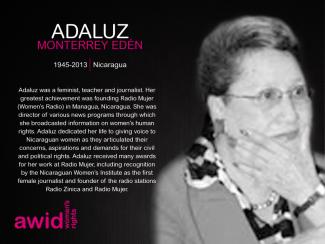
In our 2015 Online Tribute we honor five Women Human Rights Defenders murdered in the Middle East and North Africa region. These defenders worked for women and civil rights as lawyers and activists. Their death highlights the often dangerous and difficult working conditions in their respective countries. Please join AWID in honoring these women, their activism and legacy by sharing the memes below with your colleagues, networks and friends and by using the hashtags #WHRDTribute and 16Days.
Please click on each image below to see a larger version and download as a file


