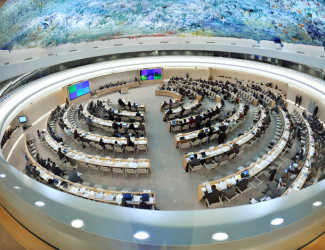
Jean-Marc Ferré | Flickr (CC BY-NC-ND 2.0)
A general view of participants at the 16th session of the Human Rights Council in Geneva, Switzerland.

Analyses Spéciales

L´AWID est une organisation féministe mondiale qui consacre ses efforts à la justice de genre, au développement durable et aux droits humains des femmes

Conseil des Droits de l'Homme (CDH)

​​​​​​Le Conseil des droits de l'homme (CDH) est un organe intergouvernemental clé du système des Nations Unies, responsable de la promotion et la protection des droits humains autour du globe. Il se réunit  trois fois par an en session ordinaire, en Mars, Juin et Septembre. Le Bureau du Haut-Commissariat des Nations Unies aux Droits de l’Homme (HCDH) constitue le secrétariat pour le CDH.

Le CDH :

  • Débat et adopte des résolutions sur les questions globales des droits humains ainsi que sur la situation des droits humains dans des pays particuliers

  • Examine les plaintes des victimes de violations des droits humains et des organisations activistes, au nom des victimes de violations des droits humains

  • Nomme des experts indépendants (que l'on connaît sous le nom de « Procédures Spéciales ») pour réviser les cas de violation des droits humains dans des pays spécifiques, ainsi que pour examiner et suivre des questions globales relatives aux droits humains

  • Prend part à des discussions avec les experts et les gouvernements sur les questions de droits humains

  • Évalue les bilans des États membres de l'ONU en matière de droits humains tous les quatre ans et demi, dans le cadre de l'examen périodique universel.

En savoir plus sur le CDH


Session actuelle: CDH 44

La prochaine session du CDH a lieu à Genève, en Suisse, du 30 juin au 17 juillet 2020.

AWID travaille avec des partenaires féministes, progressistes et du domaine des droits humains pour partager nos connaissances clé, convoquer dialogues et évènements avec la société civile, et influencer les négociations et les résultats de la session.

Avec nos partenaires, notre travail consiste à :


◾️ Suivre, surveiller et analyser les acteurs, discours et stratégies anti-droits et leur impact sur les résolutions du CDH.

◾️ Co-développer un plaidoyer collectif pour contrer les acteurs anti-droits et discuter plus en détails les résultats du Rapport de tendances 2017 du OURs

◾️ Soutenir, coordoner et développer de manière collaborative le Caucus féministe qui émerge au CDH.


Contenu lié

Fatima Qureshi

Biography

A nomad of cultures, born in Hong Kong, rooted in Turkish-Pakistani heritage, Fatima’s love for narratives - both in reading and co-creating them - fueled her passion for communications activism. Supported by her education in journalism, Fatima has worked for 7 years in digital and media communications fields with NGOs that provide education opportunities and legal aid to refugee and asylum seekers, as well as with the Muslim feminist movement which applies feminist and rights-based lenses in understanding and searching for equality and justice within Muslim legal tradition. She is a regular op-ed writer on feminist issues in the Global South.

Through storytelling in this hyper-digital age of social media, Fatima continues to collaborate with community organizers and grassroots activists to create audiovisual content with the aim to cultivate bridges of understanding towards collective liberation and decolonization. On days when she’s not working, she intently watches independent feminist films coming from Iran, Morocco and Pakistan and on other days, she performs spoken word poetry with her comrades in Kuala Lumpur.

Position
ICM Digital Communications and Partnerships Lead
Add to stories
Off

Snippet FEA EoS The Howl (FR)

Three arms with fist raised: one black, pink, and the last one in purple

Le hurlement
Participation et activisme

Pourquoi devrais-je envisager de participer à l’enquête?

Votre participation à l’enquête WITM est importante à plusieurs égards. Vous aurez, notamment, l’occasion de faire part de votre expérience vécue de la mobilisation de fonds pour soutenir votre organisation, de réclamer votre autorité en tant qu’experte sur la manière dont l’argent est transféré et qui il atteint réellement, et de contribuer à un plaidoyer collectif et cohérent auprès de financeurs afin que les fonds circulent davantage et soient de meilleure qualité. Au cours des deux dernières décennies, la recherche WITM de l’AWID s’est révélée être une ressource clé pour les activistes et les financeurs. Nous vous invitons chaleureusement à participer à sa troisième édition pour souligner la situation actuelle des ressources, remettre en question les fausses solutions, et identifier les modifications nécessaires dans le financement afin que les mouvements s’épanouissent et relèvent les défis complexes de notre époque.

About the AWID International Forum

More than an event!

The AWID International Forum is both a global community event and a space of radical personal transformation. A one-of-a-kind convening, the Forum brings together feminist, women’s rights, gender justice, LBTQI+ and allied movements, in all our diversity and humanity, to connect, heal and thrive.

About the 15th AWID International Forum

Rising Together: Connect, Heal, Thrive

The Forum theme – Rising Together – is an invitation to engage with our whole selves, to connect with each other in focused, caring and brave ways, so that we can feel the heartbeat of global movements and rise together to meet the challenges of these times.

A Hybrid Experience

For the first time, the AWID Forum offered three modes of participation:

In Person

at the Queen Sirikit National Convention Centre in Bangkok, Thailand.

Online

in Virtual Space (Capacity: 3000 participants).

Hubs

Connected in Cross Border Space.

With over 4,000 participants, 15th AWID International Forum in 2024 created a sweeping force to resist oppression towards collective healing and liberation. Keep watching this space for more forum stories and future forums updates!


A post shared by AWID (@awidwomensrights)


The past Forums

2021 - Feminist Realities. 

In December 2020, the AWID board took the difficult decision to cancel the 14th AWID International Forum which had been scheduled to take place from September 20-23, 2021, in the City of Taipei. 

Learn more here


2016 - Feminist Futures: Building Collective Power for Rights and Justice (Costa de Sauipe, Brazil)

Participants at the Black Feminisms Forum in Brazil, 2016

Given the complex world that we face today, the 2016 AWID Forum did not focus on a particular “issue”, but rather on creating more effective ways of working together!

Despite the challenging contexts in which the 2016 Forum took place (the Zika epidemic, a strike by Brazilian foreign-service workers, the impeachment of President Dilma Rousseff and subsequent turmoil), it succeeded in bringing together over 1800 participants from 120 countries and territories across all regions of the world.

What happened at the 13th AWID international Forum:

  • For 96% of participants who responded to the post Forum evaluation survey, the Forum was a major source of inspiration and energy.

  • 98% of participants considered it an important convening space for feminist movements and expressed hope that AWID continues to organize forums.

  • 59% of Forum evaluation survey respondents declared to be very satisfied with the Forum and 34% somewhat satisfied.

  • Over 150 sessions were delivered in different formats on a variety of topics ranging from bodily integrity and freedoms, to gender-based violence in the workplace, to strategies for building collective power.

  • The first-time Black Feminisms Forum (BFF), held just before the main AWID Forum, brought together 250 Black feminists from all over the world to co-create a powerful space to build and strengthen ongoing, intergenerational, transnational connections

Read more about what the 2016 AWID Forum achieved:

Download the Forum evaluation report


2012 - Transforming Economic Power to Advance Women's Rights and Justice (Istambul, Turkey)

AWID International Forum, in Cape Town, South Africa, 2008

The 12th AWID Forum was the largest and most diverse AWID Forum to date, bringing together 2239 women’s rights activists from 141 countries. Of these participants, around 65% were from the Global South and close to 15% were young women under 30, and 75% attended an AWID Forum for their first time.

The Forum program focused on transforming economic power to advance women’s rights and justice and featured over 170 different kinds of sessions including feminist economics toolbox skills-building sessions, breakout sessions representing all 10 Forum themes, in-depth sessions, and solidarity roundtables. 

Building on the momentum of the 2012 Forum, we transformed the website into a resource and learning Hub, which builds on the content generated by participants by featuring multi-media resources on all Forum components. 

Visit the 2012 Forum web archive


All AWID Forums

  • 2016: Feminist Futures: Building Collective Power for Rights and Justice (Costa de Sauipe, Brazil). Read the 2016 Forum Evaluation report
  • 2012: Transforming Economic Power to Advance Women's Rights and Justice (Istanbul, Turkey)
  • 2008: The Power of Movements (Cape Town, South Africa). Read our 2008 Forum Report
  • 2005: How does change happen? (Bangkok, Thailand)
  • 2002: Reinventing Globalization (Guadalajara, Mexico)
  • 1999: Leading Solutions for Equality and Justice (US)
  • 1996: Beyond Beijing From Words to Action (US)
  • 1993: Joining Forces to Further Shared Visions (US)
  • 1991: Working Together/Learning Together: A South North Dialogue (US)
  • 1989/1990: Global Em-Powerment for Women (US)
  • 1987: Moving Forward: Innovations in Development Policy, Action and Research (US)
  • 1985: Women Creating Wealth; Transforming Economic Development (US)
  • 1983: ‘Women in Development’ (Washington D.C, US)

What is the AWID International Forum?

Every three to four years, AWID hosts its flagship international event. It is the world’s largest event that wholeheartedly centers feminist and gender justice movements in all their diversity. It is a global gathering of feminist activists, allied movements, scholars, funders and policymakers. The Forums rotate between different regions and countries in the global South.

Nana Abuelsoud

Biography

Nana es una organizadora feminista e investigadora en derechos reproductivos y políticas demográficas que reside en Egipto. Es miembro de RESURJ (organización feminista por la justicia sexual y reproductiva), del Órgano Asesor del Proyecto A del Líbano y de la Comisión de la Comunidad de Mama Cash. Nana tiene una maestría en Salud Pública del Instituto KIT y la Universidad Vrije de Ámsterdam. En su trabajo, da seguimiento y contextualiza las políticas demográficas nacionales, al tiempo que reúne información para abordar la eugenesia moderna, las ayudas internacionales de carácter regresivo y el autoritarismo. Anteriormente, formó parte de la Fundación de Ginebra para la Educación y la Investigación Médica, la Iniciativa Egipcia para los Derechos Personales y el Colectivo Feminista Ikhtyar de El Cairo.

Add to stories
Off

Snippet FEA What if we perceived land (EN)

What if we perceived land and Nature not as private property to exploit, but as a whole to live in, learn from, and harmoniously coexist with? What if we repaired our relationships with the land and embraced more sustainable alternatives that nurture both the planet and its communities?

Nous Sommes la Solution (We Are the Solution, NSS) is one of many women-led movements striving to do this. This is their story.

Our group, organization and/or movement has not taken or mobilized funding from external funders, should we take the survey?

Yes! We recognize and appreciate different reasons why feminists, in their respective contexts, don’t have external funding: from being ineligible to apply for grants and/or receive money from abroad, to relying on resources generated autonomously as a political strategy in its own right. We want to hear from you regardless of your experience with external funding.

Test Page

This is body text

After the gallery

Some English aside content

¿Cómo se inició AWID?

AWID surgió en 1982 y se ha ido transformando con el paso de los años en una verdadera organización mundial.

Saber más de nuestra historia

Leer «From “WID” to “GAD” to Women’s Rights: The First Twenty Years of AWID» (en inglés)

Snippet FEA What are the objectives (EN)

What are the Objectives of Nous Sommes la Solution?

¿Cuáles son los idiomas oficiales de ¿Dónde está el dinero?

Por el momento, la encuesta en KOBO está disponible en árabe, español, francés, inglés, portugués y ruso. Tendrás oportunidad de seleccionar el idioma de preferencia al inicio de la encuesta.

Defending LGBTQI Rights

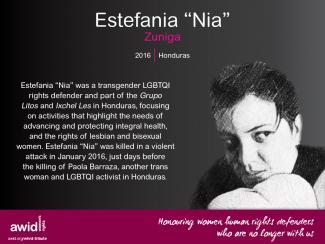
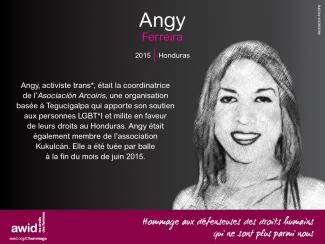
Student, Writer, Leader, Advocate. Each of the four women honored below had their own way of activism but what they had in common is that they all promoted and defended Lesbian Gay Bisexual Transgender Queer and Intersex rights. Join us in remembering and honoring these Women Human Rights Defenders, their work and legacy by sharing the memes below and tweeting by using the hashtags #WHRDTribute and #16Days. 


Please click on each image below to see a larger version and download as a file


Quels sont les enjeux sur lesquels travaille l’AWID ?

L’AWID œuvre à renforcer la justice de genre et les droits humains des femmes.

Nous travaillons à renforcer les voix et l'impact des défenseuses des droits humains, des organisations et des mouvements.

Nos Domaines prioritaires sont étroitement liés aux réalités internationales. Ils sont le reflet de situations de plus en plus précaires qui sapent les droits des femmes à l’échelle mondiale.

  • La justice économique 
  • Les ressources pour les droits des femmes
  • S'opposer aux fondamentalismes religieux
  • Les défenseuses des droits humains
  • L'activisme des jeunes féministes

Découvrir les domaines prioritaires de l’AWID