Jean-Marc Ferré | Flickr (CC BY-NC-ND 2.0)
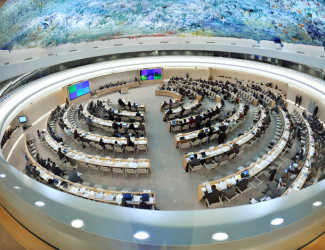
A general view of participants at the 16th session of the Human Rights Council in Geneva, Switzerland.

Analyses Spéciales

L´AWID est une organisation féministe mondiale qui consacre ses efforts à la justice de genre, au développement durable et aux droits humains des femmes

Conseil des Droits de l'Homme (CDH)

​​​​​​Le Conseil des droits de l'homme (CDH) est un organe intergouvernemental clé du système des Nations Unies, responsable de la promotion et la protection des droits humains autour du globe. Il se réunit  trois fois par an en session ordinaire, en Mars, Juin et Septembre. Le Bureau du Haut-Commissariat des Nations Unies aux Droits de l’Homme (HCDH) constitue le secrétariat pour le CDH.

Le CDH :

  • Débat et adopte des résolutions sur les questions globales des droits humains ainsi que sur la situation des droits humains dans des pays particuliers

  • Examine les plaintes des victimes de violations des droits humains et des organisations activistes, au nom des victimes de violations des droits humains

  • Nomme des experts indépendants (que l'on connaît sous le nom de « Procédures Spéciales ») pour réviser les cas de violation des droits humains dans des pays spécifiques, ainsi que pour examiner et suivre des questions globales relatives aux droits humains

  • Prend part à des discussions avec les experts et les gouvernements sur les questions de droits humains

  • Évalue les bilans des États membres de l'ONU en matière de droits humains tous les quatre ans et demi, dans le cadre de l'examen périodique universel.

En savoir plus sur le CDH


Session actuelle: CDH 44

La prochaine session du CDH a lieu à Genève, en Suisse, du 30 juin au 17 juillet 2020.

AWID travaille avec des partenaires féministes, progressistes et du domaine des droits humains pour partager nos connaissances clé, convoquer dialogues et évènements avec la société civile, et influencer les négociations et les résultats de la session.

Avec nos partenaires, notre travail consiste à :


◾️ Suivre, surveiller et analyser les acteurs, discours et stratégies anti-droits et leur impact sur les résolutions du CDH.

◾️ Co-développer un plaidoyer collectif pour contrer les acteurs anti-droits et discuter plus en détails les résultats du Rapport de tendances 2017 du OURs

◾️ Soutenir, coordoner et développer de manière collaborative le Caucus féministe qui émerge au CDH.


Contenu lié

Voici votre guide pratique et les infographies «Vers un écosystème de financement féministe»

What Our Members Say - ES

Lo que dicen nuestrxs miembrxs

Snippet FEA HEALTH CONDITIONS (EN)

An illustration of a white-skinned person in yellow uniform of a nurse with stethoscope in their hand.

HEALTH CONDITIONS

Laurie Carlos

Laurie Carlos était une comédienne, réalisatrice, danseuse, dramaturge et poétesse aux États-Unis. Artiste hors pair et visionnaire, c’est avec de puissants modes de communication qu’elle a su transmettre son art. 

« Laurie entrait dans la pièce (n’importe quelle pièce/toutes les pièces) avec une perspicacité déroutante, un génie artistique, une rigueur incarnée, une féroce réalité – et une détermination à être libre... et à libérer les autres. Une faiseuse de magie. Une devineresse. Une métamorphe. Laurie m’a dit un jour qu’elle entrait dans le corps des gens pour trouver ce dont ils et elles avaient besoin. » - Sharon Bridgforth

Elle a employé plusieurs styles de performance alliant les gestes rythmiques au texte. Laurie encadrait les nouveaux·elles comédien·ne·s, performeur·euse·s et dramaturges, et a contribué à développer leur travail dans le cadre de la bourse Naked Stages pour les artistes émergent·e·s. Associée artistique au Penumbra Theatre, elle a participé à la sélection de scripts à produire, dans l’objectif « d’intégrer des voix plus féminines dans le théâtre ». Laurie faisait également partie des Urban Bush Women, une compagnie de danse contemporaine reconnue qui contait les histoires de femmes de la diaspora africaine.

Elle fit ses débuts à Broadway dans le rôle de Lady in Blue, en 1976, dans la production originale et primée du drame poétique For colored girls who have considered suicide / when the rainbow is enuf de Ntozake Shange. L’oeuvre de Laurie inclut White Chocolate, The Cooking Show et Organdy Falsetto

« Je raconte les histoires à travers le mouvement – les danses intérieures qui se produisent spontanément, comme dans la vie – la musique et le texte. Si j’écris une ligne, ce n’est pas forcément une ligne qui sera dite ; ce peut être une ligne qui sera bougée. Une ligne à partir de laquelle de la musique est créée. Le geste devient phrase. Tant de ce que nous sommes en tant que femmes, en tant qu’êtres, tient aux gestes que nous exprimons les un·e·s par rapport aux autres, tout le temps, et particulièrement dans les moments d’émotion. Le geste devient une phrase, ou un état de fait. Si j’écris “quatre gestes” dans un script, cela ne signifie pas que je ne dis rien;cela veut dire que j’ai ouvert la voie à ce que quelque chose soit dit physiquement. » Laurie Carlos

Laurie est née et a grandi à New York, a travaillé et vécu à Minneapolis-Saint-Paul. Elle est décédée le 29 décembre 2016, à l’âge de 67 ans, après un combat contre le cancer du côlon. 


Hommages :

« Je pense que c’était exactement l’intention de Laurie. De nous sauver. De la médiocrité. De l’ego. De la paresse. De la création artistique inaboutie. De la paralysie par la peur.
Laurie voulait nous aider à briller pleinement.
Dans notre expression artistique.
Dans nos vies. » - Sharon Bridgforth pour le Pillsbury House Theatre

« Quiconque connaissait Laurie aurait dit que c’était une personne singulière. Elle était sa propre personne. Elle était sa propre personne, sa propre artiste ; elle mettait en scène le monde tel qu’elle le connaissait avec un vrai style et une compréhension fine, et elle habitait son art. » – Lou Bellamy, Fondatrice de la Penumbra Theatre Company, pour le Star Tribune 

Lire un hommage complet par Sharon Bridgforth (seulement en anglais)

Alejandra Morena

Biography

Alejandra se passionne pour les droits des femmes et la justice de genre. Elle rêve de créer un monde qui place le soin en son cœur, celui des personnes comme celui de la nature. Experte féministe en droits humains, elle a travaillé dans des domaines en lien avec le genre, le climat, la justice sociale et économique au sein de diverses organisations internationales. Ses domaines d’expertise comprennent le développement des connaissances et la co-création, la recherche, la facilitation et le plaidoyer. Elle est titulaire d’un master en droits humains de l’université d’Essex et a rédigé et co-élaboré de nombreuses publications, dont l’article «Enragée: Femmes et Nature». La campagne Activisme Féministe Sans Peur s’appuie sur des entretiens et des recherches menés par Alejandra. 

Originaire d’Argentine, elle a vécu et travaillé dans plusieurs pays d’Europe et d’Amérique latine au cours des vingt dernières années. Alejandra aime la photographie, la mer, préparer des gâteaux avec sa fille et déguster des plats du monde entier. En tant que mère, elle met un point d’honneur à briser le cycle des schémas répétitifs transgénérationnels. Alejandra puise son énergie et son inspiration auprès des femmes extraordinaires qui font partie de sa vie, et qui vivent aux quatre coins du monde.

Position
Research & Advocacy Lead, Resourcing Feminist Movements
Add to stories
Off

Reason to join 3

Share your stories and hear from others. By connecting our experiences, narratives and proposals we help co-create and amplify Feminist Realities.

The AWID Forum Access Fund

We strive to make the AWID Forum a truly global gathering with participation from a diverse array of movements, regions and generations. To this end, AWID mobilizes resources for a limited Access Fund (AF) to assist some participants with the costs of attending the Forum. 

The 14th AWID International Forum will take place 11-14 January 2021, in Taipei, Taiwan. 


How will  the Access Fund be allocated?

For this AWID Forum, there will be no application process. 

Access Fund grants will be allocated by invitation only to:

  • Two  persons per activity selected for the Forum program (decided by those organizations, groups or individuals organizing the activity) 
  • Participants who identify as part of Priority Forum  Constituencies (PFCs) recommended by the organizations, networks and groups who are co-creating the Forum with AWID. 
  • PFCs are those which we consider would strengthen our collective power as movements, are not centered in mainstream feminist movements, and whose Feminist Realities we would like to honor, celebrate and visibilize: 
    - Black feminists 
    - Indigenous feminists
    - Trans, gender non-conforming and intersex feminists
    - Feminists with disabilities 
    - Feminist sex workers and informal workers, including migrant workers
    - Feminists affected by migration 
    - Women affected by drug policy
    - Feminists from the Forum regions (with a focus on the Pacific and mainland China) 

In addition, AWID will fund approximately 100 participants from the Forum’s location. Forum Committee Members (Content and Methodology, Access and Host) as well as those in the Artists Working Group [link] are also granted Access Fund support.

What does the Access Fund cover?

For selected participants, the Access Fund will cover the cost of their:

  • Flight
  • Accommodation
  • Visa
  • Local transportation in Taipei
  • Travel medical insurance

The Access Fund will NOT cover their: 

  • Forum registration fee
  • Transportation to and from the airport in their city of departure
  • Other incidental costs

Apart from the Access Fund, how can I fund my participation at the Forum?

We have listed other ideas on how to fund your participation at the AWID Forum on the Funding Ideas page. 

More Funding Ideas

Snippet - CSW69 Image - FR

Snippet FEA WE ARE LEGAL AND ALWAYS WERE (ES)

España

Sindicato OTRAS


SOMOS LEGALES Y

SIEMPRE LO FUIMOS

Roxana Reyes Rivas

Roxana Reyes Rivas, philosopher, feminist, lesbian, poet, politician and LGBT and women’s rights activist from Costa Rica. Owner of a sharp pen and incisive humour, a laugh a minute. She was born in 1960 and raised in San Ramón of Alajuela, when it was a rural town, and her whole life she would break away from the mandates of what it meant to be a woman.   

With El Reguero (Costa Rican lesbian group) she organized lesbian festivals for over a decade, fun-filled formative spaces to come together at a time when the Costa Rican government and society persecuted and criminalized the lesbian existence. For hundreds of women the lesbian festivals where the only place they could be themselves and come together with others like them.  

Roxana would often say founding political parties was one of her hobbies. “It’s important for people to understand there are other ways to do politics, that many issues need to be solved collectively”. She was one of the founders of the New Feminist League and VAMOS, a human rights focused political party.

“The philosophical trade is meant to jab, to help people ask themselves questions. A philosopher who doesn’t irritate anyone is not doing her job”. For 30 years Roxana taught philosophy at several Costa Rican public universities. Through her guidance, generations of students reflected about the ethical dilemmas in science and technology.  

Roxana’s favourite tool was humour, she created the Glowing Pumpkin award, an acknowledgement to ignorance that she would bestow upon public figures, through her social media channels, mocking their anti-rights expressions and statements.  

An aggressive cancer took Roxana at the end of 2019, before she could publish a compilation of her poems, a departing gift from the creative mind of a feminist who always raised her voice against injustice.

What does AWID do?

Values - intersectionality

Interseccionalidad

Creemos que para que los movimientos feministas sean transformadores y sólidos debemos seguir trabajando en nuestras similitudes y diferencias. También debemos cuestionar el poder y los privilegios, tanto dentro como fuera de nuestros movimientos.

AWID Member Community Guidelines

Co-creating welcoming and safe spaces

The co-creation of our feminist realities starts with ourselves and how we treat each other. We are dedicated to creating and protecting safe and supportive spaces for our communities both online and in person. We also consider that safe and welcoming spaces are co-owned and co-created.

We  expect our members to act in a manner that is ethical, responsible and consistent with the values of AWID and assume collective responsibility to ensure an atmosphere of mutual respect and solidarity. 


All AWID members are encouraged to: 

  • Connect with others, help break isolation and further solidarity.  It’s easy to feel lost and alone, and a little friendliness and responsiveness goes a long way.

  • Interact and engage peacefully. Differences in opinion will naturally arise, so please think of these differences as useful for expanding your thinking and ways of seeing the world.

  • Help build a space that recognizes and validates multiple lived experiences and diversities of bodies and gender expressions. Recognize that we all carry intersectional identities.

  • Use inclusive language. Be respectful of how people want to be referred to in terms of gender identity or expression (like pronouns), and practice inclusive language. 

  • Listen and make adjustments in your behavior and ways of engaging if someone says they feel uncomfortable. Don’t ask others questions that you wouldn't want to be asked yourself.

  • Help challenge oppressive behavior, which includes harassment, verbal or physical violence, violation of consent, and any action that perpetuates classism, ageism, ableism, racism, misogyny, heterosexism, transphobia and other oppressions.  If needed, please reach out to AWID staff. 

  • Practice speaking and listening with an open mind and heart and without judgement.

  • Be honest, open and heartfelt. Speak and share authentically about your experiences, your challenges, your hopes and dreams, and your vision for your own life and your community.

  • Practice active listening and self-awareness. Be aware of how much time and space you are taking up- leave room for others, practice active listening and learning.

  • Be mindful and credit others for their work and activism. Remember that we are all working collectively to contribute to change-- Ensure that you recognize the contribution of others and credit them when appropriate e.g. in discussions, or in articles, pictures etc.

  • Stay safe! We encourage you to take measures to protect yourself online and in person, especially if you have reason to believe that speaking out will put you in danger. Members may use aliases or profile images that conceal their identity. For more information please refer to the Digital Security First Aid Kit for Human Rights Defenders produced by APC - Association for Progressive Communications. 

  •  Respect the privacy needs of others! Do not share or forward any information without explicit permission.


Our Values

Solidarity 

We take a position in solidarity with each other and diverse struggles for justice and freedoms. We strive to mobilize and strengthen collective action and practice meaningful ways of working with each other.

Human rights

We believe in a full application of the principle of rights including those enshrined in international laws and affirm the belief that all human rights are interrelated, interdependent and indivisible. We are committed to working towards the eradication of all discriminations based on gender, sexuality, religion, age, ability, ethnicity, race, nationality, class or other factors.

Responsibility, Accountability, and Integrity

We strive for transparency, responsible use of our resources, fairness in our collaborations and accountability and integrity with our members, partners, funders and the movements with(in) which we work. We are committed to reflecting on our experiences, sharing our learnings openly, and striving to change our practices accordingly.

Intersectionality

We believe that for feminist movements to be transformative and strong we must continue to work across our similarities and differences. We also must interrogate power and privilege both within and outside our movements.

Bodily autonomy, integrity and freedoms

We celebrate everyone's right to choose their identities, relationships, goals, work, dreams and pleasures, and what they do with their mind, body and spirit. We believe in working towards access to resources, information and safe and enabling environments that allow this to happen.

Justice and systemic change

We work towards a world based on social, environmental, and economic justice; and interdependence, solidarity, and respect. We work towards dismantling systems of oppressive power and against all its manifestations, including patriarchy, fundamentalisms, militarisms, fascisms and corporate power that threaten our lives and our world. We want a just world where resources and power are shared in ways that enable everyone to thrive.


Please note:  

AWID reserves the right to delete comments, suspend or revoke membership when our community guidelines have been violated. AWID members are not authorised to represent AWID in any official capacity unless stipulated in writing. Members cannot use AWID spaces to proselytize or recruit members to join a religious faith or organisation. Members cannot use AWID spaces to request funds for personal use although links to external fundraising efforts or activism campaigns are permissible.
 

Snippet - Rights and Resources - FR

Droits et ressources : se préparer pour les 30 prochaines années

✉️ Les inscriptions en personne sont closes. Inscrivez-vous au livestream ici
Événement en anglais 

📅 Mercredi 12 mars 2025
🕒 12.00h-13.30h EST

🏢 PNUD, 304 E 45th St. Doha Room, 11th Floor (FF Building)

Organisé par : PNUD, Femena, SRI et AWID

Snippet FEA Unio Otras Photo 2 (FR)

Photo de Sabrina Sanchez agitant un drapeau et menant une manifestation. Elle marche en portant un ensemble de lingerie et des talons. Il y a des gens avec des affiches derrière elle.

Dorothy Masuka

«Yo no planeaba ser una cantante, el canto planeó estar en mí.» - Dorothy Masuka (entrevista de Mail & Guardian)

Dorothy Masuka, nacida en 1935 en Bulawayo (en ese momento Rodesia del Sur, ahora Zimbabue), creció en Sudáfrica, y se convirtió en una reconocida compositora, cantante de jazz, activista, y defensora ferviente de  la lucha contra el apartheid. Definida como «una arquitecta del discurso de la música popular africana de liberación», Dorothy a menudo cantaba sobre política en lenguas indígenas africanas y, a través de todo su trabajo, confrontó las políticas racistas del gobierno sudafricano.

Una de estas canciones, titulada «Dr. Malan» (por el político pro-apartheid D.F. Malan) fue prohibida. Luego, en 1961, grabó «Lumumba», una canción sobre el asesinato del líder anticolonial Patrice Lumumba. El trabajo y el activismo de Dorothy atrajeron la atención de la División Especial de la policía sudafricana, y fue forzada a un exilio político que se prolongaría durante tres décadas. Durante ese tiempo, trabajó con grupos independentistas, incluido el Congreso Nacional Africano. En 1992, cuando el apartheid comenzó a desmoronarse y Nelson Mandela fue liberado de prisión, Dorothy regresó a Sudáfrica.

Su trabajo incluye la primera canción que grabó, en 1953, titulada «Hamba Notsokolo», que fue un éxito durante la década de 1950, y hoy es un clásico muy valorado. También escribió «El Yow Phata Phata», una canción que fue adaptada por Miriam Makeba, quien hizo de «Pata, Pata» un hit internacional.

Arraigados en la resistencia, la música y el activismo de Dorothy (popularmente conocida como «Auntie Dot» [«Tía Dot»]) estaban entretejidos, y dejaron un legado magnífico e inspirador.

Dorothy falleció en Johannesburgo el 23 de febrero de 2019 a la edad de 83 años, por problemas de salud.


Entrevista a Dorothy Masuka de Mail & Guardian (en inglés)

Escucha su música:

Hamba Nontsokolo
El Yow Phata Phata
 

Las organizaciones, ¿pueden afiliarse a AWID?

Si, alentamos la afiliación institucional

Actualmente contamos en nuestra membresía con cientos de organizaciones destacadas e innovadoras que trabajan en temas relacionados con los derechos de las mujeres y el desarrollo. Los criterios de afiliación son los mismos que para las personas a título individual, aunque las cuotas y los beneficios son diferentes, con el fin de atender a las necesidades de las instituciones afiliadas.

Conoce más sobre la membresía institucional de AWID