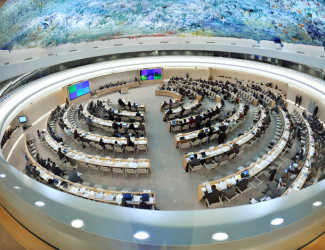
Conseil des Droits de l'Homme (CDH)
Le Conseil des droits de l'homme (CDH) est un organe intergouvernemental clé du système des Nations Unies, responsable de la promotion et la protection des droits humains autour du globe. Il se réunit trois fois par an en session ordinaire, en Mars, Juin et Septembre. Le Bureau du Haut-Commissariat des Nations Unies aux Droits de l’Homme (HCDH) constitue le secrétariat pour le CDH.
Le CDH :
-
Débat et adopte des résolutions sur les questions globales des droits humains ainsi que sur la situation des droits humains dans des pays particuliers
-
Examine les plaintes des victimes de violations des droits humains et des organisations activistes, au nom des victimes de violations des droits humains
-
Nomme des experts indépendants (que l'on connaît sous le nom de « Procédures Spéciales ») pour réviser les cas de violation des droits humains dans des pays spécifiques, ainsi que pour examiner et suivre des questions globales relatives aux droits humains
-
Prend part à des discussions avec les experts et les gouvernements sur les questions de droits humains
-
Évalue les bilans des États membres de l'ONU en matière de droits humains tous les quatre ans et demi, dans le cadre de l'examen périodique universel.
Session actuelle: CDH 44
La prochaine session du CDH a lieu à Genève, en Suisse, du 30 juin au 17 juillet 2020.
AWID travaille avec des partenaires féministes, progressistes et du domaine des droits humains pour partager nos connaissances clé, convoquer dialogues et évènements avec la société civile, et influencer les négociations et les résultats de la session.
Avec nos partenaires, notre travail consiste à :
◾️ Suivre, surveiller et analyser les acteurs, discours et stratégies anti-droits et leur impact sur les résolutions du CDH.
◾️ Co-développer un plaidoyer collectif pour contrer les acteurs anti-droits et discuter plus en détails les résultats du Rapport de tendances 2017 du OURs
◾️ Soutenir, coordoner et développer de manière collaborative le Caucus féministe qui émerge au CDH.
Contenu lié
L’AWID est-elle une organisation féministe ?
Reason to join 1
Faites partie d’une organisation et d’une communauté internationales, associatives et féministes. Nos membres sont établi·e·s dans toutes les régions du monde; iels apprennent les un·e·s des autres et se soutiennent mutuellement dans un réseau mondial fondé sur la solidarité.
Почему мне стоит принять участие в опросе?
Есть много причин, по которым ваше участие в опросе очень важно. Это возможность поделиться своим опытом привлечения финансирования для деятельности вашей организации; заявить о себе как об эксперте в вопросах движения денежных средств и их получателей; внести свой вклад в коллективную и последовательную адвокацию среди доноров, чтобы привлечь более объемное и эффективное финансирование. За последние два десятилетия исследования AWID в этой области зарекомендовали себя как ключевой ресурс для активисток(-тов) и доноров. Мы приглашаем вас присоединиться к нам в реализации третьей части инициативы «Где деньги?», чтобы осветить реальное состояние ресурсного обеспечения, оспорить ошибочные решения и указать на то, как необходимо изменить финансирование, чтобы движения процветали и реагировали на сложные вызовы нашего времени.
Fahmida Riaz
“Afterwards
After love the first time,
Our naked bodies and minds
A hall of mirrors,
Wholly unarmed, utterly fragile,
We lie in one another's arms
Breathing with care,
Afraid to break
These crystal figurines.” - Fahmida Riaz
Fahmida Riaz broke social taboos by writing about female desire in her poetry, creating alternative narratives about women’s bodies and sexuality, and setting new standards in Urdu literature.
Her work faced harsh criticism from conservatives, who accused her of using erotic and “pornographic” expressions in her poetic language.
Fahimida was eventually blacklisted and charged with sedition under Section 124A of the Pakistan Penal Code) during the dictatorship of Zia Ul Haq. Forced into exile in 1981, she spent almost seven years in India before returning to Pakistan.
As part of the preface to “Badan Dareeda” ('The Torn-Bodied'), a collection of poetry published in 1974, she wrote:
The brilliance of Fahmida was in defying any singular logic or categories of gender, nation, religion or culture. She refused to be put in the role of a ‘woman poet’, breaking with traditional definitions of feminine poetry and concepts and themes (ranging from political consciousness, body, culture, desire, religion, home) and knocking down inhibitions put on her gender.
“You have to understand that culture can have no essence. Cultures move, flowing into one another, forming new cultures. Culture is born this way. There is no clash of cultures.”
Fahmida authored more than 15 books on poetry and fiction including her poem ‘Taaziyati Qaraardaaden’ (‘Condolence Resolutions’) that might serve as an appropriate tribute to her life and legacy and a collection of poems (Apna Jurm To Saabit He ‘My Crime Stands Proven’) published in 1988 during her time in exile.
Fahmida Riaz was born in Meerut, India on 28 July 1946 and passed away on 21 November 2018 in Lahore, Pakistan.
¿Por qué AWID eligió Taipéi como sede del Foro?
AWID dedicó casi dos años al trabajo de identificar una sede para el Foro en la región Asia-Pacífico (la ubicación del Foro rota entre las distintas regiones).
Sobre la base de una investigación documental inicial y de consultas con aliadxs (que nos llevaron a eliminar muchas otras opciones de la región), organizamos una serie de visitas exhaustivas a Nepal, Malasia, Sri Lanka, Tailandia, Indonesia y, más tarde, Taiwán.
Cada visita incluyó, no solo la evaluación de la infraestructura logística, sino también encuentros con grupos y activistas feministas locales para entender mejor el contexto y conocer su percepción de las oportunidades y los riesgos potenciales de organizar un Foro de AWID en sus contextos.
En nuestras visitas encontramos movimientos feministas locales impresionantemente vibrantes y diversos.
Estos movimientos expresaron, en varias ocasiones, sentimientos encontrados respecto de las oportunidades y los riesgos que podría acarrearles la visibilidad de un evento como el Foro. En una de las visitas, durante los primeros treinta minutos de la reunión, escuchamos a lxs activistas presentes decir, en forma unánime, que un Foro de AWID sufriría una enorme reacción, que los derechos LGBTQ son un asunto particularmente candente, y que los grupos fundamentalistas aparecerían con toda su fuerza a interrumpir el evento.
Cuando respondimos, «De acuerdo, entonces ustedes no creen que sea una buena idea», nuevamente la respuesta unánime fue «Por supuesto que es una buena idea, ¡queremos cambiar la narrativa!». En algunos de estos lugares nos resultó difícil oír y ver que muchxs activistas feministas querían aprovechar la oportunidad de un evento grande y visible, y que estaban preparadxs a enfrentar los riesgos locales; pero nuestras consideraciones, como anfitrionxs de casi dos mil personas de todo el mundo, nos imponen un cálculo distinto del riesgo y la factibilidad.
También tuvimos que analizar qué significa organizar un foro feminista que a sea coherente con los principios de inclusión, reciprocidad y autodeterminación, en aquellos casos en que la política y la práctica de Estado son, en general, contrarias a estos principios (aunque lxs funcionarixs de los ministerios de turismo hayan trabajado arduamente para atenuar estas características).
Sopesamos las consideraciones de infraestructura con la oportunidad potencial de impulsar algunas agendas feministas a nivel nacional, y el contexto político nacional.
En muchos de estos lugares, monitorear el contexto nos resultó un ejercicio pendular: de un momento abierto y seguro para los debates feministas podíamos pasar a otro de brutal represión y xenofobia, capaz de sacrificar las prioridades feministas como piezas de negociación política para tranquilizar a las fuerzas antiderechos del ala derechista.
El proceso ha sido una reflexión aleccionadora sobre el contexto increíblemente complicado para el activismo por los derechos de las mujeres y la justicia de género en todo el mundo.
Nuestras dificultades en la región Asia-Pacífico nos llevaron a preguntarnos si no sería más fácil mover el Foro a una región distinta. Sin embargo, hoy en día no podríamos organizar un Foro de AWID en Estambul como lo hicimos en 2012, ni podríamos hacerlo en Brasil como lo hicimos en 2016.
Teniendo en cuenta toda esta complejidad, AWID seleccionó Taipéi como ubicación para el Foro porque:
- ofrece un cierto grado de estabilidad y seguridad para la diversidad de participantes que convocamos al Foro;
- tiene también un alto nivel de capacidad logística, y resulta accesible para muchxs viajerxs (con la facilitación de un trámite de visa electrónico para conferencias internacionales); y
- el Foro es bien recibido por el movimiento feminista local, que está muy interesado en interactuar con feministas de todo el mundo.
Al organizar el Foro de AWID, estamos tratando de construir y sostener, de la mejor manera posible, un espacio para las diversas expresiones de solidaridad, indignación, esperanza e inspiración que son el núcleo de los movimientos feministas.
En este momento, creemos que Taipéi es la sede, dentro de la región Asia-Pacífico, que mejor nos permitirá construir ese espacio seguro y rebelde para nuestra comunidad feminista global.
De hecho, en el mundo contemporáneo no existe una ubicación ideal para un Foro centrado en las Realidades Feministas. Donde sea que vayamos, ¡debemos construir ese espacio juntxs!
Snippet FEA Map of Spain Union Otras (EN)

Do you produce an annual report?
Yes, we do produce annual reports.
All our annual reports are accessible online.
Solidarity: membership why page
Solidarity
We take a position in solidarity with each other and diverse struggles for justice and freedoms. We strive to mobilize and strengthen collective action and practice meaningful ways of working with each other.
Islam Bibi
Nós redistribuímos recursos para os nossos parceires beneficiários e identificamo-nos como um fundo feminista e/ou de mulheres. Devemos participar no inquérito?
Não, apreciamos muito o vosso trabalho, mas atualmente não solicitamos respostas de fundos feministas e de mulheres. Encorajamos-vos a partilhar o inquérito com os vossos parceires beneficiários e as vossas redes feministas.
Navleen Kumar
"No era una persona. Era una potencia". - Así recuerda unx compañerx activista a Navleen Kumar.
Nacida el 15 de octubre de 1994, Navleen Kumar fue una ferviente activista por el derecho a la tierra y la justicia social de la India.
Con integridad y compromiso, trabajó durante más de una década para proteger y restaurar las tierras de los pueblos indígenas (adivasi) en el distrito de Thane, un área arrebatada por los propietarios y promotores inmobiliarios a través de medios como la coerción y la intimidación. Luchó contra esta injusticia y estos crímenes a través de intervenciones legales en diferentes tribunales, y descubrió que la manipulación de los registros de las tierras era una característica recurrente en la mayoría de los casos de adquisición de terrenos. En uno de los casos, el de los Wartha (una familia tribal), Navleen descubrió que la familia había sido engañada con la complicidad de funcionarixs gubernamentales.
Así, a través de su trabajo, ayudó a restituir la tierra a la familia Wartha, y siguió dedicándose a otros casos de transferencias de tierras adivasi.
"Su artículo sobre el impacto de la alienación de la tierra en las mujeres y las niñas y niños adivasi traza la historia y las complejidades de la alienación tribal desde la década de los 70, cuando las familias de clase media comenzaron a trasladarse a los suburbios de Mumbai, que se extendían mientras el valor de la propiedad en la ciudad aumentaba de forma exponencial.Los complejos de viviendas proliferaron en estos suburbios, y lxs integrantes de las comunidades tribales, que eran analfabetxs, pagaron el precio por ello. El costo de las tierras de primera, cerca de las líneas de ferrocarril, alcanzó un precio elevado y los constructores se abalanzaron sobre este cinturón como buitres, arrebatando de forma ilegal las tierras a las comunidades tribales y otrxs residentes locales ". - Jaya Menon, Comisión de Justicia y Paz.
Durante el curso de su activismo, Navleen recibió numerosas amenazas y sobrevivió a varios atentados contra su vida. A pesar de ello, siguió trabajando no sólo en lo que era importante para ella, sino que además contribuyó a cambiar la vida y la realidad de las muchas personas a las que apoyó en su lucha por la justicia social.
Navleen murió apuñalada el 19 de junio de 2002 en su edificio de departamentos. Dos gánsteres locales fueron arrestados por su asesinato.
Anatomy of a Survivor's Story
Maryum Saifee (@msaifee), New York, USA
When you do a search for “Female Genital Mutilation” or “FGM” online, an image of four line-drawings of the female anatomy pop up next to its Wikipedia entry. It illustrates four types of violence. The first being a partial cut to the clitoris. The second, a more invasive cut with the entire clitoris removed. The third is progressively worse with the removal of the clitoris, labia majora and minora. And the fourth box illustrates a series of hash marks to symbolize stitches over the vaginal opening to allow only for urination and menstruation.
As a survivor of FGM, most questions about my story fixate on the physical. The first question I usually get asked is what type of FGM I underwent. When I told a journalist once that I went through Type 1, she said “oh, that’s not so bad. It’s not like type three which is far worse.” She was technically right. I had the least invasive form. And for many years, I gaslighted myself into feeling a sense of relief that I was one of the lucky ones. I comforted myself noting that I could have been less fortunate with all of my genitalia gouged out, not just the clitoral tip. Or worse I could have been one of the ones who didn’t survive at all. Like Nada Hassan Abdel-Maqsoud, a twelve year old, who bled to death on a doctor’s operating table earlier this year in Upper Egypt. Nada is a reminder to me that for every data point -- 200 million women and girls who live with the consequences of FGM globally -- there is a story. Nada will never be able to tell hers.
As much as I find the label “survivor” suffocating at times -- I also realize there is privilege embedded in the word. By surviving, you are alive. You have the ability to tell your story, process the trauma, activate others in your community and gain insights and a new language and lens to see yourself through.
The act of storytelling can be cathartic and liberating, but it can also shatter the storyteller in the process.
Without integrating the psychosocial support of trained clinicians into storytelling and healing retreats, well-intentioned interventions can result in more trauma. This is all the more important as FGM survivors navigate the double pandemic of their own PTSD from childhood trauma, and the indefinite COVID-19 global shutdown.
In many anti-FGM advocacy spaces, I have seen this insatiable hunger to unearth stories -- whatever the cost to the storyteller. The stories help activate funding and serve as a data point
for measuring impact.
Survivor stories then become commodities fueling a storytelling industrial complex. Storytellers, if not provided proper mental health support in the process, can become collateral damage.
My motivation in writing this piece is to flip the script on how we view FGM survivors, prioritizing the storyteller over the story itself.
FGM survivors are more than the four boxes describing how the pieces of our anatomy were cut, pricked, carved, or gouged out. In this essay, I’ll break down the anatomy of an FGM survivor’s story into four parts: stories that break, stories that remake, stories that heal, and stories that reveal.
Type 1: Stories that break
I was sitting in the heart of Appalachia with a group of FGM survivors, meeting many for the first time. As they shared their traumas, I realized we all belonged in some way or another to the same unenviable club. A white Christian survivor from Kentucky - who I don’t think I would have ever met if we didn’t have FGM survivorship connecting us - told the contours of her story.
There were so many parallels. We were both cut at seven. She was bribed with cake after her cut. I was bribed with a jumbo-sized Toblerone chocolate bar when mine was over. Absorbing her trauma overwhelmed me. And I imagine when I shared my story, others in the circle may also have been silently unraveling. We didn’t have a clinician or mental health professional in a facilitation role and that absence was felt. The first night, I was sharing a room with six other survivors and tried hard to keep the sounds of my own tears muffled. By the last day, I reached breaking point. Before leaving for the airport, my stomach contracted and I convulsively vomited. I felt like I was purging not only my pain, but the pain of the others I’d absorbed that week. We all dutifully produced our stories into 90 second social media friendly soundbites with narration and photos. But at what cost?
Type 2: Stories that remake
On February 6, 2016, the Guardian published my story as a survivor. The second it was released, I was remade. My identity transformed from nondescript, relatively invisible mid-level Foreign Service Officer to FGM survivor under a public microscope. That same day, then-U.S. Ambassador to the United Nations Samantha Power tweeted my story with the introduction: “I was seven years old” before linking to the article. The tweet symbolized a moment for me where my personal and professional worlds collided. Since then, they have been forever intertwined.
Even though I spent ten years of my career as a diplomat focused on other issues -- I lived in Cairo during the early days of the Arab Spring in 2011 and served in Baghdad and Erbil when the Syrian revolution turned from an uprising to civil war -- all of those past experiences that began to make mefeel erased. When I spoke on panels, my identity would be reduced to “survivor.” Like other survivors, I have worked hard to rewrite the script on how others see me.
I reinsert pieces of my other identities when speaking to underscore to the broader public that while yes, I am a survivor of childhood trauma and while my FGM story may have remade a part of my identity, it doesn’t define me.
Type 3: Stories that heal
With the guidance of a mental health expert, I have spent the last few months doing a deep dive into my FGM survivor story. I have told and retold my story over dozens of times in public venues. My goal is to break the culture of silence and inspire action. At this point, the telling of my story has almost become mechanized, as though I am reciting a verse from the Quran I memorized as a kid. I would always start with: “I was sitting an anthropology class when a fellow student described her research project on Female Genital Mutilation. And that’s when I had the memory jolt. A memory I had suppressed since childhood came flooding to the foreground.” I go into the details of what happened in granular detail -- the color of the floor, the feelings of confusion and betrayal in the hazy aftermath. And then I go on to talk about the afternoon I confronted my mother about the summer she and my father shipped my brother and off to India to stay with my aunt. The summer it happened. I later found out my aunt cut me without my parents’ consent. In my years of telling and retelling this story, I would have moments I felt nothing, moments I would break down, and moments of relief. It was a mixed bag, often contradictory emotions happening all at once.
When I began to take apart the story, I discovered the core moment where I felt most gutted. It wasn’t the cut itself. It was the aftermath. I remember sitting in a corner alone, feeling confused and ashamed. When I looked at my aunt on the other side of the room, she was whispering to my cousin and they both pointed and laughed at me. Unearthing the moment of shame - the laughter - has haunted me since childhood. The piece that was carved out of me is called “haram ki boti” which translates into sinful flesh. Over time, the physical scar healed. But for many FGM survivors, the psychological wounds remain
Type 4: Stories that reveal
Last year, I decided to take a sabbatical from the Foreign Service. I was burning out on both ends -- I had just completed a really tough assignment in Pakistan and was also doing anti-FGM
advocacy in my personal capacity. When I came home, an acquaintance from graduate school approached me to capture my story on film. As part of the process, she would send a camera
crew to shadow me. Sometimes while giving speeches, other times filming mundane interactions with friends and family. On a visit to my home in Texas, I’ll never forget the moment where my mom told me her story of survival. As part of the film, we went on a roadtrip to Austin to visit the university where I first had the memory jolt. My mom is patiently waiting for the cameraman to set up his tripod. My father is standing next to her.
In the end, we eventually had the conversation I never had the courage to have with either of my parents face to face. Looking them both in the eye, retelling my story with a camera as witness, we discussed how FGM ripped our family apart (specifically my dad’s relationship with his sister). For the first time, I heard my mom talking about her own experience and the feeling of betrayal when she discovered my aunt cut me without her consent. When I later told her that FGM was actually indigenous to the U.S. and Europe and that it was a cure for hysteria (prescribed by doctors) up until the 19th century, my mother exclaimed “that’s crazy to me, this was a cure for hysteria. I’m going to educate other doctors to speak out.” And in that moment, my mother, a survivor who had never shared her story before, became an activist.
My story, intertwined with her story, revealed a tightly woven fabric of resistance. With our voices, we were able to break the cycle of intergenerational structural violence. We were able to rewrite the stories of future generations of girls in our own family and hopefully one day, the world.
“Dreams”
by Neesa Sunar (@neesasunar), Queens, USA
This is a woman breaking free from her mundane reality, devoid of color. She dreams in a colorful, "nonsensical" way that people in her life would not understand. She could be considered insane, yet her dreams are more vivid and imaginative than actual life. This is frequently how schizophrenia occurs to me, more engaging and exciting than real life.

< United against the violence, by Karina Ocampo
Freeing the Church, Decolonizing the Bible for West Papuan Women, by Rode Wanimbo >
Snippet FEA Union Otras Photo 1 (ES)

Escribí un artículo sobre un asunto relacionado con los derechos de las mujeres y el desarrollo. ¿Cómo puedo compartirlo con la membresía de AWID?
Our values - Justice and systemic change
Justicia y cambio sistémico
Trabajamos por un mundo basado en la justicia social, ambiental y económica; y por la interdependencia, la solidaridad y el respeto. Trabajamos para desmantelar los sistemas de poder opresivo y contra todas sus manifestaciones, incluidos el patriarcado, los fundamentalismos, los militarismos, los fascismos y el poder corporativo que amenazan nuestras vidas y nuestro mundo. Queremos un mundo justo en el que los recursos y el poder sean compartidos en formas que permitan que todas las personas prosperen.
Palwasha Tokhi
هل استطيع الوصول للاستطلاع وتعبئته من هاتفي؟
نعم، يمكن تعبئة الاستطلاع من خلال الهاتف الذكي.
Nadyn Jouny
« Le privé est politique » - tel est le mantra féministe que personnifiait la fougueuse et courageuse Nadyn Jouny. Nadyn avait personnellement vécu la douleur de la violence structurelle des systèmes juridiques qui refusent aux femmes de jouir de leurs droits.
Lorsqu’elle décide de demander le divorce, les tribunaux religieux chiites – conformément aux lois relatives au statut personnel du Liban – lui refusent la garde de son jeune fils Karam. Comme tant d’autres femmes au Liban et d’autres pays, Nadyn s’est retrouvée dans la situation douloureuse et insoutenable de devoir abandonner ses droits sur son enfant pour pouvoir quitter une relation abusive et non voulue. Mais Nadyn s’est battue, jusqu’au dernier jour.
Elle s’est servie de ses compétences médiatiques pour devenir la voix de celles qui n’en ont pas dans leur combat contre un droit de la famille discriminant, tant au Liban qu’à l’étranger. Nadyn a cofondé le groupe autofinancé « Protecting Lebanese Women » (PLW) et s’est alliée à d’autres mères libanaises vivant des situations similaires. Ensemble, elles ont cherché à sensibiliser la société en manifestant pour leurs droits devant les tribunaux religieux et attirant l’attention des médias sur les très grandes injustices qu’elles subissaient.
Nadyn a également collaboré avec ABAAD – Resource Center for Gender Equality, une autre organisation libanaise pour les droits des femmes, à l’occasion de campagnes pour la défense des droits des femmes, l’égalité dans le droit de la famille et la garde des enfants, et contre le mariage forcé et précoce.
Pour nombre de ses collègues, elle « symbolisait le combat d’une mère libanaise contre toutes les formes de répression et de misogynie » (en anglais), utilisant « son expérience personnelle et sa propre trajectoire d’autonomisation pour donner aux autres l’espoir qu’elles peuvent être des catalyseuses de changement positif ». - ABAAD – Resource Center for Gender Equality, Liban
Nadyn a tragiquement perdu la vie dans un accident de voiture le 6 octobre 2019, alors qu’elle se rendait à une manifestation contre les augmentations de taxes injustifiées, dans un pays qui connaît déjà une crise financière croissante. Nadyn Jouny n’avait que 29 ans au moment de son décès.
2002: les discussions sur les questions relatives au financement du développement commencent
La Conférence de Monterrey sur le financement du développement a marqué le début des discussions sur les questions relatives au financement du développement.
- Le Consensus de Monterrey a été adopté lors de cette première conférence internationale sur le financement du développement. Il s’agissait de la première réunion au sommet organisée sous l’égide des Nations Unies à traiter des questions financières fondamentales et des problématiques connexes relatives au développement mondial.
- La conférence et ses phases préparatoires furent le théâtre d’une coopération sans précédent entre les Nations Unies, la Banque mondiale (BM), le Fonds monétaire international (FMI) et l'Organisation mondiale du commerce (OMC), montrant une partie des efforts entrepris pour promouvoir une cohérence et une homogénéité plus importantes au sein des systèmes et institutions monétaires, commerciaux et financiers internationaux.
- Lors de cette conférence, les débats sur le financement du développement ont, pour la première fois, impliqué les gouvernements, des représentant-e-s de la société civile et le secteur privé. Ces acteurs ont porté les discussions au-delà des aspects « techniques » pour traiter des modalités de mobilisation et de canalisation des ressources financières nécessaires à la mise en œuvre des objectifs de développement internationalement convenus auparavant lors des sommets et conférences des Nations Unies des années 1990. Parmi ces objectifs figurent notamment les objectifs du Millénaire pour le développement (OMD).
- Le Caucus des femmes a non seulement noté le caractère historique de cette conférence et déclaré que celle-ci pouvait permettre de relever les défis structurels qui continuaient à ralentir le développement, mais il a aussi souligné les inquiétudes engendrées par les conséquences de la militarisation croissante et de la montée des fondamentalismes à l’encontre des femmes, et ceci malgré le fait que le Consensus de Monterrey considérait que le système économique et financier mondial fonctionnait au profit de toutes et tous.
Pour en savoir plus sur les six axes de Monterrey et sur les mécanismes de suivi de la conférence : Gender Issues and Concerns in Financing for Development (en anglais), par Maria Floro, Nilufer Çagatay, John Willoughby et Korkut Ertürk (INSTRAW, 2004).