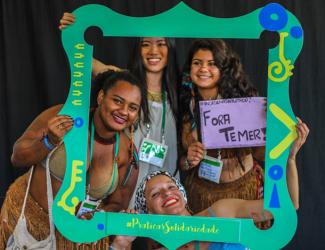
L´AWID est une organisation féministe mondiale qui consacre ses efforts à la justice de genre, au développement durable et aux droits humains des femmes
S'organiser de manière créative face à des menaces croissantes
Les jeunes activistes féministes jouent un rôle crucial au sein des organisations et des mouvements pour les droits des femmes à travers le monde. Ce sont elles qui soulèvent les nouveaux problèmes auxquels les féministes sont confrontées aujourd'hui. Leur force, leur créativité et leur adaptabilité sont vitales pour assurer la viabilité des organisations féministes.
Pourtant, elles sont confrontées à toute une série d’obstacles particuliers, notamment l'accès limité au financement et au soutien, le manque de possibilités de renforcement des capacités et une augmentation considérable des agressions sur les jeunes défenseuses des droits humains. Ces obstacles entraînent un manque de visibilité qui rend leur intégration et leur participation effective au sein des mouvements pour les droits des femmes encore plus difficiles.
Une approche multigénérationnelle
Le Programme d’activisme des jeunes féministes de l'AWID a été mis en place pour veiller à ce que les voix des jeunes femmes soient entendues et représentées dans le discours féministe. Nous voulons faire en sorte que les jeunes féministes aient un meilleur accès à du financement, à des opportunités de renforcer leurs capacités et aux processus internationaux.
En plus de soutenir directement les jeunes féministes, nous travaillons également avec des activistes des droits des femmes de tout âge pour élaborer des modèles et des stratégies d’organisation multigénérationnelles plus efficaces.
Nos actions
Nous souhaitons que les jeunes féministes puissent jouer un rôle actif dans les prises de décisions qui concernent leurs droits. Nos actions incluent :
Favoriser la mise en commun et le partage d'informations par la Plateforme de jeunes féministes. Étant donné l'importance des médias en ligne pour le travail des jeunes féministes, notre équipe a lancé la Plateforme de jeunes féministes en mai 2010. Elle a pour objectifs d’échanger des renseignements, de renforcer les capacités des membres par le truchement de webinaires et de discussions en ligne, et d'encourager la consolidation d’une communauté de jeunes féministes.
Soutenir la recherche et le renforcement des connaissances sur l'activisme des jeunes féministes, pour accroître la visibilité et l'influence de leur activisme au sein et entre les mouvements pour les droits des femmes et auprès d'autres acteurs-trices clés, tels les donateurs.
Faire la promotion de la collaboration multigénérationnelle, en explorant de meilleures façons de travailler ensemble.
Inciter les jeunes féministes à s’engager dans les processus internationaux relatifs au programme de développement, notamment ceux des Nations Unies.
S’assurer leur collaboration dans tous les domaines prioritaires de l'AWID, y compris le Forum, pour faire en sorte que leurs contributions, leurs perspectives, leurs besoins et leur activisme se traduisent dans les débats, les politiques et les programmes qui les concernent.
Contenu lié
Snippet FEA Union Otras (EN)
UNION OTRAS
The Sex Workers' Trade Union Organisation (Organización de Trabajo Sexual, OTRAS) is the first union of sex workers in the history of Spain. It was born out of the need to ensure social, legal and political rights for sex workers in a country where far-right movements are on the rise.
After years of struggles against the Spanish legal system and anti-sex workers groups who petitioned to shut it down, OTRAS finally obtained its legal status as a union in 2021.
Its goal? To decriminalize sex work and to ensure decent working conditions and environments for all sex workers.
The union represents over 600 professional sex workers, many of whom are migrant, trans, queer and gender-diverse.
هل استطلاع "أين المال" متاح للأشخاص ذوي/ات الإعاقات؟
نعم، انه متاح للأشخاص أصحاب/ صاحبات الإعاقات السمعية، البصرية، النظرية والفكرية المختلفة.
Our values - bodily autonomy
Bodily autonomy, integrity and freedoms<
We celebrate everyone's right to choose their identities, relationships, goals, work, dreams and pleasures, and what they do with their mind, body and spirit. We believe in working towards access to resources, information and safe and enabling environments that allow this to happen.
Carol Thomas fue una pionera en el trabajo por los derechos sexuales y reproductivos de las mujeres en Sudáfrica. Fue una ginecóloga de gran talento y la fundadora del WomenSpace [EspacioDeMujeres].
No sólo las empleó en su práctica, sino que también abogó por proporcionar formas no tradicionales de asistencia sanitaria a las mujeres, ofreciendo servicios de alta calidad, empáticos y accesibles.
"Ella recibió no sólo la alegría de los embarazos y la llegada de nuevxs bebés, sino también la ansiedad que puede generar la infertilidad, un parto prematuro, el cáncer femenino, así como también la angustia de los abortos espontáneos y lxs mortinatxs". Helen Moffett
Carol pensó en nuevos paradigmas cuyo centro de atención fuesen las necesidades de las mujeres con menor acceso a los servicios y derechos que puede aportar una sociedad:
"El entorno socioeconómico imperante en el que nos encontramos hoy se traduce en una carga desproporcionada de enfermedades y desempleo que las mujeres tienen que soportar... Como mujer negra, desfavorecida en el pasado, tengo una idea clara de lo que está sucediendo en nuestras comunidades". - Carol Thomas
La innovadora y multipremiada empresa social de Carol, "“iMobiMaMa”, utilizaba los quioscos móviles y la tecnología interactiva para conectar directamente a las mujeres con servicios de salud prenatal y reproductiva, información y apoyo en las comunidades de toda Sudáfrica.
Carol apoyó a las mujeres tanto en los embarazos deseados como en los no deseados, y fue mentora de muchxs enfermerxs y doctorxs a lo largo de su vida.
Fue calificada, además, como ginecóloga de referencia "para las personas trans que podían recibir de ella una atención afirmativa. Ella supo cómo manejarse cuando muchas personas no tenían todavía en claro el lenguaje o los pronombres. Sus mantas calientes, su capacidad para escuchar y decir lo que necesitabas oír eran muy reconfortantes." -Marion Lynn Stevens.
Carol Thomas falleció el 12 de abril de 2019 a causa de una serie de complicaciones tras un doble trasplante de pulmón, en el punto más álgido de su carrera profesional.
Los homenajes que llegaron después de su muerte inesperada se refieren a ella de muchas formas: como " modelo a seguir, mujer guerrera, innovadora, líder dinámica, rompe-moldes, dínamo, científica brillante, doctora compasiva".
Sin duda, Carol Thomas será recordada y honrada por ser todo esto y mucho más.
Pourquoi l’AWID a-t-elle choisi de tenir le Forum à Taipei ?
Les recherches à distance et les consultations menées auprès de nos allié·e·s nous ont permis d’éliminer plusieurs options de la région.
Nous avons ensuite organisé une série complète de visites au Népal, en Malaisie, au Sri Lanka, en Thaïlande, en Indonésie et (plus tard) à Taïwan. Sur place, chaque visite comprenait non seulement un examen de l’infrastructure logistique, mais aussi des réunions avec des activistes et des groupes féministes locales·aux afin de mieux comprendre la situation et leur analyse des risques et opportunités potentielles quant à un Forum de l’AWID dans leur contexte.
Durant nos visites sur place, nous avons rencontré de formidables mouvements féministes locaux, divers et dynamiques.
Ils ont souvent exprimé des sentiments partagés entre risques et opportunités liées à la visibilité apportée par un événement comme le Forum. Durant l’une des réunions, les activistes présent·e·s soulignèrent à l'unanimité, au cours des 30 premières minutes, que le Forum de l’AWID pouvait entraîner de nombreux contrecoups, que les droits LGBTQ étaient un sujet politique particulièrement sensible et que les groupes fondamentalistes chercheraient de toutes leurs forces à interrompre l’événement. Lorsque nous répliquâmes « ok, donc vous ne pensez pas que ce soit une bonne idée », leur réponse également unanime fut « bien sûr que si, nous voulons changer les récits !».
Il était difficile d’entendre et de voir dans certains endroits le nombre d’activistes féministes qui voulaient utiliser l’opportunité de visibilité d’un tel événement comme levier, prêt·e·s à faire face aux risques locaux ; mais l’accueil de près de 2000 personnes venues du monde entier nécessitait de prendre en compte d’autres calculs de risque et de faisabilité.
Nous avons également débattu de questions sur ce qu’implique l’organisation d’un forum féministe en cohérence avec les principes d’inclusion, de réciprocité et d’autodétermination, là où les politiques et les pratiques étatiques vont généralement à leur encontre (même si les représentant·e·s des Ministères du Tourisme ont tenté ardemment de concilier ce point).
Nous avons pris en considération l’infrastructure au regard des opportunités éventuelles permettant d’insuffler un élan pour certaines priorités féministes nationales, ainsi que le contexte politique du pays.
Dans beaucoup d’endroits, suivre le contexte donnait des impressions de balancier pouvant pencher vers l’ouverture et la sécurité des débats féministes à un moment donné, et vers la répression totale et la xénophobie l’instant d’après, sacrifiant les priorités féministes dans les négociations politiques cherchant à apaiser l’extrême droite ou les forces anti-droits.
Ce processus a donné lieu à des réflexions sur le contexte extrêmement difficile pour l’activisme des droits des femmes et de la justice de genre au niveau mondial.
Les défis de la région Asie-Pacifique nous ont amené à nous demander : ne serait-ce pas plus simple de tenir le Forum dans une autre région ?
Pour autant, nous ne pourrions aujourd’hui organiser un Forum de l’AWID à Istanbul comme nous l’avions fait en 2012, ou au Brésil comme en 2016.
Malgré toute cette complexité, l’AWID a finalement choisi Taipei comme lieu de Forum car :
La ville offre un certain degré de stabilité et de sécurité aux divers·e·s participant·e·s du Forum que nous voulons rassembler.
Elle dispose aussi de capacités logistiques importantes, en plus d’être accessible pour beaucoup de voyageurs·ses (avec une facilitation de procédure de visa électronique pour les conférences internationales).
Le mouvement féministe sur place est accueillant vis-à-vis du Forum et désire s’engager avec des féministes du monde entier.
L’organisation du Forum de l’AWID implique pour nous la création et la disposition d’un espace qui s’ajuste au mieux à une diversité de formes d’expression de solidarité, d’indignation, d’espoir et d’inspiration. Celles-ci sont au cœur de nos mouvements féministes.
Actuellement, Taipei nous semble donc être l’emplacement de la région Asie-Pacifique qui nous permet au mieux de bâtir un espace sécurisé et désobéissant pour notre communauté féministe mondiale.
Le fait est qu’il n’existe pas d’emplacement idéal dans le monde actuel pour tenir un Forum qui se concentre sur les Réalités féministes. Peu importe où nous irons, nous devrons construire cet espace ensemble !
Snippet FEA Union Otras Photo 4 (ES)
Должен ли я отвечать на все вопросы сразу или я могу делать это с перерывами?
При необходимости, вы можете сохранить свои ответы и вернуться к опросу позже. Eсли Вы хотите сохранить ответы и вернуться к опросу позже, это можно сделать при условии, что Вы продолжите работу на том же устройстве. KOBO сохранит Ваши ответы в левом верхнем углу страницы опросника и подгрузит Ваш черновик, когда Вы вернетесь к опросу.
Membership why page - Angelina Mootoo quote
Al unirme a AWID, espero poder ayudar a la movilización del movimiento feminista. No solo para las mujeres privilegiadas, sino para TODAS las mujeres y activistas feministas.- Angelina Mootoo, feminista interseccional y caribeña, Guyana/EEUU
Mereani Naisua Senebici, que l’on appelait aussi « Sua », a été membre de l’Association des jeunes femmes chrétiennes (YWCA) des Fidji pendant de longues années.
En plus d’avoir travaillé avec divers groupes de femmes dans des contextes multiraciaux, ruraux et urbains, elle s’est impliquée dans le soutien et la promotion des droits des femmes et des jeunes femmes.
Au YWCA de Lautoka, elle travaillait avec des femmes d’origine indienne et comptait parmi les pionnières du développement de la pratique sportive et la participation des femmes et athlètes trans localement.
« Les membres du YWCA des Fidji ont profondément aimé Sua pour son dévouement et son soutien inébranlable envers tous les efforts déployés par l’organisation » – Tupou Vere
Mereani faisait partie de la House of Sarah (HoS), une initiative de l’Association of Anglican Women (AAW) lancée en 2009, un organisme de sensibilisation autour des violences basées sur le genre et de soutien des femmes victimes de violence. Ayant commencé sa pratique en tant que bénévole dévouée, elle offrait notamment son soutien aux femmes dans tout le Pacifique.
Mereani s’est éteinte en 2019.
« Une personne qui aimait les gens, qui était présente sur tous les fronts de l’autonomisation des femmes et du travail du mouvement au niveau communautaire. Repose en paix, Sua. » – Tupou Vere
Freeing the Church, Decolonizing the Bible for West Papuan Women
By Rode Wanimbo (@rodwan986), Jayapura, Papua Province of Indonesia
“Lord, we are unworthy. We are the ones who committed sin for Eve ate the fruit in Eden. We are just women who grow sweet potatoes, look after pigs and give birth to children. We believe you died on the cross to set us free. Thank you, In Jesus’s name Amen.”
This is a typical prayer of women I have heard during my visits to ministries in several villages. Even I said the same prayer for many years.
I was born and grew up in Agamua, the Central Highlands of West Papua. My father belongs to the Lani tribe and my mother comes from Walak.
In Lani and Walak languages - languages spoken in the Central Highlands - tiru means a pillar. There are four tiru (pillars) standing firmly in the middle of the Lani roundhouse (honai), around wun’awe or a furnace. Tiru is always made of the strongest type of wood called a’pe (ironwood tree). The longer the wood gets heated and smoked from the fire in the honai, the stronger it becomes. Without tiru, the honai cannot stand firm. West Papuan women are these tiru.
West Papua is located in the western part of the New Guinea island, containing some of the world’s highest mountains, densest jungle, and richest mineral resources. It is home to over 250 groups and has an incredible biodiversity. Due to its natural wealth, West Papua has, over the centuries, been targeted by foreign occupiers. Until 1963, we were colonized by the Dutch. However in 1969, after a manipulative political act, we were transferred from the Dutch to Indonesia.
The first German missionaries arrived in Mansinam Island, Manokwari, in 1855. Then, in the 1950s, Christianity was brought to the Central Highlands of West Papua by Protestant missionaries of European descent from America, Canada, Australia and New Zealand.
According to Scripture in Genesis 1: 26-27, Man and Woman are created in the image of God. It means all humanity is made with the call and capacity to exercise dominion. Radah, the Hebrew word for dominion, means stewardship. Radah is not a call to exercise imperial power as declared by Pope Nicolas V, granting Catholic nations the right to “discover” and claim dominion over non-Christian lands. To diminish the capacity of humans to exercise dominion, is to diminish the image of God on earth (Lisa Sharon Harper, The Very Good Gospel).
The Evangelical Church of Indonesia (GIDI) was established as an institution in 1963. In the Sunday Service liturgy of GIDI, Women are considered unworthy to take any responsibility except collecting offerings. In 2003, after 40 years, the Department of Women was introduced within the structure of the Synod leadership.
In November 2013, I was entrusted to be a chairperson of the Women’s Department of the GIDI Synod.
Together with several other women leaders, we started a cell group that is committed to “decolonizing the Bible.” We learn together how to reconstruct the interpretation of biblical texts to champion women.
A feminist theologian named Elisabeth S Florenza calls it a feminist hermeneutic theory (Josina Wospakrik, Biblical Interpretation and Marginalization of Woman in the Churches of West Papua).
Besides the cell group, we interview our elderly women to collect our ancestors’ wisdom and values. As Bernard Narakobi in his book The Melanesian Way said: “Our history did not begin with contact with the Western explorers. Our civilization did not start with the coming of the Christian missionaries. Because we have an ancient civilization. It is important for us to give proper dignity and place to our history”.
Yum is a knotted net or woven bag handmade from wood fiber or leaves. Yum is highly valued for it symbolizes life and hope. When women of Lani and Walak get married, our maternal aunts put yum on our heads. It means we bear the responsibility for giving life and for providing food. Yum is used to carry garden produce as well as being used as a container to put a baby to sleep in as it gives warmth and a sense of security.
“West Papuan Women are Yum and Tiru” became the prime references as we contextualized women in the eyes of Jesus Christ in seminar and focus group discussions. From 2013 to 2018, we focused on reconstructing the view of women in GIDI and in gaining a healthy self-image. We are still in the process of understanding who we are to Jesus, rather than who we have been told we are by theologians and the fathers of the early Churches. Josina Wospakrik, a West Papuan Theologian said “The Gospel is incredibly rich but it was impoverished due to human ambitions and agendas.”
Since 2018, the GIDI Women Leadership team and I have formulated four priority programs: Decolonizing the Bible, Storytelling in a circle, Training of trainers for Literacy and Gender. The fourth, supported simple bookkeeping and savings groups workshops facilitated by Yapelin and Yasumat, which are faith based organizations established by GIDI leaders to reach the economic, social and health needs of women in the communities.
Storytelling in a Circle
In this programme we create a safe space for women to talk - each woman has a story. We all sit together and learn how to be good listeners.
“I became Christian and was taught that the government is God’s representative. Why did the government do nothing when the army burnt down my village and killed my relatives?” asked one woman in the storytelling circle. “My aunt was raped.” She stopped for a while. Could not talk. She cried. We all did.
The process of storytelling has driven us into deep conversation. We began to contextualize Biblical texts within our daily realities.
We started asking questions amongst ourselves: Where is God in our toughest times? Does the state government truly represent God on earth? Why does the Creator allow privileged people to destroy His own image in the name of Christianity and Development? During the process, I realized that I have been reading the Bible using somebody else’s glasses.
The church has to be a safe place to share stories and be a place of comfort to be still and rest. As we reflect on the testimonies, those who tell their stories begin the process of recovering from wounds and trauma.
Financial Literacy for Women
Culturally, West Papuans invest in relationships. The concept of saving is understood as an investment in relations, not in a bank account. And while the Indonesian central government has granted special autonomy to respond to West Papuans’ demand for self-determination, many government policies harm the quality of family life and they do not account for women’s lives. High illiteracy rates amongst women mean most women do not have access to a bank account. With no money saved, access to medical services becomes a struggle.
Through the priority programmes, Yapelin, with the active involvement and support of women, created saving groups in Bokondini and Jayapura. The saving groups are chaired by women who have access to a bank.
In coordination with Yayasan Bethany Indonesia (YBI) and Yayasan Suluh, a faith-based organization (FBO) based in Jayapura, we facilitated four literacy workshops. The literacy team facilitated the training of trainers in three different dioceses: Merauke, Sentani, and Benawa. We now have 30 facilitators in different congregations who run literacy programs.
Lack of financial support for our programs will not stop us. Being stigmatized as rebels will not stop us from standing up and speaking in church evaluation meetings and conferences. It is stressful but I am committed together with several women leaders to calling on the power-holders within to free the church.
The Gospel known as Good News should become news that liberates women from a very patriarchal circle of power, liberates women from social stigma and returns women to the original purpose of The Creator.
The Gospel must be a mirror to reflect who we are collectively. As Lisa Sharon Harper, in her book The Very Good Gospel said “The Gospel is not only about an individual’s reconciliation with God, self and communities. But also speaks on systemic justice, peace between people groups and freedom for the oppressed”.
Rode Wanimbo is the chairperson of the Women’s Department of Evangelical Church of Indonesia (GIDI).
“Offerings for Black Life”
By Sokari Ekine (@blacklooks), New Orleans
Coming from a place of healing and self-care is a political act that guides us to be focused and to move as one. In New Orleans, we created and will be creating altars in honour of those murdered by police and white supremacists vigilantes!
Respondi ao inquérito, mas mudei de ideias e quero que a nossa resposta seja eliminada. Como devo proceder?
Tem o direito de eliminar a sua resposta, por qualquer motivo e se assim o desejar. Queira entrar em contacto connosco através deste formulário, ao indicar "WITM Survey" ("Inquérito WITM") no título da sua mensagem, e iremos proceder à eliminação da sua resposta.
Questions (Forum page)
Des questions ?
Vous avez des questions concernant le Forum de l’AWID ou les activités connexes ? Nous avons des réponses !
Juli Dugdale was an Australian feminist who practiced intergenerational leadership rooted in principles of feminism, inclusion and equality. She was a leader, peer and mentor for many women and especially young women around the world.
Juli was a dedicated staff member, volunteer and fervent advocate for young women’s leadership with the Young Women's Christian Association (YWCA) movement for over 30 years.
She offered a strong link between the Australian movement and the World YWCA Office. Her trust in the leadership capacity of young women led to a multi-year partnership with the Australian Department of Foreign Affairs and Trade and the creation of the Rise Up manual, a global guide for young women’s transformative leadership, launched in 2018.
Juli passed away in Geneva on 12 August 2019.
Tributes:
“For those who got to work with Juli, it was a privilege. For those who didn’t, be assured that her legacy continues in the work we do every day and in the mission of the YWCA movement.” - YWCA Australia
“Juli Dugdale will forever hold a deep place in many people's hearts in the YWCA movement, especially here in Aotearoa and across the Pacific. Juli had a special relationship with the Pacific and was an incredible supporter of the young women there. She was humble, gracious, loving, caring, dedicated, passionate and had a generous heart. She embodied the YWCA's vision of 'transformative leadership' with extraordinary vision and foresight, and helped empower generations of young women leaders around the world.” - YWCA New Zealand