None On Record

Analyses Spéciales

L´AWID est une organisation féministe mondiale qui consacre ses efforts à la justice de genre, au développement durable et aux droits humains des femmes

Activisme des jeunes féministes

S'organiser de manière créative face à des menaces croissantes

Les jeunes activistes féministes jouent un rôle crucial au sein des organisations et des mouvements pour les droits des femmes à travers le monde. Ce sont elles qui soulèvent les nouveaux problèmes auxquels les féministes sont confrontées aujourd'hui. Leur force, leur créativité et leur adaptabilité sont vitales pour assurer la viabilité des organisations féministes.

Pourtant,  elles sont confrontées à toute une série d’obstacles particuliers, notamment l'accès limité au financement et au soutien, le manque de possibilités de renforcement des capacités et une augmentation considérable des agressions sur les jeunes défenseuses des droits humains. Ces obstacles entraînent un manque de visibilité qui rend leur intégration et leur participation effective au sein des mouvements pour les droits des femmes encore plus difficiles.

Une approche multigénérationnelle

Le Programme d’activisme des jeunes féministes de l'AWID a été mis en place pour veiller à ce que les voix des jeunes femmes soient entendues et représentées dans le discours féministe. Nous voulons faire en sorte que les jeunes féministes aient un meilleur accès à du financement, à des opportunités de renforcer leurs capacités et aux processus internationaux.

En plus de soutenir directement les jeunes féministes, nous travaillons également avec des activistes des droits des femmes de tout âge pour élaborer des modèles et des stratégies d’organisation multigénérationnelles plus efficaces.

Nos actions

Nous souhaitons que les jeunes féministes puissent jouer un rôle actif dans les prises de décisions qui concernent leurs droits. Nos actions incluent :

  • Favoriser la mise en commun et le partage d'informations par la Plateforme de jeunes féministes. Étant donné l'importance des médias en ligne pour le travail des jeunes féministes, notre équipe a lancé la Plateforme de jeunes féministes en mai 2010. Elle a pour objectifs d’échanger des renseignements, de renforcer les capacités des membres par le truchement de webinaires et de  discussions en ligne, et d'encourager la consolidation d’une communauté de jeunes féministes.

  • Soutenir la recherche et le renforcement des connaissances sur l'activisme des jeunes féministes, pour accroître la visibilité et l'influence de leur activisme au sein et entre les mouvements pour les droits des femmes et auprès d'autres acteurs-trices clés, tels les donateurs.

  • Faire la promotion de la collaboration multigénérationnelle, en explorant de meilleures façons de travailler ensemble.

  • Inciter les jeunes féministes à s’engager dans les processus internationaux relatifs au programme de développement, notamment ceux des Nations Unies.

  • S’assurer leur collaboration dans tous les domaines prioritaires de l'AWID, y compris le Forum, pour faire en sorte que leurs contributions, leurs perspectives, leurs besoins et leur activisme se traduisent dans les débats, les politiques et les programmes qui les concernent.

Contenu lié

Snippet Video C&H (ES)

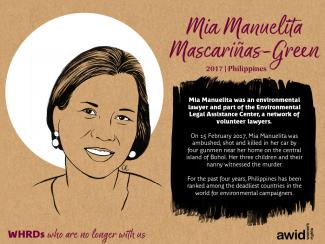
Mia Manuelita Mascariñas-Green

Key impacts on the international human rights system

Anti-rights actors have had a substantive impact on our human rights framework and the progressive interpretation of human rights standards, especially rights related to gender and sexuality.

When it comes to the impact of conservative actors in international policy spaces, the overall picture today is of stasis and regressions.


We have witnessed the watering down of existing agreements and commitment; deadlock in negotiations; sustained undermining of UN agencies, treaty review bodies and Special Procedures; and success in pushing through regressive language in international human rights documents.

Commission on the Status of Women (CSW)

The CSW, held annually in March, has long been one of the most contested sites in the UN system. In March 2015, conservative efforts set the tone before events or negotiations even began; the outcome document of the Commission was a weak Declaration negotiated before any women’s rights activists even arrived on the ground.

At 2016’s CSW, the new Youth Caucus was infiltrated by large numbers of vocal anti-abortion and anti-SRHR actors, who shouted down progressive youth organizations. Again, intensive negotiations resulted in a lacklustre text, which included regressive language on ‘the family.’

Precisely when addressing women’s human rights is of urgent importance, the CSW has been rendered a depoliticized and weakened space. Using it to advance rights has become harder and harder since progressives’ energy is taken up trying to hold the ground against conservative backlash.

Human Rights Council (HRC)

As the intergovernmental body responsible for the promotion and protection of human rights around the globe, the HRC is a key entry point for conservative actors. In recent years, this mechanism has been the scene for a number of damaging anti-human rights moves.

In conversation with other anti-rights actors, one strategy of conservative states, and blocs of states, is to aggressively negotiate out positive language and to introduce hostile amendments to resolutions, most often resolutions focusing on rights related to gender and sexuality.

To take one example, during the June 2016 session of the HRC, opposition was mounted towards a resolution on discrimination against women by the member states of the Organization of Islamic Cooperation (OIC) and allies. During contentious negotiations, multiple provisions were removed, including women’s and girls’ right to have control over their sexuality, sexual and reproductive health, and reproductive rights; and the need to repeal laws which perpetuate the patriarchal oppression of women and girls in families, and those criminalizing adultery or pardoning marital rape.

The HRC has also been the site of pernicious conservative initiatives to co-opt human rights norms and enact conservative “human rights” language, such as that of the Russia-led “traditional values” resolutions, and more recently the “Protection of the Family” agenda.

Human Rights Committee

In 2015, moving their sights to another front, a number of religious right organizations began to target the Human Rights Committee, the treaty monitoring body for the International Covenant on Civil and Political Rights (ICCPR), a pivotal human rights instrument.

Anti-human rights groups mobilized in hopes of cementing their anti-abortion rhetoric into the treaty.

When the Committee announced it was drafting a new authoritative interpretation of the right to life, over 30 conservative non-state actors sent in written submissions, advocating their misleading discourse on ‘right to life’ - that life begins at conception and that abortion is a violation of the right - be incorporated in the Committee’s interpretation of article 6.

Conservative groups targeting the Human Rights Committee was a shift considering that historically anti-human rights actors have repeatedly attempted to undermine and invalidate the essential work of the treaty monitoring bodies, including the Human Rights Committee.

SDG negotiations and Agenda 2030

Anti-human rights actors were involved in lobbying towards the development of the new Sustainable Development Goals (SDGs) in 2015, focusing again on rights relating to gender and sexuality. These efforts had limited traction in their attempts to embed regressive language in Agenda 2030.

However, after successfully pushing back against progressive language in the final text, conservative actors then pivoted to another strategy. In an attempt to evade state accountability and undermine the universality of rights, several states have repeatedly made reservations to the Goals.

On behalf of the African Group, Senegal claimed that African states would only “implement the goals in line with the cultural and religious values of its countries.”

The Holy See also made a number of reservations, stating it was “confident that the related pledge ‘no one will be left behind’ would be read” as meaning “the right to life of the person, from conception until natural death.”

Saudi Arabia went one step further, declaring that the country would not follow any international rules relating to the SDGs that reference sexual orientation or gender identity, describing them as running “counter to Islamic law.”

General Assembly (GA)

Anti-rights actors have made increasing headway at the UN General Assembly (GA).  Most recently, during the 71st session in 2016, the GA was the scene of feverish anti-rights organizing in opposition to the new mandate created by the Human Rights Council resolution on sexual orientation and gender identity in June 2016: the Independent Expert on SOGI. Four separate attempts were made to undercut the mandate in GA spaces.

One approach was to introduce a hostile resolution at the Third Committee[1], led by the African Group, which in essence aimed to indefinitely defer the new mandate. While this approach was not successful, such an attempt in the GA to retroactively block the creation of a mandate brought forward by the Human Rights Council represented a new and troubling tactic - anti-right actors are now working to directly undermine the HRC’s authority respective to the General Assembly.

Another approach targeted the Fifth Committee (responsible for administration and budgetary matters) as an entry point to attack the mandate. In an unprecedented move a number of States attempted (again, unsuccessfully) to block the funding of UN human rights experts, including the new IE on SOGI[2],.

While these multiple efforts were unsuccessful in blocking the creation and continuation of the new mandate, the significant support they received, the novel strategizing employed, and the strong alliances built along regional lines through negotiations point to difficulties ahead.


[1] The Third Committee of the GA deals with agenda items relating to a range of social, humanitarian affairs, and human rights issues.  Each year it discusses and issues resolutions on issues including the advancement of women, the protection of children, family, and youth.

[2] While UN Special Procedures experts (i.e. Special Rapporteurs, Working Group members and Independent Experts) work pro bono, some funds are generally allocated to facilitate country visits on the invitation of the national government, and support staff.


Other Chapters

Read the full report
จะมีมาตราการด้านการเข้าถึงสำหรับฟอรัมที่จะเกิดขึ้นหรือไม่

ตอบแบบสั้นคือ ใช่! AWID กำลังทำงานร่วมกับคณะกรรมการการเข้าถึงเพื่อให้มั่นใจว่าฟอรัมนี้จะสามารถเข้าถึงได้มากที่สุดเท่าที่จะเป็นไปได้ เรากำลังทำการตรวจสอบการเข้าถึงสถานที่จัดงานฟอรัม โรงแรมโดยรอบ และการคมนาคมขนส่ง ข้อมูลโดยละเอียดเกี่ยวกับการช่วยการเข้าถึงของ AWID ฟอรัม จะถูกอัปเดทเนื้อหาที่นี่ก่อนที่จะเปิดการลงทะเบียน ในระหว่างนี้ หากมีคำถามใดๆ โปรดติดต่อเรา

2021 : Le pouvoir féministe en action

En 2021, l’AWID, comme beaucoup d’autres organisations, a dû faire face aux répercussions de la pandémie mondiale en cours sur notre façon de travailler et notre rôle en ces temps particuliers. L’année nous a appris trois leçons essentielles sur la façon de traverser cette période en tant qu’organisation mondiale de soutien au mouvement féministe.

Téléchargez le rapport annuel 2021


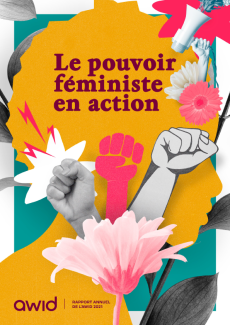
Couverture en français du rapport annuel 2021 de l'AWID. Il montre un collage de poings de protestation levés, ainsi que des fleurs et la silhouette d'une personne aux cheveux courts.

Grâce au dialogue et aux échanges indispensables à son travail, l’AWID a mis en relation des milliers de personnes avec des féministes du monde entier.

Notre expérience en 2021 nous a permis de constater que l’AWID jouait un rôle important et quelque peu unique dans la création et le maintien d’une communauté féministe mondiale transcendant les identités et les thèmes. 


Téléchargez le rapport annuel 2021

Snippet FEA FIGHT LIKE SOMEONE WHO CARES (FR)

São Paulo, Brésil

COZINHA OCUPAÇÃO 9 DE JULHO

Lutte comme quelqu'un·e qui

PREND SOIN

Sala de prensa

AWID en los medios

Compilación de noticias sobre la organización y/o el trabajo de AWID


Notas de prensa

Notas de prensa, dosieres y kits


Kits de social media

Contacto para medios

Email de contacto

+1 416 594 3773

Snippet - CSW68 Intro

Reclaiming Feminist Power

This year, we, alongside feminist activists from across the world, will be at CSW68 in New York, to challenge capitalist, neoliberal narratives and false solutions around poverty, development and financing. Through in-person events, lives on our socials, an exhibit booth and more; we are showing up to convene, amplify and support the voices and participation of our members, partners and allies.

Learn more about our program this year below.

Lucy O.

Biography

Con más de 10 años de experiencia en finanzas, Lucy ha dedicado su carrera a misiones con y sin fines de lucro. También ha prestado trabajo voluntario para organizaciones sin fines de lucro. Desde el acelerado mundo de las finanzas, Lucy siente pasión por estar al día con las competencias tecnológicas asociadas con este ámbito. Lucy se incorporó a AWID en 2014. En su tiempo libre disfruta de la música, de viajar y de practicar una variedad de deportes.

Position
Coordinadora Contable
Add to stories
Off

Snippet FEA Introducing Carmen Silva Ferreira (EN)

We have the pleasure to introduce you to Carmen Silva Ferreira.

She was born in Bahia, the Northeastern part of Brazil. She is an immigrant, a social activist and a mother of 8 children.

Carmen experienced homelessness at the age of 35, after migrating to Sao Paulo on her own. This led her to become a fierce advocate for vulnerable, marginalized and invisibilized communities most affected by the housing crisis. She eventually became one of the founders of MSTC in 2000.

As a visionary political organizer and the current leader of the MSTC, Carmen’s work has laid bare the city's housing crisis and provided inspiration to others on different ways to organize and manage occupations. She stood strong on the forefront of several occupations. One of them is the 9 de Julho Occupation, which now serves as a stage for direct democracy, and a space where everyone can be heard, seen, appreciated and work together.

Carmen has been long celebrated for her boldness in giving life back to abandoned buildings in the heart of São Paulo.

To know more about her life, you can follow her on Instagram!

Here are your report and infographics: Toward a feminist funding ecosystem

Snippet - CSW68 - Responding to Anti-rights - FR

Répondre aux évolutions antidroits

in Multilateral and Regional Spaces

✉️ Sur invitation uniquement
📅Mardi 12 mars
🕒14 h - 15 h 30 HNE

Organisateur : Consortium de l'Observatoire sur l'universalité des droits (OURs)
🏢Blue Gallery, 222 E 46th St, New York

Kasia Staszewska

Biography

Kasia soutient le travail des mouvements féministes et de justice sociale depuis 15 ans. Avant de rejoindre l'AWID, Kasia dirigeait les politiques et le plaidoyer d’ActionAid et d’Amnesty International, tout en se mobilisant avec des féministes et des groupes de justice sociale en Pologne pour l'accès à l'avortement et la lutte contre les violences aux frontières européennes. Kasia est passionnée par le ressourcement des organisations féministes dans tout leur courage, leur richesse et leur diversité. Elle partage son temps entre Varsovie et son village communautaire de bricolage dans la forêt. Elle adore les saunas et aime follement son chien Wooly.

Position
Cheffe de l’Initiative Ressourcement des Mouvements Féministes
Add to stories
Off

Snippet FEA ASOM Challenges Story 1 (ES)

DESAFÍOS

  • Cambio Climático
  • Acesso a créditos
  • Intermediários