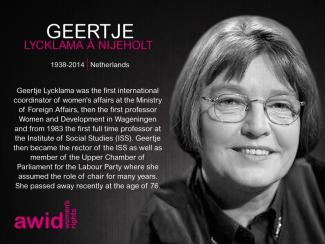
Geertje Lycklama à Nijeholt
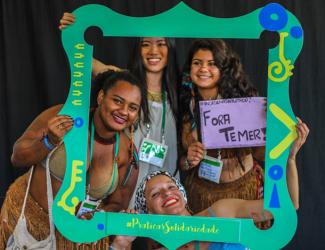
Les jeunes activistes féministes jouent un rôle crucial au sein des organisations et des mouvements pour les droits des femmes à travers le monde. Ce sont elles qui soulèvent les nouveaux problèmes auxquels les féministes sont confrontées aujourd'hui. Leur force, leur créativité et leur adaptabilité sont vitales pour assurer la viabilité des organisations féministes.
Pourtant, elles sont confrontées à toute une série d’obstacles particuliers, notamment l'accès limité au financement et au soutien, le manque de possibilités de renforcement des capacités et une augmentation considérable des agressions sur les jeunes défenseuses des droits humains. Ces obstacles entraînent un manque de visibilité qui rend leur intégration et leur participation effective au sein des mouvements pour les droits des femmes encore plus difficiles.
Le Programme d’activisme des jeunes féministes de l'AWID a été mis en place pour veiller à ce que les voix des jeunes femmes soient entendues et représentées dans le discours féministe. Nous voulons faire en sorte que les jeunes féministes aient un meilleur accès à du financement, à des opportunités de renforcer leurs capacités et aux processus internationaux.
En plus de soutenir directement les jeunes féministes, nous travaillons également avec des activistes des droits des femmes de tout âge pour élaborer des modèles et des stratégies d’organisation multigénérationnelles plus efficaces.
Nous souhaitons que les jeunes féministes puissent jouer un rôle actif dans les prises de décisions qui concernent leurs droits. Nos actions incluent :
Favoriser la mise en commun et le partage d'informations par la Plateforme de jeunes féministes. Étant donné l'importance des médias en ligne pour le travail des jeunes féministes, notre équipe a lancé la Plateforme de jeunes féministes en mai 2010. Elle a pour objectifs d’échanger des renseignements, de renforcer les capacités des membres par le truchement de webinaires et de discussions en ligne, et d'encourager la consolidation d’une communauté de jeunes féministes.
Soutenir la recherche et le renforcement des connaissances sur l'activisme des jeunes féministes, pour accroître la visibilité et l'influence de leur activisme au sein et entre les mouvements pour les droits des femmes et auprès d'autres acteurs-trices clés, tels les donateurs.
Faire la promotion de la collaboration multigénérationnelle, en explorant de meilleures façons de travailler ensemble.
Inciter les jeunes féministes à s’engager dans les processus internationaux relatifs au programme de développement, notamment ceux des Nations Unies.
S’assurer leur collaboration dans tous les domaines prioritaires de l'AWID, y compris le Forum, pour faire en sorte que leurs contributions, leurs perspectives, leurs besoins et leur activisme se traduisent dans les débats, les politiques et les programmes qui les concernent.
Мы проанализируем ответы, чтобы получить представление о тенденциях, и представим результаты на 15-м Международном форуме AWID в Бангкоке, а также в режиме онлайн, в декабре 2024 года. Зарегистрируйтесь для участия в Форуме здесь!
par Haddy Jatou Gassama
Il est de coutume pour la tribu mandingue, en Gambie, de mesurer la première écharpe utilisée par les mères pour porter leur nourrisson sur leur dos. (...)
illustration : « Puta sacrée », par Pia Love >
Alors que les fondamentalismes, les fascismes et autres systèmes d’oppression se métamorphosent et trouvent de nouvelles tactiques et stratégies pour consolider leur pouvoir et influence, les mouvements féministes persévèrent et célèbrent leurs victoires nationales, régionales et internationales.
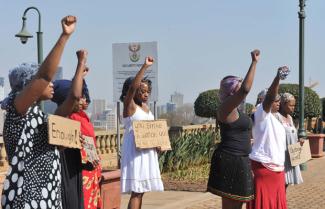
La reconnaissance en 2019 par le Conseil des droits de l’Homme du droit à l’intégrité et à l’autonomie corporelles, par exemple, a marqué une étape cruciale. Des résolutions du Conseil sur la discrimination envers les femmes et les filles admettent cependant un recul lié à des groupes de pression rétrogrades, des conceptions idéologiques ou un détournement de la culture ou la religion pour s’opposer à l’égalité de leurs droits. Des avancées féministes sont aussi notées dans le travail des Procédures spéciales, qui soulignent notamment l’obligation des États de contrer les doctrines de l’idéologie du genre, rappellent à l’ordre les antidroits qui détournent des références à la « culture », et signalent que les convictions religieuses ne peuvent pas servir à justifier la violence ou la discrimination.
“Afterwards
After love the first time,
Our naked bodies and minds
A hall of mirrors,
Wholly unarmed, utterly fragile,
We lie in one another's arms
Breathing with care,
Afraid to break
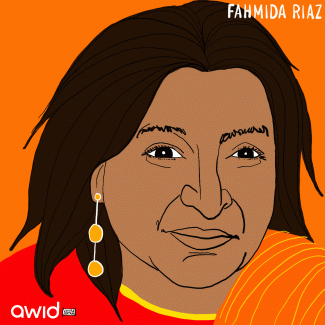
These crystal figurines.” - Fahmida Riaz
Her work faced harsh criticism from conservatives, who accused her of using erotic and “pornographic” expressions in her poetic language.
Fahimida was eventually blacklisted and charged with sedition under Section 124A of the Pakistan Penal Code) during the dictatorship of Zia Ul Haq. Forced into exile in 1981, she spent almost seven years in India before returning to Pakistan.
As part of the preface to “Badan Dareeda” ('The Torn-Bodied'), a collection of poetry published in 1974, she wrote:
The brilliance of Fahmida was in defying any singular logic or categories of gender, nation, religion or culture. She refused to be put in the role of a ‘woman poet’, breaking with traditional definitions of feminine poetry and concepts and themes (ranging from political consciousness, body, culture, desire, religion, home) and knocking down inhibitions put on her gender.
“You have to understand that culture can have no essence. Cultures move, flowing into one another, forming new cultures. Culture is born this way. There is no clash of cultures.”
Fahmida authored more than 15 books on poetry and fiction including her poem ‘Taaziyati Qaraardaaden’ (‘Condolence Resolutions’) that might serve as an appropriate tribute to her life and legacy and a collection of poems (Apna Jurm To Saabit He ‘My Crime Stands Proven’) published in 1988 during her time in exile.
Fahmida Riaz was born in Meerut, India on 28 July 1946 and passed away on 21 November 2018 in Lahore, Pakistan.
Juhi is a tech enthusiast with a Bachelor's degree in Computer Engineering from Gujarat Technological University and a postgraduate background in Wireless Telecommunications and Project Management from Humber College. With a passion for problem-solving and a love for staying ahead in the ever-evolving tech landscape, Juhi has found herself navigating through various industries as an IT Technician. to the nurturing environment of the School Board, Juhi has had the opportunity to apply her technical skills in diverse settings, always embracing new challenges with enthusiasm. Beyond the code and circuits, Juhi loves life's adventures. Exploring new places and cultures is like a breath of fresh air to her. Whether it's discovering hidden gems in the city, trying out exotic cuisines, or embarking on thrilling adventure sports, Juhi is always up for new experiences.
Le Forum de l’AWID est le plus grand événement mondial axé sur les mouvements féministes et de justice de genre dans toute leur diversité. Il s'agit d'un espace de transformation créé par et pour les mouvements féministes, où les féministes du Sud Global et autres communautés historiquement marginalisées occupent le devant de la scène, élaborent des stratégies pour changer le pouvoir et se connectent avec les mouvements alliés, la philanthropie et les politiques. C'est donc avec le cœur plein que nous vous annonçons que...
Le 15e Forum international de l'AWID se tiendra du 2 au 5 décembre 2024 à Bangkok, en Thaïlande !
Nous espérons réunir 2 500 participant.e.s en personne et 3 000 participant.e.s en ligne/hybride.
Lorsque des milliers de féministes se réunissent, nous créons une force de solidarité écrasante qui a le pouvoir de changer le monde. Nous sommes enthousiastes, et nous savons que vous l'êtes aussi, alors restez à l'écoute pour plus de détails, y compris l'inscription et nos plans pour un programme plein de magie féministe.
"This community is a place for connections, to understand our individual fights as part of global struggles, and sometimes even dance! There aren’t places like this online where you can meet real grassroots activists from all over the world and build solidarity and sisterhood."
- Paz Romero, Argentina
Our final Feminist Film Club program is now available to view: “Films from Nuestramérica” is a film series on Latin/Central American Feminist Realities curated by Alejandra Laprea (Venezuela).
 |
Akosua Hanson is an artistic activist, based in Accra, Ghana. Her work spans radio, television, print media, theatre, film, comic art exhibitions, art installations, and graphic novels. Akosua’s activism has been centred around pan-Africanism and feminism, with an interest in the intersection of art, pop culture, and activism. She has a Masters in Philosophy in African Studies with a focus on Gender and African Philosophical Thought. Akosua Hanson is the creator of Moongirls, a graphic novel series that follows the adventures of four superheroes fighting for an Africa free from corruption, neocolonialism, religious fundamentalism, rape culture, homophobia and more. She works as a radio host at Y 107.9 FM, Ghana. |
In these panels, the Moongirl Wadjet is engaged in BDSM lovemaking with a two-gender daemon. Of the four Moongirls, Wadjet is the healer and philosopher, the conduit of the Oracle. She does this to launch a scientific and spiritual process – an experiment she calls “Illumination by the Light of the Full Moon” – through which she traces a vibrational time arc between her memories, sensations, emotions, visions, and imagination. It is a form of vibrational time travel in order to discover what she terms as “truth-revelations.”
During the experience, some of Wadjet’s hazy visions include: an approaching apocalypse brought about by humans’ environmental destruction in service to a voracious capitalism; a childhood memory of being hospitalized after a mental health diagnosis; and a vision of a Moongirls’ origin story of the Biblical figure of Noah as an ancient black Moongirl warning of the dangers of environmental pollution.
More than a fun kink to explore for the sensations, BDSM can be a way of addressing emotional pain and trauma. It has been a medium of sexual healing for me, providing a radical form of liberation. There is a purge that happens when physical pain is inflicted on the body. Inflicted with consent, it draws out emotional pain – almost like a “calling forth.” The whip on my body allows me to release suppressed emotions: anxiety, depression, my sense of defenselessness to the stresses that overwhelm me sometimes.
When engaging in BDSM as an avenue for healing, lovers must learn to be very aware of and responsible for each other. Because even though consent may have been initially given, we must be attentive to any changes that might occur in the process, especially as feelings intensify. I approach BDSM with the understanding that in order to surrender pain, love and empathy have to be the basis of the process and by that, I create space or open up for love.
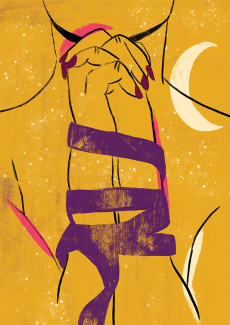
The engagement with aftercare after the infliction of pain is a completion of the process. This can be done in very simple ways such as cuddling, checking if they need water, watching a movie together, sharing a hug or just sharing a joint. It can be whatever your chosen love language is. This holding space, with the understanding that wounds have been opened, is necessary to complete the process of healing. It is the biggest lesson in practising empathy and learning to really hold your partner, due to the delicacy in blurring the lines between pain and pleasure. In this way, BDSM is a form of care work for me.
After BDSM sex, I feel a clarity and calm that puts me in a great creative space and spiritually empowers me. It is an almost magical experience watching the pain transform into something else in real time. Similarly, this personally liberating experience of BDSM allows Wadjet to access the foreknowledge, wisdom, and clarity to aid in her moongirl duties in fighting African patriarchy.
Moongirls was birthed during my tenure as the director for Drama Queens, a young artistic activist organization based in Ghana. Since our inception in 2016, we’ve employed different artistic media as part of their feminist, pan-Africanist, and environmentalist activism. We used poetry, short stories, theatre, film, and music to address issues such as corruption, patriarchy, environmental degradation, and homophobia.
Our inaugural theatre production, “The Seamstress of St. Francis Street” and “Until Someone Wakes Up” addressed the problem of rape culture in our communities. Another one, “Just Like Us,” was arguably one of the first Ghanaian theatre productions to directly address the country’s deep-seated issue of homophobia. Queer Universities Ghana, our queer film workshop for African filmmakers, has trained filmmakers from Ghana, Nigeria, South Africa, and Uganda. Films birthed during the workshop, like “Baby Girl: An Intersex Story” by Selassie Djamey, have gone on to be screened at film festivals. Therefore, moving to the medium of graphic novels was a natural progression.
About seven years ago, I’d started a novel that I never completed about the lives of four women. In 2018, the Open Society Initiative for West Africa (OSIWA) opened up a grant opportunity that launched the production of the project and my uncompleted novel was turned into Moongirls.
There have been two seasons of Moongirls made up of six chapters each. Contributing writers and editors for the first season were Suhaida Dramani, Tsiddi Can-Tamakloe, George Hanson, and Wanlov the Kubolor. Writers for the second season were Yaba Armah, Nadia Ahidjo, and myself. Character illustrations and conceptualizations were by Ghanaian artist Kissiwa. And AnimaxFYB Studio, a premium animation, design, and visual effects studio, does the illustrations.
|
|
Writing Moongirls between 2018 and 2022 has been a labour of love for me, even, a labour for liberation. I aim to be very explorative in form and style: I’ve dabbled in converting other forms of writing, such as short stories and poetry, to graphic novel format. By merging illustration and text, as graphic novels do, Moongirls aims to tackle the big issues and to honor real life activists. My decision to centre queer women superheroes – which is rare to see in this canon – came to mean so much more when a dangerous backdrop started developing in Ghana in 2021.
Last year saw a marked hike in violence for the Ghanaian LGBT+ community that was sparked by the shutdown of an LGBT+ community centre. This was followed by arbitrary arrests and imprisonment of people suspected to be on the queer spectrum, as well as of those accused of pushing an “LGBT agenda.” Crowning this was the introduction in Ghanaian Parliament of an anti-LGBT bill named “Proper Human Sexual Rights and Ghanaian Family Values.” This bill is arguably the most draconian anti-LGBT bill ever drafted in the region, following previous attempts in countries like Nigeria, Uganda and Kenya.
I remember quite vividly the first time I read the draft of this bill.
It was a Friday night, typically a night I take off to rest or party after a long work week. By sheer luck, the draft was leaked and shared with me on a WhatsApp group. As I read it, a deep sense of fear and alarm made burnt toast of my Friday night chill. This bill proposed to slap any LGBT+ advocacy with five to ten years of imprisonment, and to fine and imprison people who identify as LGBT+ unless they “recanted” and accepted conversion therapy. In the draft bill, even asexual people were criminalized. The bill went for all fundamental freedoms: freedoms of thought, of being, and the freedom to hold one’s personal truth and choose to live your life by that truth. The bill even went for social media and art. If it passed, Moongirls would be banned literature. What the bill proposed to do was so evil and far-reaching, I was stunned into a depression at the depth of hate from which it had been crafted.
Scrolling through my Twitter timeline that night, the terror I felt inside me was mirrored. The timeline was a livestream of emotions as people reacted in real time to what they were reading: disbelief to terror to a deep disappointment and sorrow when we realized how far the bill wanted to go. Some tweeted their readiness to fold up and leave the country. Then, in the way Ghanaians do, sorrow and fear is alchemized to humour. From humour came the zest to upscale the fight.
So, the work still continues. I created Moongirls to provide an alternative form of education, to provide knowledge where it has been suppressed by violent patriarchy, and to create visibility where the LGBT+ community has been erased. It is also important that African BDSM is given this platform of representation when so much of BDSM representation is white. Sexual pleasure, through BDSM or otherwise, as well as non-heterosexual love, transcend race and continent because sexual pleasure and its diversity of experience are as old as time.
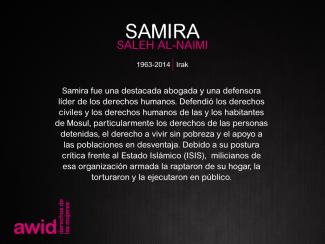
"No era una persona. Era una potencia". - Así recuerda unx compañerx activista a Navleen Kumar.
Con integridad y compromiso, trabajó durante más de una década para proteger y restaurar las tierras de los pueblos indígenas (adivasi) en el distrito de Thane, un área arrebatada por los propietarios y promotores inmobiliarios a través de medios como la coerción y la intimidación. Luchó contra esta injusticia y estos crímenes a través de intervenciones legales en diferentes tribunales, y descubrió que la manipulación de los registros de las tierras era una característica recurrente en la mayoría de los casos de adquisición de terrenos. En uno de los casos, el de los Wartha (una familia tribal), Navleen descubrió que la familia había sido engañada con la complicidad de funcionarixs gubernamentales.
Así, a través de su trabajo, ayudó a restituir la tierra a la familia Wartha, y siguió dedicándose a otros casos de transferencias de tierras adivasi.
"Su artículo sobre el impacto de la alienación de la tierra en las mujeres y las niñas y niños adivasi traza la historia y las complejidades de la alienación tribal desde la década de los 70, cuando las familias de clase media comenzaron a trasladarse a los suburbios de Mumbai, que se extendían mientras el valor de la propiedad en la ciudad aumentaba de forma exponencial.Los complejos de viviendas proliferaron en estos suburbios, y lxs integrantes de las comunidades tribales, que eran analfabetxs, pagaron el precio por ello. El costo de las tierras de primera, cerca de las líneas de ferrocarril, alcanzó un precio elevado y los constructores se abalanzaron sobre este cinturón como buitres, arrebatando de forma ilegal las tierras a las comunidades tribales y otrxs residentes locales ". - Jaya Menon, Comisión de Justicia y Paz.
Durante el curso de su activismo, Navleen recibió numerosas amenazas y sobrevivió a varios atentados contra su vida. A pesar de ello, siguió trabajando no sólo en lo que era importante para ella, sino que además contribuyó a cambiar la vida y la realidad de las muchas personas a las que apoyó en su lucha por la justicia social.
Navleen murió apuñalada el 19 de junio de 2002 en su edificio de departamentos. Dos gánsteres locales fueron arrestados por su asesinato.
Patience es profesional global en recursos humanos y ha acumulado más de 10 años de experiencia en la gestión de recursos humanos (RRHH) en el sector sin fines de lucro. Anteriormente, trabajó en Mercy Corps como Oficial Global de Recursos Humanos para África, donde brindaba apoyo en todo lo concerniente al ciclo de vida del personal para personas expatriadas en la región de África oriental y meridional, y brindaba orientación técnica en recursos humanos a les encargades de recursos humanos en las oficinas nacionales de la región africana. Antes de sumarse al equipo global de personal, se desempeñaba como Punto Focal Nacional de Recursos Humanos y Salvaguardia, formó parte del equipo de gestión superior encargado de dirigir todos los asuntos de recursos humanos y salvaguardia. Antes de Mercy Corps, dirigió el Departamento de Recursos Humanos y Operaciones de SNV Netherlands Development Organization e integró el equipo de gestión nacional. Asimismo, posee experiencia de consultoría en Recursos Humanos que adquirió mientras estudiaba para su licenciatura en Gestión de Recursos Humanos que terminó con honores. Es una apasionada de la gestión de recursos humanos, le encanta trabajar con la gente y tiene al bienestar y la salvaguardia como sus valores fundamentales, los que aplica en su vida profesional. Por su pasión por los deportes, también se puede encontrar a Patience en un estadio de baloncesto, de tenis o de fútbol.
Every three to four years, AWID hosts its flagship international event. It is the world’s largest event that wholeheartedly centers feminist and gender justice movements in all their diversity. It is a global gathering of feminist activists, allied movements, scholars, funders and policymakers. The Forums rotate between different regions and countries in the global South.
Se rassembler à l’échelle mondiale, en tant qu’individus et mouvements, nous permet de générer une force considérable. Rejoignez-nous à Bangkok, en Thaïlande et en ligne en décembre 2024.
Crear | Résister | Transform es para ti y para todxs lxs increíbles activistas feministas y por la justicia social que conozcas. Reunámonos para compartir nuestras estrategias de resistencia, para crear conjuntamente algo de magia feminista, y para transformar juntxs este mundo.
Thank you, Ángela and Pilar.

 |
Yannia Sofía Garzón Valencia I am a Black woman and a community weaver. I live in Santander de Quilichao in Cauca, Colombia. I am interested in the creative processes that organize sustainable collective life. I like exchanging thoughts and cooking, investigating and analyzing, planting seeds and learning from plants, reading and playing. I am currently coordinating the observatory of gender-based violence against afro-descendant communities in Colombia (@VigiaAfro). |

There was an unusually large green playing area and we sat on little wooden stools under an elderberry tree. We were finally experiencing that other form of love – that pleasure of being together and listening to each other. For me, these kinds of chats are among the expressions of love that life had only recently allowed me to enjoy. I had not known this other form of love – the kinds found outside workshops, activist spaces, classrooms, or workplaces – to be possible. Yet we three friends spent the afternoon amongst ourselves and we did not pretend to be blind to the color of our respective skins. Rather, it was a lived factor that allowed us to intimately discuss the similarities and differences in our childhood and youthful experiences.
Those chats were unrelated to any upcoming activities of the Black movement in Colombia, but they still nourish me and acquire new meanings. Our closeness was woven through coming together, recognizing each other, and identifying the uniqueness of our liberations. And by realizing there is not just one but many paths to liberation – those paths we inhabited every time we said “no” and rebelled. Far from feeling discomfort, we met in an authenticity made of weakness and strength, one which brought us closer instead of separating us.
Our purpose on that beautiful afternoon was to just be – to have an awareness of simply being amongst ourselves. We walked through our pasts so that the memories that stayed with us were those we decided to keep as ours, and not those that fear let through and found a place for. We remembered exact fragments of TV shows, and sang songs written by artists who had taught us about loving well, hating well, cursing like the worst villain, and suffering like the best leading lady.
We told each other about our school pranks, and what remained in our subconscious after being exposed to the many ways the media repeats the same thing – after the teachers and nuns at school overexposed us to stories so that we would identify with and appropriate Cinderella’s aspirations for our own lives. This would set the tone for the rest of our story: the drama of the impoverished and diminished girl who is yet to achieve her full value through an act that redeems her condition. And that act can only be brought about by the gaze of a male who, at the very least, is white, hence deserving of what is between our thighs – his “main aspiration” – and the “perfect realization of our dreams,” which we are told should then be our main aspiration.
There were three of us there that afternoon. Each had been brought up in a different part of the country, but it was fascinating that we could all still quote fragments and situations from songs and soap operas that often – as we realized by getting to know each other – shared codes or symbols that were replicated, with a few variations, in our homes, in our first relationships, and in our neighborhoods and schools. Brought up by “dramas” (is that what that very successful genre is called?) where the more you suffer, the more you deserve, the issue of “how and in which situations it is acceptable and legitimate to suffer” becomes an important mandate on how the person who suffers should be seen, what they should do, and whom they should be. Some of us managed to liberate ourselves and “learn” a definition of love that could only be learnt in adulthood, shattering illusions, and accepting natural sin. And becoming aware of the industrial production of a virgin, which we may refuse to look like as she has no place in our understanding, and the disappointment this alienation brings.
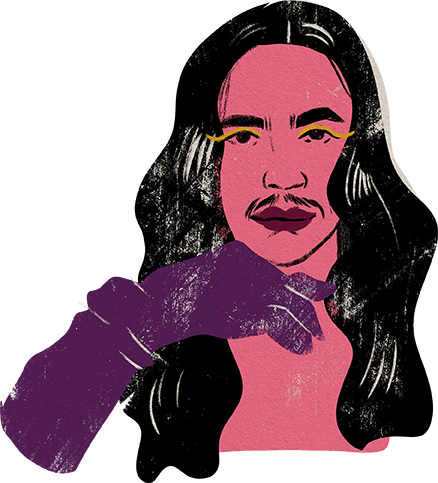
After singing, we reviewed our early sexual explorations. I never thought that most people experienced them before the age of nine and that even in adulthood, those experiences, those memories, remain a heavy burden. Even today, in thousands of places, millions of girls and boys see their innocence curtailed by lack of trust and the ignorance we present them with when they try to explore their bodies. Blaming curiosity is a most efficient control mechanism. We went back to the brief conversations we had when we changed the history of our lives from cursed Black beings to a perspective that rebirthed us. We remembered how many of our aunts and female cousins left their homes, their core, their roots, to seek a future outside, elsewhere.
The future comes with a price: it demands that those relationships that marked our childhood are reshaped and confined to oblivion. They are our foundations, but they are not relevant if we want to move ahead. For us, advancing was to learn by heart what we do to ourselves with the opportunities we find elsewhere. That it is elsewhere, and not within us, that opportunities lie, that we are available, that we need to be outside. However, for many of our aunts and female cousins, the few opportunities to enroll and stay in an evening class or take a sabbatical from domestic work were paid for by becoming the first sexual experience of relatives living in the future. A future for which others before them had also paid for, and whose price they had already forgotten. The demand for this payment arrived with the same inevitability as a public utility service bill. We will not take up that legacy.
In Colombia and Latin America, there was an etiquette manual called La urbanidad de Carreño (Carreño’s Etiquette Manual). It was mandatory reading until the 90s in both public and private schools. The manual conditioned how bodies were perceived and my mother, taken in and brought up by Carmelite nuns, knew it by heart. The first time I read it I had to stop more than once to rub my stomach, which hurt from laughing so much. It has ridiculous instructions such as: take a shower with your eyes closed and turn off the lights to wear your nightclothes. Different chapters address how one is to behave at home, in the street, and during a dinner or lunch party – in short, the norms of good taste and etiquette. The ethical core of good citizens was the urbanity that allowed one to distance oneself from rural life. The same manual indicated that shouting a greeting to an acquaintance on the other side of the street was indecorous; good manners dictate that you must cross the street. By the same token, men must remove their coats and place them over puddles of water if accompanying a woman whose shoes should not get wet. I thought about greeting someone across a river, and how it is so hot where we live that we don’t require coats.
"She learned that to care for her belly, she needed to keep her tissues warm, to avoid the cold that comes through the soft spot on the top of the head, through the feet, the ears, so it would not hurt particularly at moontime. For that, you need to be careful about what you eat and what you don’t eat, how you dress and how you walk, as all that has to do with girls’ health. The woman elder says that, from her devoted grandfather, she learnt that cramps became more common when houses no longer had floors made of mud and/or wood. When concrete and tiles came, when the material making up the house allowed the cold to come in through the feet, tension also grew in the belly tissue."
The manual’s author, Mr. Carreño is the opposite of the grandfather of a woman elder born in Turbo. She told me once that her grandfather was a wise man, that he told her about birthing and how to take care of her body. She learned that to care for her belly, she needed to keep her tissues warm, to avoid the cold that comes through the soft spot on the top of the head, through the feet, the ears, so it would not hurt, particularly at moontime. For that, you need to be careful about what you eat, how you dress, and how you walk, as all that has to do with a girl’s health. The woman elder said that, from her devoted grandfather, she learnt that cramps became more common when houses no longer had floors made of mud and/or wood. When concrete and tiles came, when the material making up the house allowed the cold to come in through the feet, tensions in the belly tissue also grew.
Surprised again. Such a distance between Don Carreño and the wise grandfather in terms of being aware of life – as distant as the mandates of proper behavior that stifle your impulses and senses, even the most common sense that values health. At that moment, I was able to understand one of the many ways that concrete obstructs the earth’s breathing, and our own as part of her. I had not realized there was, and still is, the architecture and materials for taking care of our bodies. In Colombia, as well as in other countries, the materials used to make houses are taken as indicators of multidimensional poverty. A house built with concrete moves the home away from being considered poor. This is just one disappointing example of how progress pushes us to abandon the relationship between our environment and our body. Good taste and urbanity pushes us outside: to move forward, they lie, you have to go out there.
It bothered us to realize that neither our mothers nor fathers had spoken to us about menstruation, except when the brown stain had already smeared our knickers. They failed to preserve us from the shame that was supposed to be a natural feeling once menstruation had come. Along with menstruation came the belly cramps often endured in silence, because there was work to be done; some cramps were due to cysts, hematomas, or fibroids that killed the grandmothers who had discovered and forgotten the healing treatments, and then were forgotten themselves. That our mothers and fathers’ breaths turned colder and colder, but the Outside froze familiarity and, instead of warming our bellies, passed judgment with advice similar to warnings of the only thing men care about. This was applied to all men – legitimizing the plundering role of the phallus, as if its only option was to take what we have between our legs. The multiple versions of that truth were replaced by an unmovable and deeply-set naturalization: telling all women that we must preserve ourselves for one of them, for the one that will first introduce his penis inside us, for the one that will give us something in exchange, and that we are women only because we aspire to and let him put it inside us. As a girl I explored little penises and clitorises and, in between games among girls, the question was whispered: whose turn is it to play man and whose turn is it to play woman? And the answer: the beginnings of little orgasms, regardless of with whom. I guess the same must happen among male bodies.
The experiences and explorations of our aunts, female cousins, and acquaintances focused on the body and its nudity as taboo. They avoided expressing and naming it, to the point of covering it up, assigning new names to its excreting, expelling, procreating, and, just for us women, its receiving functions. Once I heard a woman elder in a workshop say that when she was living with her grandmother, her memory was of this old woman sleeping with one eye open, the other closed, and a rifle by the mattress. The softest night sound was enough for her to grab the rifle and aim. This is a common situation in the Colombian Pacific, where some harmful behaviors are normalized. Married and single men who like a young woman would enter her room at night – we call it gateada. It was a risk: if those with authority in the home realized what was happening, abuse or not, the man could be hurt or even killed.
This practice of taking the law into one’s own hands has failed to put an end to gateadas, even today. In that same workshop – as I kept telling my sisters – other participants said that neither they nor their mothers would leave their daughters alone with their fathers at bath time, unless the girls were wearing underwear. I remembered then my father’s voice saying, when I was seven, your mother never let me bathe you. After sharing this, another woman responded that, in contrast, her father would give her a bath naked in the courtyard of her childhood home until she turned seven, and then her eldest brother did it until she turned nine. She never felt anything strange in the way they looked at her; for them, it was just another task in caring for the most spoiled child in the home. She remembered being seen for what she was: a daughter child, a sister child, who did not like the water.
Once again childhoods, yesterday and today. We were surprised by that story, and it comforted us. Even I had seen things being different elsewhere; my daughter’s father bathed her in the tub until she was almost two. Even before turning two, he would give her a few soft slaps upwards on her bum, to make it bigger, as he said. Here, we could also speak of other dimensions of how we construct our bodies, but that is a different story. For me, it was one care task, among many, that we agreed to divide between ourselves before the baby was born. And the decision to not see every man as a lurking rapist does not mean they are not rapists, but instead that they can stop being so. There are also men and male bodies that have been brought up to never be rapists.
This is still happening. It happened to a friend of ours and to my own daughter. I thought: how can it be that some women are coupled with men they cannot trust to care for their daughters? I am sure that my mum loved my dad. And even though we seldom speak about the woman she was before becoming my mum, I know her experiences of abuse cannot be compared to the brutality and over-tolerance of those of today. But that is still a decision many women in many places make, and that leads to other questions. How often, how repeated were cases of abuse in our extended families to make women openly, or in indiscernible ways, forbid their partners from bathing their daughters? Is it related to the media overexposure we are subject to almost from birth? What makes family ties blur and turn into just bodily-satisfaction exchanges? Is it the proximity to urban values that cares so much about the right shapes of female bodies as objects of desire, and pushes male bodies to behave like owners and conquerors, fulfilling the mandate to mimic media representations so they feel safe in their identity? Is it concrete and other codes, like the Carreño etiquette, that sustain it? Is it encouraged by the need to forget certain relationships as the price of progress, that insistence on “doing for the outside?” What happens to what we learned in our times, those of us who, in secret or not, undertook sexual explorations as children? Were they erased by guilt? Were they the seeds of mistrust and shame in nudity? Were they the seeds of mistrust and shame of being inside oneself? Indeed, aren’t these learnings possibilities to trust in, understand the nudity of bodies as part of respecting oneself and others? These questions emerge in trusted spaces, where the fear to say what one thinks and feels is driven away by the intention of accompaniment. I imagine how many of us there are in all corners of this planet and I am certain these are not new questions, that messages in them are repeated, and that we find ourselves living the answers.

This journal edition in partnership with Kohl: a Journal for Body and Gender Research, will explore feminist solutions, proposals and realities for transforming our current world, our bodies and our sexualities.

نصدر النسخة هذه من المجلة بالشراكة مع «كحل: مجلة لأبحاث الجسد والجندر»، وسنستكشف عبرها الحلول والاقتراحات وأنواع الواقع النسوية لتغيير عالمنا الحالي وكذلك أجسادنا وجنسانياتنا.
« Le privé est politique » - tel est le mantra féministe que personnifiait la fougueuse et courageuse Nadyn Jouny. Nadyn avait personnellement vécu la douleur de la violence structurelle des systèmes juridiques qui refusent aux femmes de jouir de leurs droits.
Lorsqu’elle décide de demander le divorce, les tribunaux religieux chiites – conformément aux lois relatives au statut personnel du Liban – lui refusent la garde de son jeune fils Karam. Comme tant d’autres femmes au Liban et d’autres pays, Nadyn s’est retrouvée dans la situation douloureuse et insoutenable de devoir abandonner ses droits sur son enfant pour pouvoir quitter une relation abusive et non voulue. Mais Nadyn s’est battue, jusqu’au dernier jour.
Elle s’est servie de ses compétences médiatiques pour devenir la voix de celles qui n’en ont pas dans leur combat contre un droit de la famille discriminant, tant au Liban qu’à l’étranger. Nadyn a cofondé le groupe autofinancé « Protecting Lebanese Women » (PLW) et s’est alliée à d’autres mères libanaises vivant des situations similaires. Ensemble, elles ont cherché à sensibiliser la société en manifestant pour leurs droits devant les tribunaux religieux et attirant l’attention des médias sur les très grandes injustices qu’elles subissaient.
Nadyn a également collaboré avec ABAAD – Resource Center for Gender Equality, une autre organisation libanaise pour les droits des femmes, à l’occasion de campagnes pour la défense des droits des femmes, l’égalité dans le droit de la famille et la garde des enfants, et contre le mariage forcé et précoce.
Pour nombre de ses collègues, elle « symbolisait le combat d’une mère libanaise contre toutes les formes de répression et de misogynie » (en anglais), utilisant « son expérience personnelle et sa propre trajectoire d’autonomisation pour donner aux autres l’espoir qu’elles peuvent être des catalyseuses de changement positif ». - ABAAD – Resource Center for Gender Equality, Liban
Nadyn a tragiquement perdu la vie dans un accident de voiture le 6 octobre 2019, alors qu’elle se rendait à une manifestation contre les augmentations de taxes injustifiées, dans un pays qui connaît déjà une crise financière croissante. Nadyn Jouny n’avait que 29 ans au moment de son décès.
Tout au long de ses 38 années de carrière, Debbie Stothard a collaboré avec diverses communautés pour impliquer des États, des organisations intergouvernementales et autres parties prenantes en Asie, en Afrique, en Europe et dans les Amériques sur des questions de droits humains et de justice. Son travail porte essentiellement sur les thématiques des affaires et des droits humains, de la prévention des atrocités et du leadership des femmes. Elle a, de ce fait, animé ou secondé près de 300 formations au cours des 15 dernières années. La plupart de ces formations était des ateliers à destination de groupes de base et organisés sur le terrain, centrés sur le plaidoyer en faveur des droits humains, les connaissances économiques fondamentales, les affaires et les droits humains, la justice transitionnelle et la prévention des atrocités. Son travail dans le domaine de la justice transitionnelle et de la prévention des atrocités s’est principalement déroulé au Myanmar, mais elle a également été conseillère en matière d’interventions dans d’autres situations nationales dans le monde.
Entre 1981 et 1996, Debbie a été reporter spécialisée dans les affaires criminelles, organisatrice d’évènements étudiants, analyste politique, universitaire, conseillère gouvernementale et traiteure en Malaisie et en Australie, tout en étant bénévole pour des causes en lien avec les droits humains. Elle a fondé ALTSEAN-Burma en 1996, qui fut à l’initiative d’un large éventail de programmes sur les droits humains à la fois innovants et autonomisants. ALTSEAN mène notamment un programme permanent et intensif de leadership à destination de diverses jeunes femmes à Burma qui, au cours des 22 dernières années, a aidé à renforcer et élargir le leadership des femmes dans les zones touchées par un conflit. Debbie Stothard a siégé au Conseil de la fédération internationale des droits humains (FIDH) pendant neuf années en sa qualité de secrétaire générale adjointe (2010–2013) puis de secrétaire générale (2013–2019). Elle a mis cette période à profit en promouvant la mission et le profil de la FIDH lors de près de 100 réunions et conférences par année.