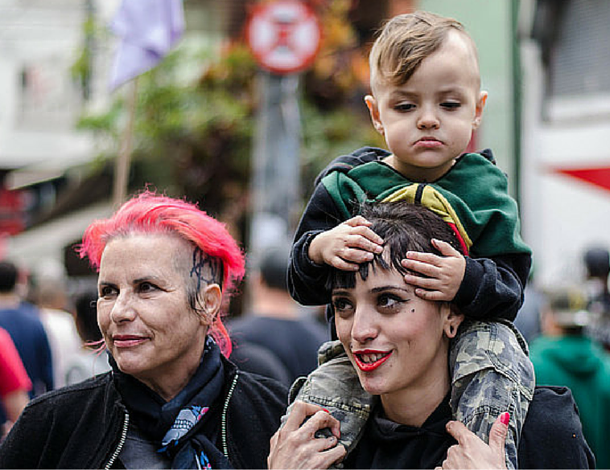
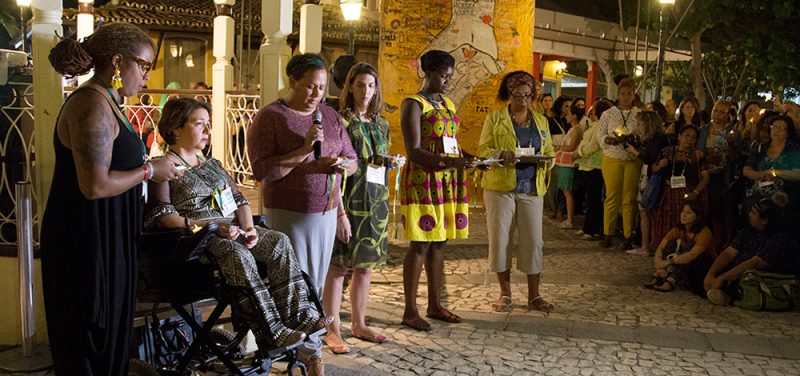
Flickr/Leonardo Veras (CC BY 2.0)

Analyses Spéciales

L´AWID est une organisation féministe mondiale qui consacre ses efforts à la justice de genre, au développement durable et aux droits humains des femmes

Protection de la famille

Contexte

Au cours des dernières années, nous avons observé une nouvelle tendance inquiétante dans les espaces internationaux consacrés aux droits humains. Les discours axés sur « la protection de la famille » sont en effet utilisés pour défendre des violations des droits de membres de la famille, pour renforcer et justifier l’impunité des auteurs de ces violations et pour restreindre l’égalité des droits au niveau de la vie familiale. 

La campagne en faveur de la « Protection de la famille » est motivée par une volonté conservatrice d’imposer des conceptions « traditionnelles » et patriarcales de la famille et de priver les membres de la famille de leurs droits pour les transférer à « l’institution familiale ».

Les initiatives visant à la « Protection de la famille » reposent sur :

  • la montée du traditionalisme,
  • la montée du conservatisme culturel, social et religieux,
  • l’existence d’une hostilité vis-à-vis des droits humains des femmes, des droits sexuels, des droits des enfants et enfin des droits des personnes dont l’identité de genre et l’orientation sexuelle ne sont pas conformes aux normes.

Depuis 2014, un groupe d’Etats travaille de front dans les espaces dédiés aux droits humains sous le nom de « Group of Friends of the Family » (Groupe des ami-e-s de la famille) ; des résolutions sur la « Protection de la famille » ont été adoptées chaque année depuis 2014.

Ce programme s’est propagé au-delà du Conseil des droits humains. Nous avons observé l’introduction d’un discours régressif autour de la « famille » à la Commission sur la condition de la femme, ainsi que des tentatives d’introduction dans les négociations sur les Objectifs de développement durable.


Notre approche

L’AWID travaille avec des partenaires et des allié-e-s pour s’opposer ensemble à la « Protection de la famille » et à d’autres programmes régressifs et défendre l’universalité des droits humains.

En réponse à l’influence croissante d’acteurs régressifs au sein des espaces dédiés aux droits humains, l’AWID a rejoint des allié-e-s afin de créer l’Observatoire sur l'Universalité des droits (OURs) (site en anglais). L’OURs est un projet de collaboration qui surveille, analyse et diffuse les informations concernant les initiatives anti-droits telles que la « Protection de la famille ».

Le premier rapport de l’OURs, Nos droits en danger, trace une cartographie des acteurs et actrices qui constituent le lobby mondial anti-droits et identifie leur réthorique et stratégies clés ainsi que leur impact sur les droits humains.  

Le rapport précise que le programme de « Protection de la famille » a développé une collaboration entre un large éventail d’acteurs régressifs aux Nations Unies, qu’il décrit comme « un cadre stratégique abritant des positions anti-droits et patriarcales multiples, où le cadre vise entre autres à légitimer et institutionnaliser ces positions. »

Contenu lié

Snippet Kohl - Intro

Corporalidades Transnacionales

Desde siempre el feminismo sostiene que lo personal es político. El Festival Crear, Resister, Transform generó espacios en los que el feminismo pudo discutir las cuestiones relativas al cuerpo, el género y las sexualidades, y analizar las interconexiones de estos asuntos entendidos como experiencias profundas del cuerpo y, a la vez, un terreno en los que los derechos están en constante disputa y riesgo en la sociedad.

El poder de los movimientos feministas radica en el modo de organizarnos y emprender acciones coordinadas, no solo en nuestras propias comunidades y movimientos, sino también con otras causas y grupos aliados por la justicia social. El espacio brindó la oportunidad de que los movimientos compartieran y reforzaran los procesos de organización y las estrategias tácticas de forma mutua.

La pandemia mundial sanitaria del COVID-19 ha puesto de manifiesto como nunca antes el fracaso del capitalismo neoliberal, expuesto las fallas de nuestros sistemas y acentuado la necesidad de construir nuevas realidades y las oportunidades para ello. Una recuperación económica y social feminista exige el trabajo conjunto. Esta edición, en alianza con Kohl: una publicación para la investigación sobre cuerpo y género, analizará soluciones, propuestas y realidades feministas para transformar nuestro mundo actual, nuestros cuerpos y nuestras sexualidades.

Puedes explorar los artículos en línea o
Descargar en PDF

Soy nueva en este campo y existen muchos términos que me resultan confusos, ¿me pueden ayudar?

Snippet - COP30 - Radical Democracy - ES

Democracia radical y justicia climática: el debate ausente en la COP30

Modelos de gobernanza alternativos como vías para salir de la crisis climática.

📅 Miércoles 12 de noviembre de 2025
📍 Seminario Mar Nossa Sra Da Assunção, Pará, Brasil

Más información aquí

Paulina Cruz Ruiz

Paulina Cruz Ruiz, originaire de Rabinal dans la région de Baja Verapaz au Guatemala, était une défenseuse des droits humains au pouvoir ancestral Maya Achí (autochtone). Elle participait activement à la mobilisation et à la résistance communautaires, notamment via des mesures juridiques contre des projets miniers sur des territoires autochtones, aux effets sévères et néfastes pour leur tissu socioenvironnemental. 

« Le modèle d’industrie extractive promu par le gouvernement guatémaltèque et la construction de projets de développement à grande échelle sur des terres autochtones, sans le consentement des communautés, est source de litiges constants avec les mouvements de résistance. » - Minority Rights Group International (groupe international pour les droits des minorités)

Paulina a également participé à la Marche pour la dignité, la vie et la justice, durant laquelle des milliers de guatémaltèques ont initié, le 1er mai 2019, une marche de huit jours contre la corruption et l’impunité face aux poursuites et aux assassinats de défenseur·e·s des droits humains, des terres ainsi que de leaders paysan·ne·s et autochtones.   

Paulina a été assassinée le 14 septembre 2019 près de chez elle, dans le village de Xococ. 

D’après Minority Rights Group International, « l’une des problématiques constantes qui affecte le plus les communautés mayas tient dans l’accroissement des activités de l’industrie minière. »


En savoir plus sur les mayas au Guatemala (en anglais)

En savoir plus sur la Marche pour la dignité, la vie et la justice (en anglais)

Kunyit Asam: The Roots of Love and Resilience

By Prinka Saraswati, Gianyar, Bali

The menstrual cycle usually lasts between 27 and 30 days. During this time, the period itself would only go on for five to seven days. During the period, fatigue, mood swings, and cramps are the result of inflammation.

In traditional Javanese culture, this is the moment for women to rest and take care of themselves. During this moment, a woman would take Kunyit Asam, a jamu or herbal drink to soothe the inflammation. This elixir consists of turmeric and tamarind boiled together in a pot.

I still remember my first period - it was one day before graduation day in elementary school. I remember pedaling my bike feeling something warm running between my thighs. When I arrived home I did all I could to clean myself and then put on a menstrual pad. My mother came home from work about four hours later. I told her what had happened. She looked me in the eye and asked how I felt. I told her that it was painful, that my body was swollen in every place. Then she asked me to go with her to the backyard. I followed her to our little jungle, my mother sat down on the soil and smiled.

“See this slender leaf? This is the leaf of Kunyit, *empon-empon that leaves the yellow stain on your fingers. What’s most important is not the leaf, but the roots. You dig the soil and slowly grab the roots.”, my mother showed me how to pick Kunyit or Turmeric roots. Then we went to the kitchen where she boiled water along with some tamarind. While waiting for it to boil, she showed me how to wash and grate the orangey-yellow root. Then, we put the grated turmeric into the boiling tamarind water. “Tomorrow, you can make it for yourself. This will help you to feel better!”.

I remember the first time I tasted it - a slightly bitter taste but also sour. My mother always served it warm. She would also put some in a big bottle which I would place on my stomach or lower back for further relief. For days after, my mother’s hands and mine were yellow. My friends could always tell every time I got period because my hands would be yellow.

A year after my first period, I found out that you could get the bottled version in convenience stores. Still, I made my own Kunyit Asam every time I had my period because the one in the convenience stores was cold. It did not smell of wet soil and warm kitchen.

Fast forward, I am a 26 year old woman who casually makes this drink for friends when they have their periods. I’ve made some for my housemates and I’ve delivered some for friends who live in different towns. I do not grow turmeric roots in my garden, but I have grown and shared the love from my mom. What was once from garden to cup is now from *pasar to cup.

A couple of days ago, I asked my mother who taught her how to make the jamu.

“Who else? Yang Ti*! Your grandmother was not just a teacher”, said my mom. I was never close to my grandmother. She passed away when I was eight. All I knew from my mom was that she was a math teacher who had to teach courses after work. I had this image of my grandmother as a hard worker who was kind of distant with her children. My mom did not disagree with that but explained it came from her survival instinct as a mother. “She tried to make time. She tried. She taught me how to make jamu so I could take care of myself and my sisters”.

My mother is the second child out of seven, six of whom are girls. The reason my grandmother taught her is so that all of her children could take care of each other. While my mother was taught how to make the drink, my mother’s older sister was taught how to plant turmeric. Yang Ti knew which one loved the smell of soil more and which one loved the smell of the kitchen. My mother was the latter. She learned how to plant from my aunt, her older sister.

My grandfather worked in a bank but he got laid off when he was in his 40s. So, my grandmother had to do a side-hustle to support their children. My mother was in high school at that time when Yang Ti woke her and her older sister up at dawn. “Would you help me to pick some roots?”. Of course nobody said no. Especially if it was your mother, especially if you were born in Javanese culture where saying “no” sounded like a bad word. Together, the three of them went to the backyard, and they harvested empon - empon, rhizome, that was buried inside the soil. She grew many kinds of rhizome; temu lawak, temu putih, ginger, galangal, kunci, kencur, and kunyit. That was the day where my mother realized that her mother was never far away from her.

That was the day where she could spend more time with her mother. There, in the garden. There, in the kitchen.

“We’re sending these for Ibu Darti, the lady who lives across the river. Kunyit Asam for her and her daughters.”, said my grandmother to my mother and my aunt that day. They poured the Turmeric-Tamarind warm drink into a tall thermos and later my grandmother would deliver it on the way to school.

Over time, my grandmother got more orders for jamu. Everybody in the family helped her to make and deliver her jamu. The small business lasted only a few years, but that was what paid for my mother and her siblings’ education.

Today, my mother, who got laid off just a few days before I wrote this piece, harvested Turmeric and other roots. She’s making her Turmeric Tamarind drink from her kitchen.

My phone rang in the middle of this afternoon, a couple minutes after I boiled the rest of my grated turmeric. Today is one day after my period.

“Ingka, have you washed your pot after boiling those turmeric? It would forever be yellow if you don’t wash it right away!”


  • *empon-empon = roots like ginger, turmeric, etc. coming from the Javanese word “Empu” which means, something or someone that has deep knowledge.

  • *jamu = Indonesia’s traditional elixir made of roots, barks, flowers, seeds, leaves, and fruits.

  • *Yang Ti = Javanese term for grandmother, taken from the term “Eyang Putri” the female you look up to.

  • *pasar = the word for traditional market in Indonesian.


“Feminist Movement”

by Karina Tungari, Hamburg, Germany  (@_katung_)

The more women support other women, the quicker we’ll see progress. Together we are stronger and make even more impact.

Karina Tungari, Hamburg, Germany  (@_katung_)


CFA 2023 - Themes - ES

Temas

Apreciaremos propuestas de actividades referidas a todo el rango de áreas temáticas e intersecciones que son importantes para los movimientos feministas y por la justicia de género. En el formulario de propuesta podrás marcar más de un tema que se adecúe a tu actividad.

  • Cuerpos libres, espíritus libres: todo lo que que se relacione con la autonomía corporal, el género y la sexualidad, la salud y los derechos reproductivos, la libertad de vivir sin violencia de género, la libertad de vivir segurxs, el placer y la alegría en nuestros cuerpos diversos, identidades y comunidades, y mucho, mucho más.
  • Resistir frente a los antiderechos: tanto a nivel local como global, lxs feministas están liderando la resistencia frente a todas las formas de opresiones interseccionales, incluidos los fascismos, los fundamentalismos y los regímenes autoritarios; tenemos mucho para compartir y mucho sobre lo cual elaborar estrategias conjuntas.
  • Movimientos y organización: conozcamos nuestros respectivos movimientos. Desde el tránsito por los espacios de poder (internos y externos) hasta las estrategias de protección frente a la represión de las mujeres y las personas de género no normativo defensoras de los derechos humanos, desde el armado de alianzas hasta las formas creativas y exitosas de organización: aprendamos e inspirémonos recíprocamente.
  • Justicia económica y economías feministas: este tema abarca todos los esfuerzos feministas para transformar nuestras economías, desde el desafío de los modelos extractivistas dominantes y la defensa de los derechos laborales, hasta corporizar y vivir prácticas y alternativas económicas feministas en la vida cotidiana.
  • Financiar y dotar de recursos al activismo: obtener el financiamiento imprescindible constituye un desafío compartido para los movimientos de todo el mundo; estudiemos juntxs el ecosistema de financiamiento feminista, desde el análisis crítico hasta las experiencias de primera mano y las formas prácticas de financiar el trabajo feminista.
  • Clima, justicia ambiental, tierra y agua: la justicia ecológica y climática tiene profundas raíces en muchos de nuestros movimientos y comunidades; desde las tradiciones ancestrales hasta las visiones futuristas, desde los poblados ecológicos hasta las campañas para poner fin al extractivismo y acceder a la justicia, invitamos a abarcar un amplio rango de actividades sobre todos los aspectos de la justicia climática y ambiental.
  • Militarización, guerra y conflicto armado: nuestro objetivo es poner de relieve la organización, el análisis y las experiencias feministas que a menudo se encuentran en las primeras filas de la respuesta a las crisis, ayudando a sostener la vida, la comunidad y la justicia en los momentos más duros de guerra y conflicto prolongado.
  • Descolonización: la descolonización es central en todos y cada uno de nuestros temas y, sin embargo, también constituye, en sí misma, una agenda feminista clave de resistencia y construcción de mundo en muchas realidades coloniales y postcoloniales.
  • Realidades digitales y tecnología feminista: nos entusiasma esta oportunidad de celebrar las increíbles iniciativas feministas que transforman los mundos digitales, desafían las estructuras de poder de los gigantes tecnológicos y democratizan la tecnología, convirtiéndola en algo verdaderamente por y para la gente.
  • Justicia de sanación: existe una increíble diversidad de abordajes sobre el cuidado colectivo y la justicia de sanación. En todo el mundo, sanadorxs y movimientos están reivindicando la justicia de sanación como principio político, como conjunto de prácticas, como viaje de aprendizaje, como forma de vida y mucho más.
  • ¡Agrega aquí tu propio tema!

Sexting Like a Feminist: Humor in the Digital Feminist Revolution Snippet Small

Sexting como feminista: el humor en la revolución digital feminista

por Chinelo Onwualu

El 2 de septiembre de 2021 lxs increíbles activistas feministas y por la justicia social del festival Crear | Résister | Transform de AWID nos juntamos no solo para compartir estrategias, crear juntxs y transformar al mundo sino también para decir cosas sucias en Twitter.


Leer más


Je vis une situation de violence au sein de l’une ou plusieurs relations interpersonnelles. Est-ce que l’AWID peut m’aider ?

L’AWID n’est pas une organisation de services de première ligne, ni de défense de la personne

Nous vous conseillons de demander conseil à un-e avocat-e, de communiquer avec un refuge pour femmes ou un centre d’accueil près de chez vous.

Les HotPeachPages, une ressource en ligne, contiennent des liens vers les refuges pour femmes dans le monde entier. L’AWID ne peut garantir l’exactitude ou la qualité de ces listes, mais elles peuvent constituer un bon point de départ si vous ne connaissez aucune organisation près de chez vous.

Snippet - COP30 - Actions - FR

Événements et actions à la COP30

Du 8 au 16 novembre 2025

Pleasure Garden Exhibition

The artwork is a photography and illustration collaboration between Siphumeze and Katia during lockdown. The work looks at black queer sex and plesure narratives, bondage, safe sex, toys, mental health and sex and many more. It was created to accompany the Anthology Touch.

Mental Health
Mental Health
Sex and Spirtuality
Sex and Spirtuality
Orgasm
Orgasm

About the Artists:

Siphumeze Khundayi portrait
Siphumeze Khundayi is an art-maker, photographer and facilitator interested in creative ways of bringing together dialogue and artistic practice in relation to African Queer identity.

She is creative director of HOLAAfrica! a pan-Africanist womanist online collective.

Her solo and collaborative performance work has been featured in a number of festivals and theatre spaces such as Ricca Ricca Festival in Japan

She directed two Naledi nominated productions in 2017 and 2018. She directed a show that won a Standard Bank Ovation award in 2020.

As a photographer she was part of a group exhibition titled Flowers of my Soul in Italy organised by the Misfit Project. Produced three publications for HOLAAfrica and was published in and provided the cover for volume two: As You Like of the Gerald Kraak Anthologies.
katia portrait
Katia Herrera is a 21-year-old  Digital visual artist from the noisy city of  Santo Domingo in the Dominican Republic. Despite Herrera being a self-proclaimed introvert, her artwork is remarkably loud in a world trying to quiet black voices. With titles like Black Woman, You Own the Moon, Earth Goddess, Forever,  and Universe Protector, Herrera’s legacy will be marked by her passion for highlighting the endurance and perseverance of black folks of old and present to contrast the narrative that black skin should only be associated with slavery.

One of her most lovely and vivaciously titled works, Universe Protector, portrays the black soul as a divine entity full of strength, power, and greatness. In her youth, her love of graphic design was stimulated by her parents’ artistry and the Photoshop they had downloaded on their computer for their professional photography.

Clone of CFA 2023 - Hybrid like never before: in person - ES

Híbrido como nunca antes

Por primera vez, el Foro de AWID ofrece tres modos de participación:

Participación presencial

Lxs participantes se reunirán en Bangkok, Tailandia. ¡No podemos esperar!

#7 - Sexting like a feminist Tweets Snippet FR

Montre patte blanche! Et affiche tes données…

You want this pussy? Let me see that paper. (Seriously, where are your test results? Digital copy is fine.)

Tu veux cette ch*tte? Montre-moi ton doc. (Mais vraiment, où sont tes résultats de tests? En numérique ça ira.)

2008: The Doha International Conference takes place with limited achievements

Follow-up International Conference on Financing for Development, Doha, Qatar

Snippet - COP30 - Our Tools title - EN

Boîte à outils pour les organisations à la COP30

Colectivo Morivivi

El Colectivo Moriviví es una colectiva de solo mujeres. Nuestra producción artística consiste en muralismo, muralismo comunitario y acciones/performances de protesta. Nuestro trabajo tiene como objetivo democratizar el arte y llevar a la esfera pública las narrativas de las comunidades de Puerto Rico, para generar espacios en donde sean validadas. Creemos que, a través del artivismo, podemos promover conciencia sobre temas sociales y fortalecer nuestra memoria colectiva.

“Cacibajagua” 2017, Mural Project. Jiangxi, China
“Cacibajagua” 2017, proyecto de mural, Jiangxi, China
“Cacibajagua” 2017, Mural Project. Jiangxi, China
“Cacibajagua” 2017, proyecto de mural, Jiangxi, China
“Paz para la Mujer” 2015, collaboration with Coordinadora Paz para la Mujer Organization. Santurce,
“Paz para la Mujer” 2015, colaboración con la organización Coordinadora Paz para la Mujer, Santurce, Puerto Rico


“Paz para la Mujer” 2015, collaboration with Coordinadora Paz para la Mujer Organization. Santurce, Puerto Rico
“Paz para la Mujer” 2015, colaboración con la organización Coordinadora Paz para la Mujer, Santurce, Puerto Rico
Collectivo Moriri Artwork

En el marco de su participación en el Grupo de Trabajo Artístico de AWID, el Colectivo Moriviví convocó a un grupo diverso de afiliadxs, asociadxs y personal de AWID y facilitó un proceso colaborativo de imaginación, configuración y decisión sobre el contenido para la creación de un mural comunitario, a través de un proceso de creación conjunta en múltiples etapas. El proyecto comenzó con una conceptualización remota con feministas de diferentes zonas del planeta reunidxs por AWID, y luego evolucionó hacia su recontextualización y realización en Puerto Rico. Nos honra haber contado con la contribución de las artistas locales Las Nietas de Nonó (@lasnietasdenono), la participación de mujeres locales en la Sesión de Pintura Comunitaria, el apoyo logístico de la Municipalidad de Caguas, y el apoyo adicional al colectivo, brindado por FRIDA Young Feminist Fund.
 
El mural explora la trascendencia de las fronteras, al presentar cuerpos como un mapa en un abrazo que realza la intersección de las distintas manifestaciones, prácticas y realidades feministas.
 
Agradecemos también a Kelvin Rodríguez, quien documentó y captó las diferentes etapas de este proyecto en Puerto Rico:

Collectivo Moriri Artwork

Sobre el Colectivo Moriviví

Colectivo Morivivi portrait

Moriviví es un colectivo de jóvenes artistas mujeres que trabajan en arte público desde abril de 2013. Con sede en Puerto Rico, hemos obtenido reconocimiento por la creación de murales y de arte comunitario.
 
El grupo se inició en festivales locales de arte urbano. A medida que nuestro trabajo se fue haciendo más conocido, algunas organizaciones y líderes comunitarias comenzaron a contactarnos. Al principio éramos solo ocho estudiantes de secundaria que querían pintar juntas un mural. Y en estos ocho años de duro trabajo hemos enfrentado muchos desafíos. Ahora estamos en un período de transición. Queremos reestructurar internamente el colectivo durante el próximo año. Nuestro objetivo es abrir nuevas oportunidades de colaboración y respaldar nuestro proceso de toma de decisiones con un nuevo sistema de evaluación. Aspiramos, en el largo plazo, a convertirnos en una escuela alternativa para la práctica artística, destinada a  aquellas personas interesadas en sumergirse en la producción de arte comunitario.

CFA 2023 - Hubs - ar

جديد

محاور جديدة: السفر إلى الفضاء عبر الحدود


سيجتمع المشاركات/ون فعليًا في عدد من المواقع خارج مكان انعقاد المنتدى في بانكوك، في أجزاء مختلفة من العالم، في كل يوم من أيام المنتدى. وستكون جميع هذه المواقع ذاتية التنظيم مرتبطة افتراضيًا لموقع انعقاد المنتدى في بانكوك. كما هو الحال مع الأفراد المتواصلون عبر الإنترنت، سيتمكن المشاركون/ات من تسيير النشاطات والمشاركة في المحادثات والاستمتاع ببرنامج غني ومتنوع.

سيتم الإعلان عن مواقع التجمعات في عام 2024.

Communicating Desire and Other Embodied Political Praxes | Title Snippet EN

Communicating Desire and Other Embodied Political Praxes

with Manal Tamimi, Lindiwe Rasekoala, and Louise Malherbe
Podcast credit: Zuhour Mahmoud