Conseil des Droits de l'Homme (CDH)
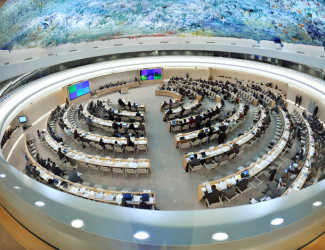
Le Conseil des droits de l'homme (CDH) est un organe intergouvernemental clé du système des Nations Unies, responsable de la promotion et la protection des droits humains autour du globe. Il se réunit trois fois par an en session ordinaire, en Mars, Juin et Septembre. Le Bureau du Haut-Commissariat des Nations Unies aux Droits de l’Homme (HCDH) constitue le secrétariat pour le CDH.
Le CDH :
-
Débat et adopte des résolutions sur les questions globales des droits humains ainsi que sur la situation des droits humains dans des pays particuliers
-
Examine les plaintes des victimes de violations des droits humains et des organisations activistes, au nom des victimes de violations des droits humains
-
Nomme des experts indépendants (que l'on connaît sous le nom de « Procédures Spéciales ») pour réviser les cas de violation des droits humains dans des pays spécifiques, ainsi que pour examiner et suivre des questions globales relatives aux droits humains
-
Prend part à des discussions avec les experts et les gouvernements sur les questions de droits humains
-
Évalue les bilans des États membres de l'ONU en matière de droits humains tous les quatre ans et demi, dans le cadre de l'examen périodique universel.
Session actuelle: CDH 44
La prochaine session du CDH a lieu à Genève, en Suisse, du 30 juin au 17 juillet 2020.
AWID travaille avec des partenaires féministes, progressistes et du domaine des droits humains pour partager nos connaissances clé, convoquer dialogues et évènements avec la société civile, et influencer les négociations et les résultats de la session.
Avec nos partenaires, notre travail consiste à :
◾️ Suivre, surveiller et analyser les acteurs, discours et stratégies anti-droits et leur impact sur les résolutions du CDH.
◾️ Co-développer un plaidoyer collectif pour contrer les acteurs anti-droits et discuter plus en détails les résultats du Rapport de tendances 2017 du OURs
◾️ Soutenir, coordoner et développer de manière collaborative le Caucus féministe qui émerge au CDH.
Contenu lié
Film club - swana
You can now watch the AWID Feminist Film Club program “Feminist Embodiments of Hope and Power” - a film series on Feminist Realities from the SWANA region curated by Esra Ozban
WATCH
Roxana Reyes Rivas
Roxana Reyes Rivas, était une philosophe, féministe, lesbienne, poétesse, politicienne et activiste pour les droits des personnes LGBT et des femmes du Costa Rica. Auteure à la plume acérée et à l’humour incisif, elle était irrésistiblement drôle. Née en 1960 et élevée à San Ramón dans la province d’Alajuela, qui était encore une localité rurale à l’époque, elle a toute sa vie refusé d’adhérer aux attentes envers « les femmes ».
Avec le groupe de lesbiennes costariciennes El Reguero, Roxana a organisé pendant plus de dix ans des festivals lesbiens, de joyeux espaces de formation où se rassembler à une époque où le gouvernement du Costa Rica et la société persécutaient et pénalisaient l’existence des lesbiennes. Ces festivals lesbiens étaient, pour des centaines de femmes, le seul endroit où elles pouvaient être elles-mêmes et se regrouper avec leurs semblables.
Roxana aimait répéter que la formation de partis politiques comptait parmi ses passe-temps. « Il est important que les gens comprennent qu’il y a d’autres manières de faire de la politique, et que de nombreuses questions doivent être résolues collectivement. » Elle fut également l’une des fondatrices des partis Nueva Liga Feminista et VAMOS, centrés sur les droits humains.
« La philosophie est faite pour bousculer, pour aider les gens à se poser des questions. Une philosophe qui n’irrite personne ne fait pas son travail. » Pendant 30 ans, Roxana a enseigné la philosophie dans plusieurs universités publiques du Costa Rica. Des générations d’étudiant·e·ss ont suivi ses directives et réfléchi aux dilemmes éthiques que posent la science et les technologies.
L’outil de prédilection de Roxana était l’humour. Elle a créé le prix de l’ignorance La Citrouille étincelante, qu’elle décernait à des personnalités publiques sur ses réseaux sociaux, tournant en dérision leurs expressions et déclarations anti-droits.
Roxana a été emportée par un cancer agressif fin 2019, avant qu’elle ne puisse publier son recueil de poèmes, qu’elle aurait voulu être le cadeau de départ de l’esprit créatif d’une féministe qui a toujours élevé sa voix contre l’injustice.
Snippet - CSW69 - Feminist Solidarity Space 12 - ES
Espacio de solidaridad feminista
✉️ Requiere inscripción previa para grandes grupos. Entrada libre para grupos reducidos. Reserven aquí
📅 Miércoles 12 de marzo de 2025
🕒 de 02:00 a 04:00 p.m., EST
🏢 Chef's Kitchen Loft with Terrace, 216 East 45th St 13th Floor, New York
Organiza: AWID
Key opposition actors
We are witnessing an unprecedented level of engagement of anti-rights actors in international human rights spaces. To bolster their impact and amplify their voices, anti-rights actors increasingly engage in tactical alliance building across sectors, regional and national borders, and faiths.
This “unholy alliance” of traditionalist actors from Catholic, Evangelical, Mormon, Russian Orthodox and Muslim faith backgrounds have found common cause in a number of shared talking points and advocacy efforts attempting to push back against feminist and sexual rights gains at the international level.
Holy See
-
Key activities: As the government of the Roman Catholic Church, the “Holy See” uses its unique status as Permanent Observer state at the UN to lobby for conservative, patriarchal, and heteronormative notions of womanhood, gender identities and “the family”, and to propagate policies that are anti-abortion and -contraception
-
Based in: Vatican City, Rome, Italy.
-
Religious affiliations: Catholic
-
Connections to other anti-rights actors: US Christian Right groups; interfaith orthodox alliances; Catholic CSOs
Organization of Islamic Cooperation (OIC)
-
Key activities: Self-described as the “collective voice of the Muslim world”, the OIC acts as a bloc of states in UN spaces. The OIC attempts to create loopholes in human rights protection through references to religion, culture, or national sovereignty; propagates the concept of the “traditional family”; and contributes to a parallel but restrictive human rights regime (e.g. the 1990 Cairo Declaration on Human Rights in Islam).
-
Based in: Jeddah, Saudi Arabia
-
Religious affiliations: Muslim
-
Connections to other anti-rights actors: Ultra conservative State missions to the UN, such as Russia
World Congress of Families
-
Key activities: International and regional conferences; research and knowledge-production and dissemination; lobbying at the United Nations “to defend life, faith and family”
-
Based in: Rockford, Illinois, U.S.
-
Religious affiliation: Predominantly Catholic and Christian Evangelical
-
Connections to other anti-rights actors: Sutherland Institute, a conservative think-tank; the Church of Latter-Day Saints; the Russian Orthodox Church’s Department of Family and Life; the anti-abortion Catholic Priests for Life; the Foundation for African Culture and Heritage; the Polish Federation of Pro-Life Movements; the European Federation of Catholic Family Associations; the UN NGO Committee on the Family; and the Political Network for Values; the Georgian Demographic Society; parliamentarians from Poland and Moldova, etc; FamilyPolicy; the Russian Institute for Strategic Studies; and HatzeOir; C-Fam; among others
Center for Family and Human Rights (C-Fam)
-
Key activities: Lobbying at the United Nations, particularly the Commission of the Status of Women to “defend life and family”; media and information-dissemination (Friday Fax newsletter); movement building; trainings for conservative activists
-
Based in: New York and Washington D.C., U.S.
-
Religious affiliations: Catholic
-
Connections to other anti-rights actors: International Youth Coalition; World Youth Alliance; Human Life International; the Holy See; coordinates the Civil Society for the Family; the Family Research Council (U.S.) and other Christian/Catholic anti-rights CSOs; United States CSW delegation
Family Watch International
-
Key activities: Lobbying in international human rights spaces for “the family” and anti-LGBTQ and anti-CSE policies; training of civil society and state delegates (for example, ‘The Resource Guide to UN Consensus Language on Family Issues’); information dissemination; knowledge production and analysis; online campaigns
-
Based in: Gilbert, Arizona, U.S.
-
Religious affiliations: Mormon
-
Connections to other anti-rights actors: leader of the UN Family Rights Caucus; C-Fam; Jews Offering New Alternatives to Homosexuality (JONAH); the National Association for Research and Therapy of Homosexuality (NARTH); World Congress of Families; CitizenGo; Magdalen Institute; Asociación La Familia Importa; Group of Friends of the Family (25 state bloc)
World Youth Alliance
-
Key activities: Advocacy in international policy spaces including the United Nations, the European Union, and the Organization of American States for “the family”, against sexual and reproductive rights; training youth members in the use of diplomacy and negotiation, international relations, grassroots activities and message development; internship program to encourage youth participation in its work; regular Emerging Leaders Conference; knowledge production and dissemination
-
Based in: New York City (U.S.) with regional chapter offices in Nairobi (Kenya), Quezon City (The Philippines), Brussels (Belgium), Mexico City (Mexico), and Beirut (Lebanon)
-
Religious affiliations: primarily Catholic but aims for interfaith membership
-
Connections to other anti-rights actors: C-Fam; Human Life International; the Holy See; Campaign Life coalition
Russian Orthodox Church
-
Key Activities: The Russian Orthodox Church (ROC), capitalizing on its close links to the Russian state, has operated as a “norm entrepreneur” in human rights debates. Russia and the ROC have co-opted rights language to push for a focus on “morality” and “traditional values” as supposed key sources of human rights. Russia led a series of “traditional values” resolutions at the Human Rights Council and has been at the forefront of putting forward hostile amendments to progressive resolutions in areas including maternal mortality, protection of civil society space, and the right to peaceful protest.
-
Connections to other anti-rights actors: Organization of Islamic Cooperation; Eastern European and Caucasus Orthodox churches, e.g. Georgian Orthodox Church; U.S. Christian Right including U.S. Evangelicals; World Congress of Families; Group of Friends of the Family (state bloc)
Other Chapters
Snippet Join Forum Dreaming (EN)
Want to build the Forum with us?
Join as an AWID member now and participate in our next member event:
“Forum Dreaming” on June 20th.
Film club - intro
Como parte del Viaje por las Realidades Feministas de AWID, te invitamos a explorar nuestro nuevo Club de Cine Feminista: una colección de cortometrajes y largometrajes seleccionados por nuestrxs curadorxs y narradorxs feministas de todo el mundo, que incluyen a Jess X. Snow (Asia-Pacífico), Gabrielle Tesfaye (África/Diáspora Africana) y Esra Ozban (Sudoeste Asiático y África del Norte). Alejandra Laprea es la curadora del programa de América Latina y Centroamérica, que inauguraremos en septiembre, durante el evento de AWID Crear, Résister, Transform: un festival para movimientos feministas. Mientras tanto, ¡mantente atentx a los anuncios sobre proyecciones especiales y conversaciones con cineastas!
Kalpana Chakma
Nilcéa Freire
Nilcéa Freire was a Brazilian feminist activist, politician and academic. A persevering advocate for women’s rights and those of underrepresented minorities in the country, her life and work carried a long history of struggles and victories.
"While resisting we have to keep pushing for progress, and what we can achieve at this time, in my view, will be through the stupendous organization of young white women, and especially black women, in all of the state capitals and large cities of Brazil." - Nilcéa Freire
In 1999 she became the first woman to occupy the position of Dean at the State University of Rio de Janeiro. Here, she spearheaded the implementation of the first affirmative action policy for students graduating from public schools, requiring reserved places specifically for low-income black students in a public university. This system was adopted in dozens of other public universities.
Some years later, Nilcéa headed the Special Secretariat of Policies for Women in the government of former president Luiz Inácio Lula da Silva. In this capacity, she led the first National Women’s Conference. Over 12,000 women from across the country participated and the result of this collective work was embodied in the National Plan for Policies for Women.
Her commitment to women, Afro-Brazilians and indigenous peoples was also strongly reflected in her work to promote their rights through initiatives of the Brazil Ford Foundation office where she was a regional director.
The feminist activist Manoela Miklos recounted Nilcéa to be "a woman without equal".
At the age of 66, Nilcéa passed away in Rio de Janeiro on 29 December 2019 of cancer.
"Without words for the news of the death of dear Nilcea Freire. It is too sad to know that she left so early. She was always part of the ranks of those who do not settle for the injustices of the world. She was the Minister of Women, an activist, always active in the feminist cause. Much missed!” - Jandira Feghali, Federal Deputy
Watch Brazilian feminist Nilcea Freire on why we need to show solidarity with Brazil
Snippet - Title WCFM Landing - EN
Who Can Fund Me?
Reclaim Power to #FreezeFascisms: Resources for Feminists to Survive & Thrive
Feminist and gender justice movements continue to be chronically underfunded in the face of global funding cuts and freezes. Particularly in Global South regions with shrinking civic spaces, resource scarcity has impacted the most vulnerable communities.
In the face of these setbacks, AWID has updated the Who Can Fund Me? Database - an easy-to-use, practical tool for movements looking for funders from philanthropic foundations, multilateral funders to women’s and feminist funds to support vital lifesaving efforts.
Defendiendo nuestra tierra del poder corporativo

Estas industrias 'extraen' materias primas de la tierra: minería, gas, petróleo y madera son algunos ejemplos.
Este modelo económico explota desenfrenadamente la naturaleza e intensifica las desigualdades norte, donde sus grandes corporaciones se benefician y sur, de donde extraen los recursos.
Contaminación del agua, daño irreparable al medioambiente, comunidades forzadas a desplazarse son algunas de las consecuencias inmediatas.
Lee nuestro reporte de INDUSTRIAS EXTRACTIVAS
Hay alternativas sostenibles para el medioambiente y los derechos humanos de la mujer.
Descubre además cómo nos afecta económicamente

¿AWID realizará un llamado a presentar propuestas?
¡Sí! Por favor lee la Convocatoria de Actividades y presenta tu propuesta aquí. La fecha límite es el 1ero de febrero de 2024.
OURS 2021 - Chapter 1
Chapter 1
Advancing Feminist Agendas: Key Progressions on Gender and Sexuality
While fundamentalisms, fascisms and other systems of oppression shapeshift and find new tactics and strategies to consolidate power and influence, feminist movements continue to persevere and celebrate gains nationally and in regional and international spaces.
Maria Elizabeth Macias Castro
Leah Tumbalang
Leah Tumbalang fue una mujer lumad de Mindanao, en Filipinas. La historia del pueblo indígena lumad abarca generaciones de resistencia contra la minería corporativa a gran escala, de protección de los territorios ancestrales, los recursos y la cultura, y de lucha por la autodeterminación.
Leah era una líder lumad, y dirigente de Kaugalingong Sistema Igpasasindog to Lumadnong Ogpaan (Kasilo), una organización lumad y campesina que lucha contra la instalación de corporaciones mineras en Bukidnon, en la provincia de Mindanao. Fue inclaudicable en su activismo anti minería, al emprender con fervor campañas contra los efectos devastadores de la extracción de minerales en el medio ambiente y las tierras de los pueblos indígenas. Era también una organizadora política de la lista electoral Bayan Muna, que integra el partido político de izquierda Makabayan.
Durante casi una década Leah (junto con otrxs integrantes de Kasilo) recibió amenazas debido a su oposición al despliegue de grupos paramilitares, que se cree son respaldados por intereses mineros.
«Como líder lumad de su comunidad, ella está en la primera línea de lucha por sus derechos a la tierra ancestral y a la autodeterminación.» - Kalumbay Regional Lumad Organization
Estar en la vanguardia de la resistencia también significa, a menudo, ser un blanco para la violencia y la impunidad, y Leah no solamente recibió numerosas amenazas de muerte, sino que fue asesinada el 23 de agosto de 2019 en la ciudad de Valencia, en Bukidnon.
Según un informe de Global Witness, «en números absolutos, Filipinas fue el país peor afectado» en lo que respecta a activistas ambientalistas asesinadxs en 2018.
Lee el informe de Global Witness, publicado en julio de 2019
Snippet - WCFM getting the money we need - En
Getting the Money We Need | A 101 Guide on Fundraising for Small Grassroots Organizations
From building prospect funders lists with *templates*, to understand how to write a solid grant proposal, with ‘Getting the Money we Need’ Guide really we don't have to figure this out alone anymore
Read and download the guide hereText-only version
- Version française version intégrale | version texte seulement
- Versión en español versión completa | versión solo texto
Framework & Theme
The theme of the 14th AWID International Forum is: “Feminist Realities: our power in action”.
In our 14th Forum, we will celebrate and amplify Feminist Realities that are around us, in all stages of development.
We want to make this Forum our Feminist Reality - a place where you can inhabit a different world, where you bring your victories, the solutions you have devised; what makes you feel stronger, hopeful and ready to go on. It will be different from any other convening you have previously attended.
We urge you to join us in co-creating this world. It will be worth it!
Each Forum has a theme that reflects the needs of our membership and movements, and responds to our analysis of the current context.
The global context
Currently fascisms, fundamentalisms, authoritarianism and unfettered corporate power are gaining momentum globally. We see these threats converging with the State to shape public norms, narratives, and policies, entrenching a culture of fear, hate and incitement to violence in public discourse. States, previously the target of advocacy and rights claims, in many cases no longer feel accountable and in some cases themselves don’t have the power to uphold rights.
This time of volatility, complexity and uncertainty requires creativity in how we organize across movements, coherence in what we demand and daring in what we propose.
From Feminist Futures to Feminist Realities
AWID’s 2016 Forum centered on Feminist Futures and the conditions needed to bring such futures about. It was clear then, and remains evident now, the enormous challenge for many social justice movements to think outside of the current system for structural solutions. Imaginations can become narrowed from long experiences of inequality and oppression. But what we also heard then and we see all around us is that feminist movements are indeed living and promoting rights-and justice-oriented realities and solutions in big and small ways.
Indeed we see an urgency to mobilize from a place of hope, rather than from a lowest common denominator - hope that is grounded in the certainty that across the globe, however imperfectly, are experiences and practices that embody more just ways of being in the world and that by sharing, strengthening and building on these experiences, we can help them grow their influence.
These are not impossible dreams, but lived realities. This sense of possibility is a spark to re-examine and re-appreciate the transformative dimensions in our work.
A few examples of Feminist Realities across the globe
At AWID, we understand feminist realities as the living, breathing examples of the worlds we know are possible. We understand these diverse feminist realities as reclamations and embodiments of hope and power. They are embedded in the multiple ways that show us that there is a different way of living, thinking and doing-- from the daily expressions of how we live and relate to each other, to alternative systems of governance and justice. Feminist Realities resist dominant power systems such as patriarchy, capitalism, and white supremacy.
These are powerful propositions that orient us toward a vision of what is possible, and show how feminist organizing is blazing a path toward justice in movements and communities around the world.
-
In a deeply marginalized Black community in Jackson, Mississippi, an experiment in solidarity and cooperative economics is taking place through Cooperation Jackson. An ambitious plan to build community ownership outside of capitalist modes of production.
-
In West Africa, women farmers are resisting land grabbing and refusing industrialized agriculture projects, boldy claiming We Are The Solution, in a campaign to build agro-ecological solutions that center women farmers and their knowledges as the solutions to feed communities and mitigate climate change
-
Similarly, in India, 5,000 women have come together to develop community-based food sovereignty systems based on local knowledge, including grain and seed banks
-
Women in Mexico have created a moneyless economy project created by and for women and everyone they know. In El Cambalache everything has the same value: people exchange things they no longer need for things they want as well as knowledge, abilities and mutual aid that people would like to share. El Cambalache was built on the anti-systemic, anti-capitalist values of local social movements
-
In Rojava, Kurdish people are building democracy without the state and Kurdish women offer Jineology as a framework for challenging patriarchy, capitalism and the state, creating systems and institutions to put this framework into practice
-
In the UK, Anarcho Agony Aunts are a sex and dating advice show, covered from a feminist, antifascist, anarchist perspective. Hosts Rowan and Marijam are reclaiming space from the alt-right in giving people (mostly men) a space to ask tricky questions in a judgment-free zone.
-
The African Feminist Judgment Project drafts and disseminates alternative judgments for important African landmark cases on a range of legal issues. At the heart of the project is propositional feminist judicial practice and alternative feminist judgments that contribute to African jurisprudence, legal practice and judicial decision-making
-
The Usha Cooperative in India was founded when mainstream banks refused services to sex workers in Sonagachi. Sex workers self-organized to prioritize their economic concerns and set up their own financial institution. The Usha Cooperative is cooperative bank of over 20,000 sex workers and has provided over USD 4.7M in loans to 7,231 sex workers in a span of one year. With a membership entirely of sex workers, the bank provides real ownership and influence over the cooperative’s governance and management, pioneering ways for individuals and communities on the margins to build economic power on their own terms.
-
In Puerto Rico, a community land trust is helping to transform an informal settlement around a polluted and flood prone river channel into a sustainable community. It provides a new model for improving informal settlements in cities without them then becoming unaffordable for the original residents.
-
In several Latin American countries activists are providing peer-to-peer counselling and accompaniment on medical abortion, reclaiming women´s right to decide over their bodies as well as to medical knowledgde. (for safety reasons, no links are provided.
The 14th AWID international Forum
The AWID Forum will be organized around 6 thematic anchors:
- Resources for Communities, Movements and Economic Justice
- Governance, accountability and justice
- Digital Realities
- Bodies, pleasure and wellbeing
- Planet and living beings
- Feminist organizing
Learn more about these anchors
Building on those realities, we expect the 2020 Forum to:
- Build the power of Feminist Realities, by naming, celebrating, amplifying and contributing to build momentum around experiences and propositions that shine light on what is possible and feed our collective imaginations
- Replenish wells of hope and energy as much needed fuel for rights and justice activism and resilience
- Strengthen connectivity, reciprocity and solidarity across the diversity of feminist movements and with other rights and justice-oriented movements
The Forum is a collaborative process
The Forum is more than a four-day convening. It is one more stop on a movement strengthening journey around Feminist Realities that has already begun and will continue well beyond the Forum dates.